Per Diem Staffing: When It Makes Sense for Hospitals and Clinics
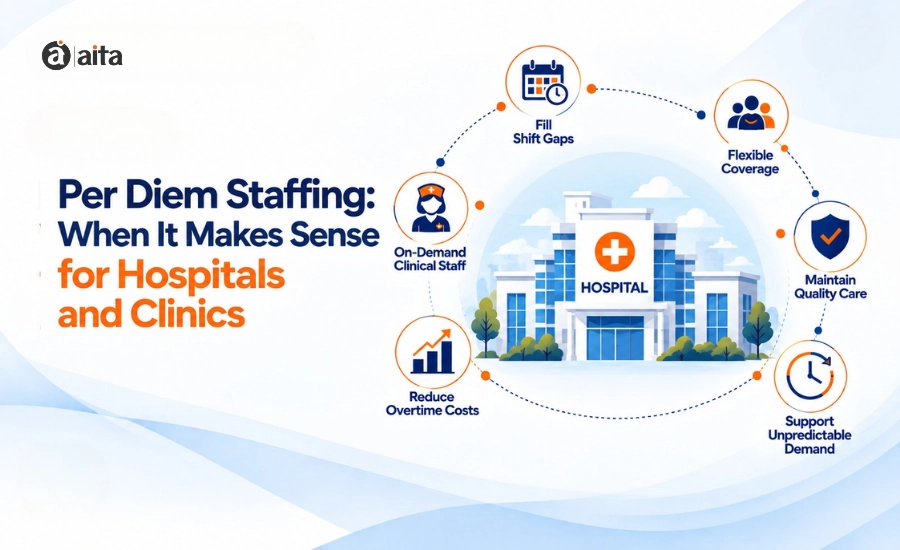
Per diem staffing is usually the first phone call a nurse manager makes at 4 p.m. on a Friday when two call-outs leave the med-surg floor short for the night shift. That scramble to fill a gap before the next shift starts is the most familiar face of per diem staffing, but it’s far from the only reason hospitals and clinics rely on it. Done right, a facility treats per diem coverage as a planned, standing part of its staffing model rather than a panic button reached for only when a schedule falls apart. Done carelessly, it quietly turns into an expensive habit that papers over a deeper scheduling problem no one has actually addressed. The sections below break down when per diem staffing genuinely earns its place, when it doesn’t, and what separates a staffing partner worth signing with from one that isn’t.
What Is Per Diem Staffing?
Per diem staffing refers to clinical workers, most often nurses, who pick up individual shifts on an as-needed basis rather than committing to a set schedule. A per diem nurse might work three shifts one week and none the next, depending on their availability and the facility’s needs. There’s no guaranteed minimum, and in most arrangements, no obligation on either side beyond the shift that’s been accepted.
That flexibility is what separates per diem coverage from the other contingent staffing models hospitals use. Travel nursing involves a multi-week or multi-month contract, usually with housing stipends, and is built for facilities with a sustained, predictable gap rather than a sporadic one. Locum tenens staffing applies the same logic to physicians and advanced practice providers, covering a defined period while a permanent provider is on leave or a position sits vacant. Permanent staffing, obviously, is the opposite end of the spectrum entirely: a long-term employment relationship with benefits and a fixed schedule.
Per diem shifts sit apart from all three because they’re built for unpredictability, offering a form of flexible clinical coverage that fixed contracts can’t match. A facility doesn’t know on Monday that it will need extra coverage on Thursday, and per diem nurse staffing exists specifically to answer that kind of short-notice need. The trade-off is that per diem staff aren’t guaranteed work, and facilities aren’t guaranteed coverage, which is a dynamic worth understanding before leaning on this model too heavily.
Signs Your Facility Has Hospital Shift Gaps
Hospital shift gaps don’t always announce themselves clearly. They tend to show up first as a pattern rather than a single bad week, and recognizing that pattern early makes the difference between a manageable fix and a staffing crisis.
A few signs tend to show up consistently:
Charge nurses are regularly calling staff on their days off to cover open shifts.
Overtime hours are climbing month over month without a clear seasonal explanation.
Nurse-to-patient ratios slip below target during specific shifts, most often nights and weekends.
Staff turnover is concentrated in particular units, suggesting burnout tied to chronic understaffing.
Scheduling staff spend disproportionate time firefighting next week’s schedule instead of planning ahead.
Any one of these alone might be a temporary blip. Several of them together, persisting for more than a month or two, usually point to a structural gap that per diem staffing can help bridge while a longer-term fix gets sorted out.
When Per Diem Nurse Staffing Makes Sense
Per diem staffing earns its place in a coverage plan in a handful of specific situations, and recognizing which one applies helps determine how aggressively to lean on it.
Seasonal Surges and Predictable Census Swings
Flu season, summer trauma volume in certain regions, and back-to-school illness spikes in pediatric units are all predictable, recurring patterns. Building a per diem bench ahead of these known surges, rather than scrambling once volume climbs, tends to produce better flexible clinical coverage and lower rates than waiting until the need is urgent.
Leave Coverage
Maternity leave, extended medical leave, and even planned vacations for specialized staff create gaps that don’t justify a permanent hire but still need reliable coverage. Per diem nurse staffing fills this role cleanly, particularly when the leave has a known end date.
Clinic Expansion or New Service Lines
A clinic adding weekend hours or a hospital opening a new unit often needs to prove out demand before committing to permanent headcount. Shift-based nursing support lets a facility staff the expansion adequately while gathering the volume data needed to justify permanent positions later.
Short-Term Census Spikes
Unexpected admission surges, whether from a community health event or simply a run of bad luck, are exactly the scenario per diem nurse staffing was built for. Having an established relationship with a staffing partner before the spike hits, rather than starting a search once the unit is already underwater, makes the response meaningfully faster.
When Per Diem Staffing Doesn't Make Sense
Honesty about the limits here matters as much as the use cases. Per diem coverage isn’t the right tool for every gap, and leaning on it in the wrong situation creates problems of its own.
A chronic, ongoing staffing shortage is the clearest example. If a unit is relying on per diem shifts every single week, month after month, that’s not a flexible staffing solution anymore. It’s a permanent staffing gap being patched with a tool designed for occasional use, and it usually costs more over time than simply hiring permanently would.
Roles requiring deep institutional knowledge are another poor fit. A per diem nurse walking into an unfamiliar unit for a single shift can’t be expected to know a facility’s specific protocols, EHR quirks, or care team dynamics the way a regular staff member does. For complex or highly specialized units, that unfamiliarity can translate into real patient safety risk if it isn’t managed carefully through strong onboarding and orientation for per diem staff.
Cost sensitivity is a factor too. Per diem shift rates typically run higher per hour than staff rates, since the premium compensates for the lack of guaranteed hours and benefits on the worker’s side. Facilities treating per diem coverage as a cheaper alternative to adequate permanent staffing usually find the math doesn’t support that assumption once overtime, orientation time, and rate premiums are factored in.
Cost and Compliance Considerations
Per diem coverage comes with real cost and compliance obligations that are easy to underestimate when a shift gap feels urgent.
Credentialing and licensing sit at the top of the list. Every per diem nurse needs current licensure in the state where they’re working, along with facility-specific competency verification and, depending on the unit, specialty certifications. Skipping or rushing this step to fill a shift faster creates liability that isn’t worth the time saved. Multistate licensure, through compacts like the one maintained by the National Council of State Boards of Nursing, has made cross-state per diem coverage somewhat easier in participating states, though facilities still need to verify compact status rather than assume it.
Overtime exposure deserves attention too. Some facilities default to offering existing staff overtime before turning to per diem coverage, which can seem cost-effective on paper but often isn’t once fatigue-related errors and staff burnout are factored in. The Bureau of Labor Statistics tracks registered nursing employment and wage data that can help facilities benchmark whether their overtime and per diem rate structures are reasonable for their region, which is worth checking periodically rather than relying on outdated internal assumptions. Bureau of Labor Statistics data on registered nurses is a useful starting point for that kind of benchmarking.
Float pool comparison is the other piece worth running the numbers on. An internal float pool, staff cross-trained to work across multiple units, can reduce reliance on external per diem staffing for routine gaps, though building one requires upfront training investment and doesn’t solve for surges that exceed what existing shift-based nursing capacity can absorb.
AITACS Staffing
Ready to close your talent gap?
Get pre-vetted specialists deployed in 3–10 days. No overhead, no risk — just the right talent, exactly when you need it.
Contact Us
Free consultation · No commitment
Building a Reliable Pool of On-Call Clinical Staff
A dependable bench of on-call clinical staff, the backbone of any flexible clinical coverage plan, doesn’t happen by posting a job listing once and hoping for the best. It takes deliberate relationship-building over time.
Facilities that do this well tend to treat their per diem roster the way they’d treat any valued staff relationship. That means consistent, fair scheduling practices rather than only calling when desperate, timely payment without administrative delays, and genuine onboarding rather than handing a new per diem nurse a badge and an EHR login with no orientation at all.
Building a diverse clinical talent pool matters here too, not just as a values statement but as a practical sourcing advantage. A broader, more varied network of per diem nurses and clinicians tends to give a facility more flexibility in matching language needs, cultural competency, and specialty experience to the patient population being served. The same principle that strengthens workforce strategy more broadly, as explored in AITACS’s piece on building a supplier-diverse workforce strategy, applies directly to building a strong per diem bench.
Communication also matters more than facilities sometimes expect. Per diem staff who feel like an afterthought, excluded from unit updates or protocol changes that affect their shifts, tend to pick up fewer shifts over time, regardless of pay rate. Treating per diem coverage as a relationship rather than a transaction tends to produce a more reliable bench over the long run.
Questions to Ask a Staffing Partner Before You Sign
Not every staffing partner manages per diem coverage with the same rigor, and a few direct questions upfront can save significant headaches later.
Ask how credentialing and license verification are handled, and ask to see the actual process rather than taking a general assurance at face value. Ask about fill rates specifically for last-minute, short-notice requests, since that’s often where the real test of a per diem nurse staffing partner shows up. Ask how the partner vets clinical competency beyond basic licensures, particularly for specialty units like ICU, ED, or L&D. Ask what happens if a per diem worker doesn’t show up for a confirmed shift, and what backup process exists. Finally, ask for references from facilities of similar size and acuity level, since a partner strong in long-term care staffing isn’t necessarily equipped for acute inpatient coverage.
A partner who answers these questions specifically and confidently, rather than vaguely, is usually the one worth trusting with a facility’s per diem coverage needs.
Per Diem Staffing vs Other Coverage Models
The table below offers a quick side-by-side comparison to help match the right coverage model to the right situation.
| Coverage Model | Best For | Typical Commitment | Relative Cost per Hour |
|---|---|---|---|
| Per diem staffing | Short-notice, sporadic gaps | Single shifts, no guarantee | Higher than staff rate |
| Travel nursing | Sustained, multi-week gaps | 8 to 26 week contracts | Higher, often with housing stipend |
| Locum tenens | Physician or APP leave coverage | Weeks to months | Higher, role-dependent |
| Internal float pool | Routine, predictable gaps | Ongoing, cross-trained staff | At or near standard staff rate |
| Permanent hire | Long-term, consistent need | Indefinite | Standard staff rate plus benefits |
No single model covers every situation, which is exactly why most well-run facilities use a blend rather than relying on just one.
Getting Per Diem Staffing Right
Per diem staffing works best as one deliberate piece of a broader coverage strategy, not as the default answer to every open shift. Used for the right situations, seasonal surges, leave coverage, clinic expansion, and genuine short-notice gaps, it gives facilities flexibility that a fully permanent staffing model can’t match. Used as a permanent patch for chronic under staffing, it tends to cost more and solve less than facilities expect.
Getting the balance right starts with understanding where your facility’s actual shift gaps are coming from, and then choosing per diem staffing deliberately rather than defaulting to it out of habit. AITACS’s healthcare staffing services are built around exactly this kind of planning, helping hospitals and clinics build a reliable per diem bench alongside broader workforce strategy rather than treating each shift gap as an isolated emergency.
If your facility is weighing whether per diem staffing fits your current coverage gaps, per diem staffing support from AITACS can help you build a plan suited to your specific units, census patterns, and compliance requirements.
Frequently Asked Questions
What is per diem staffing in healthcare?
Per diem staffing is a contingent staffing model where clinical workers, most often nurses, pick up individual shifts as needed rather than working a fixed schedule. There's no guaranteed minimum number of shifts, and either side can decline a given shift without penalty.
How is per diem staffing different from travel nursing?
Per diem staffing covers single, short-notice shifts with no ongoing commitment, while travel nursing involves multi-week or multi-month contracts, usually with housing stipends. Travel nursing suits sustained gaps; per diem staffing suits sporadic, unpredictable ones.
When should a hospital rely on per diem nurse staffing?
Per diem nurse staffing works best for seasonal surges, leave coverage, clinic expansion, and short-term census spikes. It's less suited to chronic, ongoing shortages, which usually need a permanent staffing fix rather than repeated per diem coverage.
Does per diem staffing cost more than hiring permanent staff?
Per diem rates typically run higher per hour than staff rates, since the premium compensates for the lack of guaranteed hours and benefits. For occasional gaps it's often cost-effective; for chronic gaps, permanent hiring usually works out cheaper over time.
What should a hospital check before signing with a per diem staffing partner?
Ask how credentialing and license verification are handled, what fill rates look like for last-minute requests, how clinical competency is vetted for specialty units, and what the backup process is if a confirmed worker doesn't show up for a shift.
Categories
Pharma & Healthcare Staffing
Let’s Build Your Team
Connect with AITACS to find pre-vetted healthcare and pharma professionals, reduce hiring time, and ensure uninterrupted patient care.
Get Started