Total Talent Management: Unifying Contingent and Permanent Workforce Data
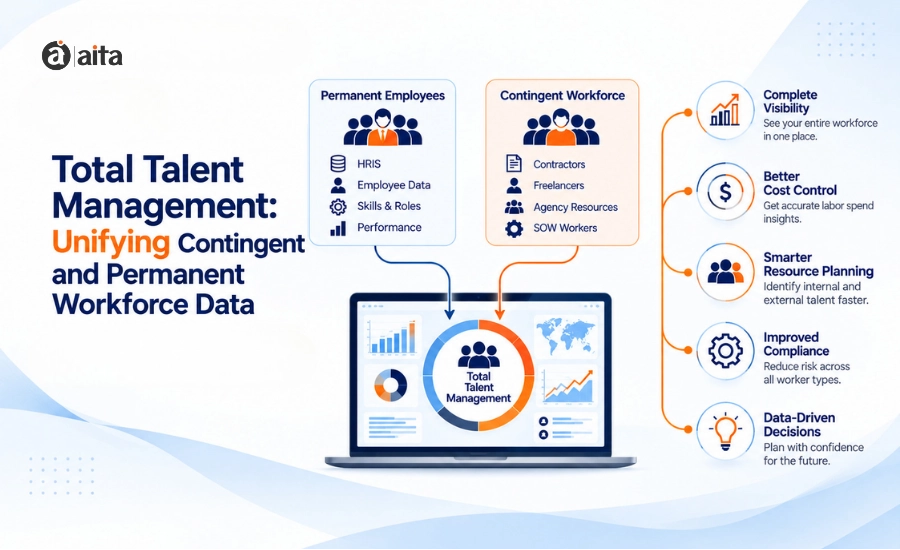
Total talent management sounds like a concept reserved for Fortune 500 workforce strategy decks, but the problem it solves is one almost every growing company runs into eventually: nobody has a complete picture of who is actually working for the organization. Permanent employees live in the HRIS. Contract workers live in a spreadsheet somewhere, or three different vendor portals, or occasionally in someone’s inbox as a string of email approvals nobody archived properly.
That fragmentation isn’t just an administrative headache. It means finance can’t get a straight answer on total labor spend without a week of reconciliation. It means a department head has no idea that a contractor with the exact skill set they need is already finishing up a project two floors away. And it means leadership is making workforce decisions based on half the data, without realizing the other half even exists.
What Total Talent Management Actually Means
Total talent management is the practice of managing permanent employees and contingent workers, contractors, freelancers, and statement-of-work resources, as a single connected workforce rather than as separate, disconnected populations. It doesn’t mean treating every worker identically. A contractor’s onboarding, compliance requirements, and management structure will always differ from a full-time employee’s. It means having visibility into both populations at once, so decisions about headcount, budget, and skills can be made with the whole picture in view.
Most organizations don’t lack the data itself. They lack a way to see it together. Permanent headcount data sits in one system, contingent worker data sits in a vendor management system or scattered agency reports, and the two rarely talk to each other. Building total talent management isn’t about adding new data. It’s about connecting data that already exists.
From Fragmented Data to One Workforce View
How total talent management connects data that already exists
HRIS
Permanent employee data:
payroll, benefits, headcount
VMS / Vendor Reports
Contingent worker data:
contracts, invoices, time
Unified Workforce
View
One connected data set,
both worker types
Blended Headcount
by department, project,
or cost center
Total Labor Cost
payroll plus contingent
spend, combined
Workforce Planning
skills visibility across
both worker types
Why This Matters More Than It Used To
Contingent labor has grown from a supplemental staffing tactic into a core part of how many organizations get work done. Project-based hiring, specialized skill gaps, and the general preference for flexibility over long-term commitment have pushed contingent spend into territory that finance teams can no longer treat as a rounding error.
When contingent spend was small, the lack of integrated visibility didn’t matter much. Now that it often rivals permanent payroll in scale for many departments, flying blind on half the workforce creates real strategic risk. A company that can’t answer a basic question like total labor cost per department, blended across both worker types, is operating with a significant blind spot.
The Cost of Fragmented Workforce Visibility
Workforce visibility gaps show up in ways that are easy to miss until they cause a real problem. A hiring manager submits a full-time requisition for a role that a contractor already sitting in another department could fill, because nobody had a system that would have surfaced that contractor’s availability.
Budget owners lose track of total spend when contingent labor costs are scattered across departmental invoices, agency statements, and procurement systems that don’t reconcile against the same reporting period as payroll. This makes workforce cost forecasting far less reliable than it should be, and it often means surprises show up at quarter-end rather than being caught in advance.
Compliance risk also grows in the gaps between systems. Worker classification, co-employment exposure, and inconsistent background check standards across different contingent vendors are the kinds of problems that stay invisible until an audit forces the issue. Fragmented data makes it much harder to catch these risks proactively rather than reactively.
Building a Blended Workforce Strategy
A blended workforce strategy starts with acknowledging that contingent and permanent workers aren’t separate populations competing for attention. They’re two components of the same labor pool, and decisions about one should factor in the other.
This shows up practically in workforce planning conversations. If a department needs to scale up for a six-month project, the decision between hiring a contractor and hiring permanently shouldn’t happen in isolation from what the rest of the organization’s contingent spend looks like or from whether similar skills already exist somewhere in the current contractor base.
Building this kind of strategy also means rethinking how workforce planning conversations are structured internally. Instead of HR handling permanent headcount planning and procurement handling contingent labor separately, with occasional coordination, the two functions benefit from shared visibility into the same underlying data, even if their day-to-day processes remain distinct.
Where Contingent and FTE Integration Gets Complicated
Contingent and FTE integration sounds straightforward in theory and gets messy in practice, mostly because the systems weren’t built to talk to each other. An HRIS is designed around employment records, benefits, and payroll. A vendor management system is designed around purchase orders, vendor invoicing, and time approval. Neither was built with the other’s data model in mind.
The integration challenge isn’t just technical. It’s also organizational. HR, procurement, and finance often have different definitions of what counts as workforce data, different reporting cycles, and sometimes different incentives. Procurement is measured on cost savings per placement. HR is measured on time-to-fill and retention. Getting both groups to agree on a shared source of truth requires more than a software purchase. It requires an internal agreement about ownership and process.
Companies that succeed at this usually start smaller than they’d like to. Rather than attempting a full data unification across every system at once, they identify the two or three most valuable data points, total headcount by department and blended labor cost being common starting points, and build reliable reporting around those before expanding further.
What a Workforce Analytics Platform Should Actually Do
A workforce analytics platform is only useful if it answers questions people actually ask. Too many organizations invest in dashboards that look sophisticated but don’t map to the decisions leadership is actually trying to make.
The most valuable starting point is usually headcount and spend visibility across both worker types, broken down by department, project, or cost center. From there, a useful platform layers in time-to-fill trends, tenure and turnover patterns for contingent workers, and comparison data on cost per role across contract versus permanent options.
What matters more than the specific software is the discipline behind it. A platform pulling in unreliable or inconsistent source data will produce reports nobody trusts, and a dashboard nobody trusts gets ignored within a quarter. Getting the underlying data clean and consistently defined matters more than the visualization layer sitting on top of it.
Unified Talent Data as a Foundation, Not a Finish Line
Unified talent data isn’t a project with a completion date. It’s an ongoing operational discipline, closer to how a company treats financial reporting than how it treats a one-time system migration. New contingent vendors get added, new departments start hiring contract workers without looping in the systems that were supposed to catch that activity, and data quality erodes without consistent maintenance.
Organizations that treat this as a finish-line project tend to see their data integrity decline within a year of the initial rollout. The ones that treat it as an ongoing discipline, with clear ownership and regular audits, are the ones still getting reliable reporting three years later.
AITACS Staffing
Ready to close your talent gap?
Get pre-vetted specialists deployed in 3–10 days. No overhead, no risk — just the right talent, exactly when you need it.
Contact Us
Free consultation · No commitment
Key Metrics Worth Tracking From Day One
Not every workforce metric is worth building a dashboard around, at least not at the start. A handful of measures tend to deliver the most value early, and getting these right before expanding into more granular reporting saves a lot of rework later.
Blended headcount by department gives leadership a true picture of team size, rather than the permanent-only number that historically shows up in most org charts. Total labor cost per department, combining payroll and contingent spend, closes the gap that usually causes budget surprises. Average tenure and conversion rate for contingent workers helps identify which roles are functioning as a genuine pipeline into permanent hiring versus which are simply revolving door positions. Vendor performance metrics, including fill rate and time-to-fill by staffing partner, help justify which relationships are actually earning their fees.
Starting with these four areas keeps the initial rollout focused. Expanding into skills-based workforce planning or predictive attrition modeling can come later, once the foundational numbers are reliable enough that people actually trust them.
How an MSP Model Supports Total Talent Management
A managed service provider model is one of the more practical paths toward total talent management, because it centralizes contingent workforce data through a single point rather than leaving it scattered across dozens of individual staffing vendors.
AITACS’s MSP/VMS staffing services consolidate vendor management, standardize reporting across contingent workers, and give organizations a single, consistent data feed to work from instead of reconciling formats from a dozen different agencies each month. That consistency is often the missing piece that makes total talent management achievable rather than aspirational.
This matters especially for organizations managing contingent talent across multiple departments or specialized functions, where reporting standards can otherwise vary widely by vendor. A properly run MSP/VMS staffing program builds standardized data capture into the process itself, which is a large part of what makes downstream workforce analytics reliable rather than a patchwork of estimates.
The same principle of centralizing specialized, fragmented sourcing shows up in other high-scarcity hiring situations too. Allied Health Staffing: Closing Gaps in Diagnostic and Therapy Roles looks at how credentialing complexity and narrow talent pools demand the same kind of coordinated, centralized approach that total talent management applies to workforce data more broadly.
Getting Started Without Boiling the Ocean
Organizations new to total talent management often stall out trying to design the perfect system before taking any action. A more realistic starting point is picking one reporting gap that’s actively causing pain, usually blended labor cost by department or a consolidated headcount view, and solving that first.
From there, expansion tends to follow a natural order: standardizing vendor reporting, connecting contingent worker data to existing HR systems where possible, and gradually building out the analytics layer once the underlying data has proven reliable. Trying to reverse that order, building sophisticated dashboards before the source data is trustworthy, almost always leads to reports that look impressive and get quietly ignored.
Executive sponsorship matters more here than in most HR initiatives, mainly because total talent management requires cooperation across departments that don’t naturally report to the same leader. Without someone senior enough to align HR, procurement, and finance around a shared definition of workforce data, the project tends to stall at the first disagreement over whose numbers are correct.
Common Pitfalls to Avoid Along the Way
A few mistakes show up repeatedly in total talent management rollouts, and most are avoidable with a bit more planning upfront.
The first is treating the initiative as an IT project rather than a cross-functional operating change. Buying a workforce analytics platform without first agreeing on data definitions, ownership, and reporting cadence across HR, procurement, and finance usually results in a tool nobody fully adopts.
The second is trying to unify every data source simultaneously instead of sequencing the rollout. Organizations that attempt a full integration across every contingent vendor and every HR system at once tend to lose momentum somewhere in month four, once the complexity of edge cases starts outweighing the visible progress.
The third is neglecting change management on the vendor side. Staffing partners and agencies need clear expectations about reporting formats and timelines, and vendors who aren’t looped into the new process early tend to keep submitting data the old way long after the new system goes live.
Frequently Asked Questions
What is total talent management?
Total talent management is the practice of managing permanent employees and contingent workers, including contractors, freelancers, and statement-of-work resources, as a single connected workforce rather than as separate, disconnected populations. It focuses on visibility across both groups rather than treating every worker type identically.
Why is workforce visibility across contingent and permanent workers so difficult to achieve?
Permanent employee data typically lives in an HRIS, while contingent worker data is scattered across vendor management systems, agency reports, or spreadsheets that rarely connect to core HR systems. This fragmentation isn't usually caused by a lack of data, but by the absence of a system that brings existing data together.
What metrics should organizations track first when building a workforce analytics platform?
A useful starting point includes blended headcount by department, total labor cost combining payroll and contingent spend, average tenure and conversion rate for contingent workers, and vendor performance metrics like fill rate and time-to-fill. Starting with a small set of reliable metrics tends to produce better results than attempting a fully comprehensive dashboard right away.
How does an MSP support total talent management?
A managed service provider centralizes contingent workforce data through a single point of contact rather than leaving it scattered across multiple staffing vendors with inconsistent reporting formats. This standardization is often the missing piece that makes reliable workforce analytics achievable.
What is the biggest mistake companies make when rolling out total talent management?
The most common mistake is treating it purely as an IT or software project rather than a cross-functional operating change. Without agreement between HR, procurement, and finance on shared data definitions and ownership, even a well-built analytics platform tends to go underused.
Categories
MSP/VMS Staffing
Let’s Build Your Workforce
Streamline hiring with AITACS MSP/VMS staffing solutions. Access pre-screened, interview-ready talent, reduce time-to-hire, improve vendor management, and scale your workforce with confidence.
Get Started