Allied Health Staffing: Closing Gaps in Diagnostic and Therapy Roles
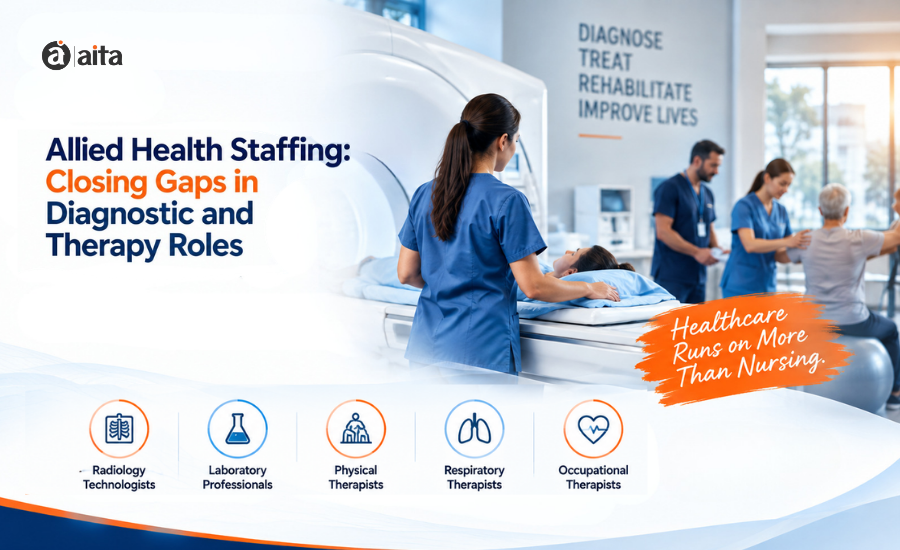
Allied health staffing rarely gets the attention that nursing shortages do, yet a hospital running short on radiology technologists or physical therapists can grind patient throughput to a halt just as fast as a nursing gap. These roles sit behind the scenes of most conversations about healthcare staffing, but they are the ones that determine whether a diagnostic order gets processed same-day or whether a patient waits a week for imaging.
Diagnostic and therapy departments run on a narrower bench than nursing units, which makes every vacancy feel bigger than it looks on an org chart. Losing two radiology techs out of a department of six is a different problem than losing two nurses out of a floor of forty. The math is less forgiving, and the search for a replacement tends to take longer because the qualified candidate pool is smaller to begin with.
Allied Health Roles at a Glance
Radiology
Technologist
Key credential
ARRT + state
license
Hardest to fill
Modality-specific
roles (MRI, CT)
Sourcing tip
Recruit from
programs before
graduation
Physical
Therapist
Key credential
State-specific
PT license
Watch for
Productivity
burnout risk
Sourcing tip
Be transparent
on caseload during
the interview
Occupational
Therapist
Key credential
OT license +
setting training
Hardest to fill
Pediatric & hand
therapy niches
Sourcing tip
Match candidates
to setting, not just
license
Lab
Technician
Key credential
MLT/MLS
certification
Watch for
Technician vs.
technologist mix-up
Sourcing tip
Offer clear
specialization paths
to aid retention
Respiratory
Therapist
Key credential
RRT + state
license
Watch for
Competing offers
from home health
Sourcing tip
Move fast; strong
candidates have
multiple offers
Why Allied Health Staffing Is Its Own Challenge
Allied health staffing covers an unusually wide range of roles, from imaging and lab work to rehabilitation therapy and respiratory care. Each of these professions requires its own licensure, its own certification pathway, and often its own accreditation body, which means a generalist healthcare recruiter can struggle to evaluate candidates with the same confidence a specialist would bring.
The credentialing piece alone adds friction that doesn’t exist in most other industries. A radiology technologist needs ARRT certification and state licensure. A physical therapist needs a state license tied to their specific jurisdiction, and that license doesn’t automatically transfer if the role is in a different state. Getting these details wrong doesn’t just slow a hire down, it can make an otherwise strong candidate ineligible to start on the timeline a department needs.
Add to that the fact that allied health professionals are often trained for adjacent but not interchangeable roles. A lab technician and a lab technologist have overlapping skill sets but different scope-of-practice boundaries. Treating these roles as equivalent during a search wastes time and produces mismatched candidates.
Where the Talent Shortage Hits Hardest
Not every allied health role faces the same level of scarcity. Imaging and rehabilitation roles tend to be harder to fill than administrative or support positions, largely because the training pipelines for these specialties are narrower and academic programs often cap enrollment due to limited clinical placement capacity.
Rural and smaller community hospitals feel this shortage most acutely. A large urban health system can usually absorb a vacancy for a few weeks without major disruption, spreading the workload across a bigger team. A rural facility with two radiology techs covering an entire department doesn’t have that flexibility, and a single resignation can force reduced hours or delayed procedures almost immediately.
Radiology Tech Hiring: Speed Without Cutting Corners
Radiology tech hiring sits near the top of the difficulty list for most hospital HR teams. Demand for imaging services has grown steadily as outpatient diagnostic volume increases, while the supply of newly certified technologists hasn’t kept pace in many regions.
The instinct when a radiology position sits open for months is to loosen the requirements, but this is exactly the wrong place to cut corners. Modality-specific experience matters enormously here. A technologist certified in general radiography isn’t automatically qualified to run an MRI suite or a CT scanner without additional certification, and placing someone in a role beyond their credentialed scope creates both a patient safety issue and a compliance liability for the facility.
What tends to work better is widening the sourcing funnel rather than lowering the bar. That means actively recruiting from technologist programs before graduation, maintaining relationships with per diem and travel radiology staff who might consider a permanent role, and being realistic about compensation benchmarks in markets where demand has pushed pay rates up.
Physical Therapist Recruitment and the Productivity Trap
Physical therapist recruitment carries a unique pressure that many other healthcare roles don’t face in the same way: productivity expectations. Outpatient rehab settings in particular often tie compensation or performance reviews to patient volume targets, and candidates who’ve burned out under aggressive productivity models are understandably cautious about walking into another one.
Hiring managers who are transparent about caseload expectations during the interview process tend to see better retention than those who let new hires discover the pace after starting. A physical therapist who accepts a role expecting a manageable caseload and then finds themselves double-booked within the first month is a physical therapist actively looking for their next opportunity within the year.
Recruitment for these roles also benefits from clear differentiation between outpatient orthopedic work, inpatient acute care, skilled nursing settings, and home health. These are meaningfully different jobs even though they share a license, and candidates usually have a strong preference for one setting over another based on pace, patient population, and autonomy.
Occupational Therapy Staffing Across Care Settings
Occupational therapy staffing spans an even broader range of settings than physical therapy, covering everything from pediatric development clinics to hand therapy specialization to geriatric rehabilitation in skilled nursing facilities. This breadth means a strong OT candidate for one setting may have almost no relevant experience for another.
Pediatric occupational therapy in particular draws from a smaller, more specialized talent pool, since it requires additional training beyond general OT licensure and tends to attract practitioners with a specific interest in developmental work. Facilities searching for pediatric OTs often find that general healthcare staffing approaches, built around broader clinical roles, don’t translate well to this niche.
Building a staffing plan for occupational therapy roles works best when it starts with an honest inventory of which settings a facility actually needs to cover, rather than posting a single generic OT opening and hoping the right specialization applies.
Lab Technician Hiring in a Tightening Market
Lab technician hiring has become noticeably harder over the past several years, driven partly by an aging workforce approaching retirement and partly by the fact that fewer students are entering medical laboratory science programs relative to demand. Many hospital labs now run understaffed simply because there aren’t enough qualified candidates applying, not because the compensation or conditions are uncompetitive.
This shortage makes it worth distinguishing clearly between technicians and technologists during a search, since these roles require different levels of education and carry different scope-of-practice limits. A facility that genuinely needs technologist-level expertise but writes a job posting loosely enough to attract technician-level applicants ends up wasting screening time on candidates who aren’t eligible for the role as designed.
Retention matters just as much as hiring in this specialty. Lab environments with predictable schedules, clear paths for specialization in areas like microbiology or blood banking, and reasonable workload distribution tend to hold onto staff longer, which reduces the constant churn that keeps a lab perpetually understaffed.
Respiratory Therapist Recruitment Since the Pandemic Shift
Respiratory therapist recruitment changed permanently after facilities saw firsthand how critical this role becomes during a surge in respiratory illness. Demand for respiratory therapists has stayed elevated well beyond the acute crisis period, driven by an aging population with higher rates of chronic respiratory conditions and expanded use of respiratory therapists in settings beyond the ICU, including sleep labs and home care.
Facilities competing for respiratory therapists now find themselves up against a wider range of employers than they used to, including home health agencies and durable medical equipment companies that didn’t traditionally recruit from the same talent pool. This has pushed compensation upward in many markets and made speed of offer a real competitive factor, since strong candidates often have multiple options moving simultaneously.
AITACS Staffing
Ready to close your talent gap?
Get pre-vetted specialists deployed in 3–10 days. No overhead, no risk — just the right talent, exactly when you need it.
Contact Us
Free consultation · No commitment
Compensation, Location, and the Realities of Competing for Talent
Pay transparency has become a bigger factor in allied health hiring than it used to be, partly because candidates in these fields compare notes easily through professional associations and online forums specific to their credential. A facility offering below-market pay for a radiology tech or respiratory therapist role will often find that out only after a search has already stalled for weeks.
Location adds another layer of complexity that doesn’t apply the same way to remote-friendly roles. Allied health professionals work on-site by definition, which means a facility in a less desirable location, whether that’s a rural area or a market with a high cost of living relative to pay, has to work harder to close the gap. Relocation assistance, flexible scheduling, and clear paths for continuing education credits can offset some of that disadvantage, but only if a facility is upfront about offering them early in the process rather than treating them as a last-minute negotiating chip.
Facilities that benchmark compensation regularly against regional data, rather than relying on figures from a few years ago, tend to spend less time renegotiating offers after a candidate has already accepted a competing one.
Building a Staffing Strategy That Doesn't Rely on Luck
Most allied health departments end up in crisis mode because they wait until a vacancy opens to start thinking about how to fill it. A more durable approach treats allied health staffing as an ongoing relationship-building exercise rather than a reactive scramble each time someone resigns.
That means maintaining contact with clinical education programs so a facility has visibility into upcoming graduates before they hit the open market. It means keeping a working relationship with per diem and travel staff who already know the facility’s systems and could be persuaded into a permanent role under the right circumstances. And it means being honest internally about which roles are consistently hard to fill and building recruitment timelines that account for that difficulty rather than assuming this search will go faster than the last one.
The scarcity dynamics here echo what shows up in other specialized hiring situations, where the right sourcing strategy depends more on how narrow the qualified talent pool is than on the seniority of the role itself. That same principle is explored from a different angle in Executive Search vs Staffing Agency: What’s the Difference?, which looks at how scarcity, not job title, should really drive the choice of hiring approach.
How a Specialized Staffing Partner Changes the Equation
Working with a partner who understands the specific credentialing, scope-of-practice, and market dynamics across allied health roles tends to shorten searches that would otherwise drag on for months. A generalist recruiter posting a job and waiting for applications is a fundamentally different process than one actively sourcing from an existing network of licensed, credentialed professionals who are open to a new opportunity.
AITACS’s healthcare staffing services are built around this kind of specialization, covering diagnostic, therapy, and clinical support roles with recruiters who understand the difference between a technician and a technologist, or between an inpatient and outpatient therapy setting, before a candidate ever reaches a hiring manager’s desk.
For facilities managing chronic gaps across multiple allied health departments at once, whether that’s imaging, rehab, or lab services, a consistent staffing partner also brings continuity that ad hoc hiring can’t match. Our healthcare staffing services are build a bench of qualified candidates in advance, rather than starting each search from a blank slate.
Frequently Asked Questions
What is allied health staffing?
Allied health staffing covers the recruitment of diagnostic, therapy, and clinical support roles outside of nursing and physician staffing, including radiology technologists, physical and occupational therapists, lab technicians, and respiratory therapists. Each of these roles carries its own licensure and certification requirements, which makes hiring for them more specialized than general healthcare recruiting.
Why is it so hard to find qualified radiology technologists?
Demand for imaging services has grown as outpatient diagnostic volume increases, but the supply of newly certified technologists hasn't kept pace in many regions. The difficulty is compounded by modality-specific certification requirements, since a technologist qualified for general radiography isn't automatically credentialed to operate an MRI suite or CT scanner.
What's the difference between a lab technician and a lab technologist?
Lab technicians and lab technologists have overlapping skill sets but different levels of education and different scope-of-practice limits. Writing a job posting that blurs this distinction often attracts candidates who aren't actually eligible for the role as designed, which wastes time during screening.
Why has demand for respiratory therapists increased in recent years?
Demand has stayed elevated due to an aging population with higher rates of chronic respiratory conditions and expanded use of respiratory therapists in settings beyond the ICU, including sleep labs and home care. Facilities now compete with a wider range of employers for this talent, including home health agencies and durable medical equipment companies.
How can hospitals improve retention in hard-to-fill allied health roles?
Retention tends to improve when facilities are transparent about workload and caseload expectations during hiring, offer clear paths for specialization or continuing education, and benchmark compensation regularly against current regional data. Facilities that wait until candidates raise these issues after accepting an offer often see higher turnover within the first year.
Categories
Pharma & Healthcare Staffing
Let’s Build Your Team
Connect with AITACS to find pre-vetted healthcare and pharma professionals, reduce hiring time, and ensure uninterrupted patient care.
Get Started