Skills-Based Hiring: The Future of Enterprise Recruitment
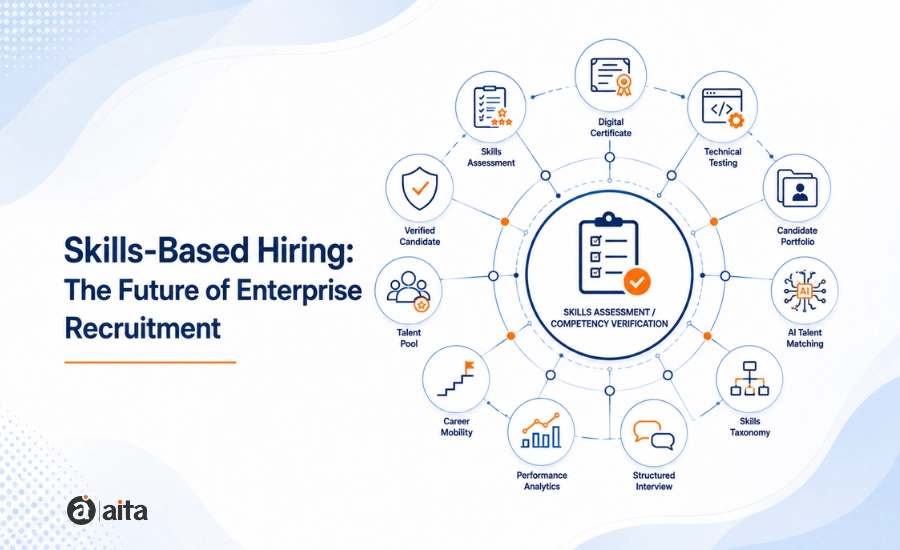
A Fortune 500 hiring manager recently told us she’d stopped requiring a four-year degree for nearly a third of her open roles not as an experiment, but because the candidates who cleared her team’s skills assessments were outperforming degree holders within ninety days. That single decision reflects a shift playing out across enterprise recruitment right now. Skills-based hiring has moved from a talent-acquisition buzzword to a structural change in how large organizations identify, evaluate, and place people. For enterprises still leaning on pedigree and years-of-experience filters, the gap between them and their skills-first competitors is widening every quarter.
This isn’t a passing trend tied to a tight labor market. It’s a recapitalization of what “qualified” actually means, and it’s forcing HR leaders, staffing partners, and hiring managers to rethink processes that have gone largely unchanged for decades.
What Skills-Based Hiring Actually Means
Skills-based hiring evaluates candidates primarily on demonstrated competencies, what they can actually do rather than proxies like degree pedigree, job titles, or years in a particular industry. In practice, that means replacing “Bachelor’s degree required” with specific, testable skill requirements, and replacing gut-feel interviews with structured assessments that measure real capability.
It’s worth being precise here because the term gets used loosely. Skills-based hiring doesn’t mean ignoring experience or credentials altogether. It means those factors stop being the primary filter and start functioning as a supporting context. A candidate with a coding boot camp certificate and a strong portfolio can now compete directly with a computer science graduate for the same role, provided both can prove they meet the actual technical bar.
Some practitioners use “skills-first hiring” interchangeably with skills-based hiring, and for most purposes, that’s fine; they describe the same philosophy. Where a distinction exists, skills-first tends to describe organizations that have gone further, redesigning job architecture, compensation bands, and internal mobility entirely around skills taxonomies rather than job titles. Skills-based hiring is the entry point; skills-first is the destination many enterprises are now building toward.
AITACS Staffing
Ready to close your talent gap?
Get pre-vetted specialists deployed in 3–10 days. No overhead, no risk — just the right talent, exactly when you need it.
Contact Us
Free consultation · No commitment
Why Enterprises Are Making the Shift
The Degree Requirement Was Never a Great Predictor
Harvard Business School and Burning Glass Institute research has repeatedly shown that requiring a four-year degree screens out large portions of qualified candidates without meaningfully predicting job performance for most roles. Enterprises that have removed unnecessary degree requirements — IBM, Walmart, and Delta Air Lines among the more visible examples didn’t do it for optics. They did it because internal data showed degree requirements were filtering out capable people while doing little to improve on-the-job outcomes.
The Talent Pool Problem
Enterprise recruiters chasing a narrow definition of “qualified” are fishing in an increasingly small pond, especially in technical, healthcare, and skilled-trade functions where demand has outpaced the supply of traditionally credentialed candidates. Widening the aperture to skills rather than pedigree opens access to career-changers, military veterans, self-taught technologists, and people who built real capability through non-traditional paths. For organizations trying to fill high-volume or hard-to-source roles, that expanded pool isn’t optional anymore; it’s the difference between hitting a hiring plan and missing it by a quarter.
Speed and Cost Pressure
Every extra week a requisition stays open costs money in lost productivity, overtime for existing staff, and, in client-facing functions, potential revenue. Skills-based processes tend to move faster because they replace lengthy resume-screening cycles and multiple rounds of subjective interviews with objective, front-loaded assessments. When a candidate’s competency is verified early, the remaining conversations can focus on fit and motivation rather than re-litigating whether the person can actually do the job.
This connects directly to how many enterprises now source talent in the first place. Contingent and project-based workforce models thrive on speed, and matching verified skills to urgent openings is central to how modern Talent on Demand solutions operate pairing pre-vetted, competency-tested professionals with roles that can’t wait through a traditional six-week hiring cycle.
Competency-Based Hiring in Practice
Competency-based hiring is the operational engine behind the skills-based philosophy. Where skills-based hiring sets the intent to evaluate what people can do, competency-based hiring supplies the method: structured frameworks that break a role down into specific, observable competencies and then test for each one.
A well-built competency framework for, say, a mid-level financial analyst role might include technical modeling ability, data accuracy under time pressure, communication clarity with non-finance stakeholders, and judgment in ambiguous scenarios. Each competency gets its own evaluation method a case study, a live exercise, a structured behavioral interview question rather than relying on a single generalist interview to cover everything at once.
The enterprises that do this well share a few habits:
They define competencies before writing the job posting, not after struggling to fill it.
They separate “must-have” competencies from “nice-to-have” ones, so hiring managers aren’t rejecting strong candidates over minor gaps.
They calibrate interviewers so that two people running the same competency interview reach similar conclusions about the same candidate.
They revisit competency frameworks at least annually since the skills that mattered for a role two years ago often aren’t the ones that matter today.
That last point matters more than it might seem. Skills relevant to cybersecurity, data analytics, and healthcare compliance shift fast enough that a competency framework built in 2023 can already be dated by 2026. Enterprises without a formal review cadence often don’t notice until they’re consistently hiring people who are competent for a version of the role that no longer exists.
Where AI Talent Matching Fits In
Skills-based hiring generates a genuine operational challenge: assessing competencies at scale is far more labor-intensive than scanning resumes for keywords. This is where AI talent matching has become less of a nice-to-have and more of a practical necessity for enterprises hiring at volume.
AI-driven matching tools parse structured skills data from assessments, verified certifications, project histories, and even code repositories or portfolio work and compare it against the specific competency profile of an open role. Done well, this doesn’t replace human judgment; it removes the volume problem so human reviewers can spend their time on the candidates who’ve already cleared a legitimate skills bar, rather than skimming hundreds of resumes hoping to spot the right ones.
The technology has matured considerably. Early versions of AI matching leaned too heavily on keyword overlap and produced results barely better than resume filtering. Current platforms increasingly incorporate skills taxonomies, adjacent-skill inference (recognizing that someone strong in Python is likely to ramp quickly on a related language), and outcome data that improves matching accuracy over time. Enterprises pairing AI talent matching with a genuine competency framework rather than using it as a shortcut around one see the strongest results because the tool is amplifying a sound process instead of masking a weak one.
Building a Skills-Based Hiring Program: Where to Start
Enterprises moving toward skills-based hiring rarely succeed by flipping a switch across every function at once. A phased approach tends to work better:
1. Audit current requirements against actual performance data.
Pull performance reviews for the last two years and compare them against the original hiring criteria. Where degree or years-of-experience requirements show no correlation with strong performance, that’s the first place to loosen the filter.
2. Pilot in one or two functions.
Technical roles and customer-facing operational roles tend to be good starting points because competencies are relatively easy to define and measure objectively.
3. Build assessment infrastructure before scaling.
Skills-based hiring lives or dies on the quality of assessment. Rushed, generic tests erode candidate trust and produce a noisy signal. This is often where enterprises benefit from a staffing partner that already has assessment methodology built and validated, rather than building it from scratch under time pressure.
4. Train hiring managers on interpreting skills data.
A hiring manager who’s spent fifteen years screening resumes doesn’t automatically know how to weigh a competency score. Structured training and clear guidance on which competencies are non-negotiable prevents the old bias from creeping back in through the interview stage.
5. Measure and adjust.
Track time-to-fill, quality-of-hire at the 90-day and 12-month marks, and retention against the old process. Skills-based hiring should show measurable improvement within two to three hiring cycles; if it isn’t, the assessment design usually needs revisiting, not the philosophy itself.
For enterprises that need to move on high-priority or contingent roles while this infrastructure is still being built internally, staffing partners running Talent on Demand models can supply pre-assessed, competency-verified talent immediately, giving internal teams room to build their permanent skills-based process without leaving urgent requisitions unfilled in the meantime.
| Factor | Traditional Hiring | Skills-Based Hiring |
|---|---|---|
| Primary filter | Degree, title, years of experience | Demonstrated competency |
| Candidate pool | Narrower, credential-dependent | Broader, includes non-traditional paths |
| Assessment method | Resume screen + subjective interview | Structured tests + calibrated interviews |
| Time-to-fill | Often longer, more interview rounds | Typically faster with front-loaded assessment |
| Bias risk | Higher — proxies correlate with background | Lower when frameworks are well-designed |
| Adaptability | Slow to reflect changing role needs | Frameworks reviewed and updated regularly |
A Note on Workforce Strategy Alongside Skills-Based Hiring
Skills-based hiring changes how enterprises evaluate people, but it doesn’t answer the separate question of how that talent gets engaged directly, contingent, or through a managed program. Enterprises running high volumes of skills-verified contingent talent often reach a point where they need to decide between a Managed Service Provider model and a Vendor Management System, a decision that shapes everything from cost control to program visibility. We’ve covered that decision in detail in our breakdown of MSP vs. VMS workforce solutions, which is worth a read for any enterprise scaling a skills-based program across multiple vendors or business units.
Getting This Right Takes More Than Good Intentions
Skills-based hiring works when it’s built on real assessment infrastructure, competency frameworks that get revisited as roles evolve, and matching technology that supports rather than replaces human judgment. It fails when it’s adopted as a talking point, a line in a press release, with no underlying change to how candidates are actually screened.
The enterprises pulling ahead right now are the ones treating this as an operational rebuild, not a policy update. They’re auditing what their old requirements actually predicted, piloting in functions where competencies are measurable, and partnering with staffing providers who bring validated assessment methodology rather than reinventing it internally under pressure.
If your organization is weighing how to build or scale a skills-based hiring program without slowing down urgent hiring needs, AITACS works with enterprise teams to combine competency-based screening with fast access to pre-assessed talent. Reach out to talk through what a skills-based approach could look like for your specific hiring challenges, or explore how our Talent on Demand services can keep critical roles moving while you build the infrastructure for the long term.
Frequently Asked Questions
What is skills-based hiring?
Skills-based hiring is a recruitment approach that evaluates candidates primarily on demonstrated competencies rather than proxies like college degrees, job titles, or years of experience. Employers use structured assessments, tests, and portfolio reviews to verify what a candidate can actually do, widening the talent pool beyond traditionally credentialed applicants.
What's the difference between skills-based hiring and skills-first hiring?
The two terms are often used interchangeably, but skills-first typically describes organizations that have gone further — redesigning job architecture, pay bands, and internal mobility entirely around skills taxonomies. Skills-based hiring is the starting point of that shift; skills-first is the more mature, fully restructured version of it.
How does competency-based hiring support a skills-based approach?
Competency-based hiring provides the operational method for skills-based hiring by breaking a role into specific, observable competencies and testing each one individually — through case studies, live exercises, or structured interviews. This replaces a single generalist interview with targeted, objective evaluation of the exact skills a role requires.
How does AI talent matching improve skills-based hiring at scale?
AI talent matching analyzes structured skills data — assessments, certifications, project history, and portfolios — to match candidates against a role's competency profile, removing the volume bottleneck of manual resume review. It works best when paired with a well-defined competency framework, since the technology amplifies good hiring criteria rather than creating them.
Why are enterprises shifting to skills-based hiring instead of traditional requirements?
Enterprises are shifting because degree and tenure requirements have shown little correlation with actual job performance, while filtering out large numbers of qualified candidates. Skills-based hiring also tends to reduce time-to-fill and expand the talent pool to include career-changers, veterans, and self-taught professionals who can prove capability directly.
Categories
Talent On Demand
Let’s Build Your Workforce
Streamline hiring with AITACS Talent On Demand solutions. Access pre-screened, deployment-ready specialists, reduce hiring delays, and scale your workforce faster with flexible staffing support tailored to your business needs.
Get Started