MSP vs VMS: Which Workforce Solution Is Right for Your Business?
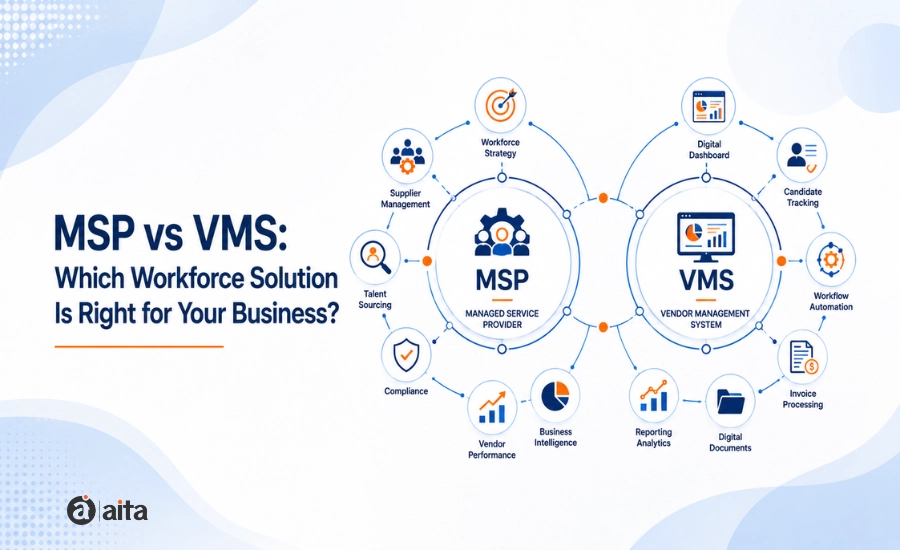
If you manage a contingent workforce program of any real size, you have almost certainly run into this question: do we need a vendor management system, or do we need a managed service provider? The MSP vs VMS decision trips up a lot of HR and procurement leaders because the two terms get used interchangeably in vendor pitches, even though they solve different problems. One is a piece of technology. The other is a program built around people, process, and accountability. Getting this distinction right shapes everything from your cost structure to how much control you keep over hiring decisions.
This guide breaks down what each model actually does, where they overlap, where they diverge, and how to figure out which one or which combination fits your organization’s stage of growth.
What a Vendor Management System (VMS) Actually Does
Contingent labor has quietly become one of the largest controllable line items in the modern workforce budget. Total managed services program spend in North America topped $200 billion in 2025 and keeps climbing as enterprises replace ad-hoc agency relationships with structured programs. At the same time, AI-enabled VMS platforms, skills-based hiring, and talent-centric MSP models are converging fast, which means the old assumption ‘MSP handles everything, agencies fill everything’ no longer reflects how the best-run programs actually operate.
For procurement and talent acquisition leaders, that shift changes the ROI conversation. It’s no longer just about which supplier charges the lowest markup. It’s about which channel an owned talent pool or a managed supplier network delivers the fastest, cheapest, and highest-quality fill for each specific role category. Getting that segmentation right is where the real 2026 ROI gains are hiding.
What an MSP Program Adds to the Picture
An MSP, or managed service provider, is a program usually run by a specialized firm that takes ownership of your entire contingent staffing process. That includes supplier selection, rate bench-marking, requisition distribution, quality control, compliance oversight, and reporting. Many MSPs use a VMS as their underlying technology, but the software is just one tool inside a much larger operation.
The practical difference shows up the moment something goes wrong. If a supplier isn’t performing, an MSP team is already tracking that and can act on it reallocating requisitions, renegotiating terms, or exiting the relationship. A VMS alone leaves that decision entirely in your hands, which is fine if you have the bandwidth for it and a problem if you don’t.
MSP vs VMS: Key Differences That Actually Matter
Stripped of the marketing language, the MSP vs VMS comparison comes down to a handful of practical differences. Here’s how they stack up side by side.
| Factor | VMS | MSP |
|---|---|---|
| What it is | A software platform for requisitions and billing | A managed program with a dedicated team |
| Who runs it | Your internal team, using the tool | An outside partner runs the program for you |
| Strategic input | Minimal; it tracks requisitions but doesn't provide guidance | Ongoing market data, rate guidance, workforce planning, and forecasting |
| Best fit | Mature programs with strong internal governance | Organizations seeking end-to-end workforce management and measurable hiring outcomes |
Why the Contingent Workforce Makes This Decision Higher Stakes
Contingent labor isn’t a side detail anymore for most mid-size and large organizations; it’s a meaningful share of total headcount, and in some departments, the majority of it. When contract, temp, and project-based workers make up a large piece of your workforce, the tooling and oversight around that population carries real financial and compliance weight.
A contingent workforce that’s poorly managed tends to show its cracks slowly: rate creep that nobody catches for a quarter, co-employment exposure that sits unnoticed until an audit, or a talent pipeline that dries up because nobody is actively cultivating supplier relationships. Neither a VMS nor an MSP eliminates every risk automatically, but the level of active management an MSP provides tends to catch these issues earlier, simply because someone is watching the program full-time rather than checking in periodically.
AITACS Staffing
Ready to close your talent gap?
Get pre-vetted specialists deployed in 3–10 days. No overhead, no risk — just the right talent, exactly when you need it.
Contact Us
Free consultation · No commitment
When a VMS Alone Is the Right Call
A standalone vendor management system tends to work well when a few conditions line up at once:
-
You already have an internal team with the time and expertise to manage supplier relationships directly.
-
Your supplier base is small and stable, so there’s less need for ongoing sourcing or renegotiation.
-
You want to keep hiring decisions fully in-house rather than routing them through a third party.
-
Budget is tighter, and you’re prioritizing lower software cost over full program management.
This setup is common in organizations that have been running contingent labor programs for years and have built up the internal muscle to do it well. The technology just needs to keep up with them.
When an MSP Program Makes More Sense
An MSP tends to pay for itself when your program has outgrown what an internal team can manage well on its own. That’s often the case when:
-
Your supplier list has grown large enough that performance tracking has become a full-time job nobody has time for.
-
You’re scaling into new markets, business lines, or specialty roles where your internal team lacks sourcing depth.
-
Compliance risk co-employment, demassification, wage and hour rules has become a genuine concern.
-
You want consolidated reporting and rate bench-marking rather than piecing it together manually.
This is particularly true in sectors where staffing needs are specialized and time-sensitive. In healthcare, for example, credentialing requirements, license verification, and rapid backfill needs make a managed program considerably more valuable than a self-service platform. AITACS’s pharma and healthcare staffing team, for instance, works inside exactly this kind of high-compliance environment, where an MSP’s ongoing oversight catches problems a software platform alone would miss.
Can You Combine MSP and VMS?
Yes, and in practice, most MSP engagements include a VMS as the underlying technology anyway. The two aren’t really competing options so much as different layers of the same stack. The real decision isn’t MSP or VMS in isolation it’s whether you want the technology on its own, or the technology paired with a team actively managing what happens inside it.
Some organizations start with a standalone VMS and add MSP oversight later as their contingent workforce grows. Others go straight to a full MSP program because they don’t have the internal bandwidth to build supplier management capability from scratch. Neither path is wrong it depends on where your organization is today and where it’s headed over the next few years.
Making the Right Call for Your Organization
Before choosing between MSP and VMS, it helps to get honest about a few things: how much internal capacity you actually have to manage suppliers day to day, how exposed you are to compliance risk, and how fast your contingent workforce is growing. A company adding a handful of contractors a year has very different needs than one scaling a blended workforce across multiple states or specialties.
It’s also worth looking at how workforce shortages are reshaping hiring strategy more broadly. Our recent piece on solving workforce shortages with smarter hiring digs into how organizations are rethinking sourcing and retention when talent pools are tight a challenge that touches this decision directly, since a thin talent market raises the value of having an MSP team actively sourcing on your behalf rather than waiting for applications to come through a portal.
Final Thoughts
There’s no universal right answer in the MSP vs VMS debate only the right answer for where your organization stands right now. A vendor management system gives you visibility and control at a lower cost, provided you have the internal team to use it well. A managed service provider gives you that same visibility plus active, ongoing management of your entire contingent workforce, which matters more as your program grows in size, complexity, or compliance exposure.
The organizations that get the most value out of either model are the ones that pick based on their actual capacity and risk profile, not just on price. Take stock of your supplier relationships, your internal bandwidth, and how much active oversight your contingent workforce genuinely needs before committing to either path.
Frequently Asked Questions
What is the difference between MSP and VMS in staffing?
A VMS (vendor management system) is software that manages requisitions, timesheets, and invoicing for contingent labor. An MSP (managed service provider) is a full program — usually run by an outside partner — that manages supplier selection, compliance, and reporting on top of that technology. In short: a VMS is a tool, an MSP is a managed service.
Is a VMS the same as an MSP?
No. A VMS is purely a software platform, while an MSP includes a dedicated team that actively manages suppliers, rates, and compliance. Most MSP programs actually use a VMS as their underlying technology, but the two terms aren't interchangeable.
When should a company use an MSP instead of a VMS alone?
Companies typically move to an MSP when their supplier base grows too large to manage internally, when they're scaling into new markets or specialty roles, or when compliance risks like co-employment and misclassification become a concern. A standalone VMS works best for smaller, stable, well-governed programs.
Can a business use both MSP and VMS together?
Yes. In fact, most MSP engagements include a VMS as the technology layer underneath the managed program. The real choice isn't MSP versus VMS — it's whether you want the software alone or the software paired with active program management.
Why does the MSP vs VMS decision matter for contingent workforce management?
Because contingent labor often makes up a significant share of total headcount, the level of oversight you choose directly affects cost control, compliance risk, and hiring quality. An MSP provides ongoing, active management, while a VMS provides visibility and control at a lower cost — provided you have the internal capacity to manage it well.
Categories
MSP/VMS Staffing
Let’s Build Your Workforce
Streamline hiring with AITACS MSP/VMS staffing solutions. Access pre-screened, interview-ready talent, reduce time-to-hire, improve vendor management, and scale your workforce with confidence.
Get Started