The Nurse Shortage Is Getting Worse in 2026 — 5 Staffing Fixes That Actually Work
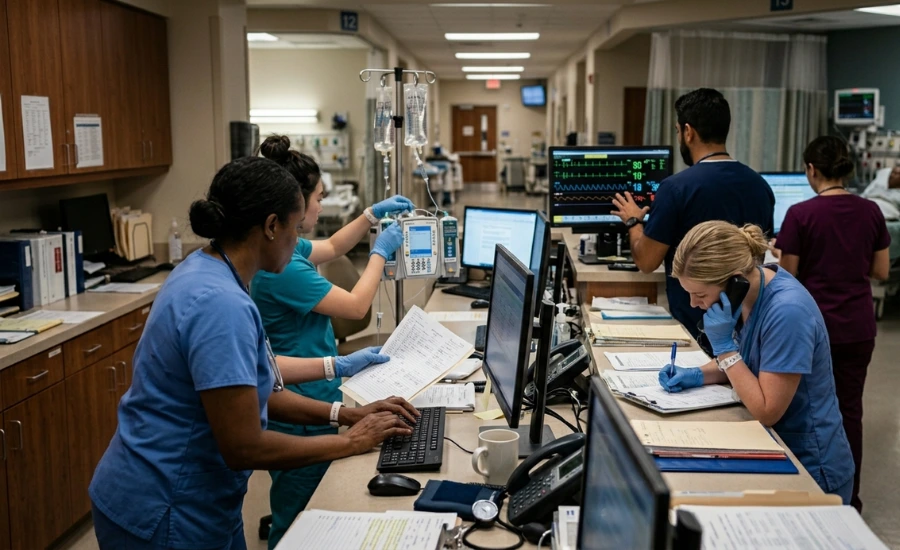
The crisis on the floor is real — and it's not improving on its own
Walk through any busy hospital unit right now, and you will feel it before anyone tells you the numbers. Charge nurses carrying patient loads that would have been unthinkable five years ago. Agency staff rotates through at unpredictable intervals. Experienced nurses burning out and leaving the profession entirely, not just switching employers.
The clinical workforce shortage has been building for over a decade, but 2026 has pushed it into genuinely critical territory. The American Association of Colleges of Nursing projects a shortfall of more than 200,000 registered nurses in the United States alone by 2026. Similar patterns are unfolding across the UK, Canada, and Australia, where aging populations are increasing patient volumes at exactly the moment the workforce pipeline is struggling to keep pace.
For hospital administrators, HR directors, and clinical operations leaders, this is not a future problem to plan for. It is a today’s problem that is affecting patient outcomes, staff morale, and financial performance right now.
This blog breaks down five nurse shortage staffing solutions that are actually working in 2026 not theoretical fixes, but practical, deployable approaches that healthcare organizations are using to stabilize their clinical workforce while the systemic issues work themselves out over the longer term.
Why the nurse shortage is worse in 2026 than it was before
Before getting into the fixes, it is worth being precise about what is driving the current wave of the healthcare staffing crisis because the causes determine which solutions will actually work.
The first driver is demographic. A significant portion of the registered nurse workforce entered the profession in the 1980s and 1990s. That cohort is now retiring and doing so faster than nursing schools can replace them. Graduation rates from nursing programs have increased, but not fast enough to offset the exit rate from the profession.
The second driver is the post-pandemic exodus. The COVID-19 pandemic did not just increase burnout in the short term; it accelerated permanent career exits. A substantial share of experienced nurses who left clinical roles during or after the pandemic have not returned. They moved into telehealth, insurance, consulting, administration, and entirely different fields. That institutional knowledge and clinical experience cannot be replaced quickly.
The third driver is geographic mismatch. Nursing graduates are not evenly distributed across regions. Rural hospitals and underserved urban areas face far more severe shortages than well-resourced urban medical centers, but the overall national statistics mask how acute the problem is in specific locations and specialties.
The fourth driver is specialty concentration. The shortage is not uniform across nursing disciplines. Critical care, emergency nursing, operating theater nursing, and mental health nursing are significantly more affected than general med-surg floors. Filling a general ward position is difficult. Filling a CCU charge nurse vacancy can be nearly impossible without external staffing support.
The cost of doing nothing — by the numbers
Before we move into solutions, it is worth anchoring the financial reality. A single unfilled RN position costs a hospital an estimated $40,000 to $60,000 per year in overtime, agency fees, and productivity loss and that figure does not include the harder-to-measure costs of care quality degradation and staff turnover driven by overload.
The visual below maps the full cost cascade that a single persistent nursing vacancy triggers across a hospital department.
Cost cascade from one unfilled nursing vacancy
1 unfilled RN position
The vacancy that starts the cascade
Overtime surge
+15–25% labour cost
Staff burnout
Turnover accelerates
Agency fill-in
2–3x standard rate
Budget overrun
$40K–$60K per vacancy
Patient load increase
Remaining staff stretched
Care quality risk
Safety events increase
Compounding workforce crisis
One vacancy becomes many
What this cascade illustrates is why reactive approaches consistently fail. By the time the financial impact of a nursing vacancy becomes visible in a budget report, the secondary and tertiary effects burnout, additional turnover, care quality degradation are already in motion. This is exactly the same dynamic we explored in our piece on Skill Gaps Are Costing Businesses $8,500/Day: Here’s How to Close Them Fast, where the core argument holds as true in healthcare as it does in any other sector: the cost of leaving a gap open always exceeds the cost of closing it.
5 nurse shortage staffing solutions that are actually working in 2026
Fix 1: Build a Strategic Agency Relationship Before You Need One
Treating a staffing agency as a last resort is one of the costliest mistakes a hospital can make. Panicked calls produce expensive, poorly matched placements that disrupt unit culture and inflate costs.
The hospitals winning in 2026 treat their agency partners as strategic allies sharing leave schedules, seasonal surge forecasts, and unit-specific expectations months in advance. AITACS Pharma & Healthcare Staffing operates exactly this way. By building deep organisational understanding before a vacancy becomes urgent, AITACS delivers faster placements, better clinical fit, and significantly less operational disruption when demand spikes.
Fix 2: Use Multiple Staffing Engagement Types Deliberately
Permanent hire or agency temp is a false binary. The organisations managing shortages best use a deliberately layered model permanent staff for roles where continuity matters, contract placements for defined coverage gaps, and pre-credentialed bank staff to absorb day-to-day fluctuations without last-minute agency calls.
AITACS supports all three engagement types within a single client partnership structuring each arrangement around the actual operational need rather than defaulting to one-size-fits-all placements.
Fix 3: Expand Where You Source From
Recruiting only locally in a supply-constrained region means competing for the same shrinking pool as every neighbouring hospital. The shortage hits rural areas and specialties like critical care, emergency, and mental health far harder than national headlines suggest.
Leading systems in 2026 are sourcing from overlooked domestic regions and building structured international recruitment programmes not as a quick fix, but as a proper workforce development pathway. AITACS manages international placements end-to-end, covering immigration support, licence conversion, cultural integration, and supervised clinical onboarding so that internationally recruited nurses arrive ready to contribute, not struggling to adjust.
Fix 4: Fix Retention Before It Becomes a Recruitment Problem
Every nurse who leaves because of burnout, poor scheduling, or lack of career progression is a recruitment problem costing $40,000–$60,000 to resolve. Retention investment almost always costs less than the recruitment it prevents.
The levers that work in 2026 are not primarily financial they are scheduling predictability, psychological safety, and visible career pathways. AITACS helps clients identify the workforce conditions driving turnover before exits happen, drawing on sector-wide insight to benchmark retention environments and pinpoint the highest-impact changes.
Fix 5: Get Ahead of Gaps With Data, Not Gut Feel
Reactive staffing decisions are the most expensive ones. The organisations leading in workforce management are using historical absence data, planned leave schedules, and patient admission forecasts to flag emerging gaps weeks sometimes months before they become crises.
AITACS builds proactive pipeline visibility into every client partnership. Rather than waiting for a vacancy notification, AITACS maps upcoming demand alongside clients and pre-positions candidates against anticipated gaps turning emergency calls into planned, well-matched deployments that cost less and perform better.
What a practical nurse shortage staffing solution looks like in combination
None of these five fixes work in isolation as well as they work together. The healthcare organizations that are navigating the clinical workforce shortage most effectively have built a layered approach: a stable permanent core, a flexible contract and bank layer, a pre-credentialed travel nurse agency relationship, a data-informed view of upcoming demand, and a genuine retention program that slows the outflow.
The visual below shows how these layers work together in a functioning healthcare workforce model.
The layered model matters because it distributes workforce risk. A hospital that relies almost entirely on its permanent staff is highly vulnerable to unexpected absence spikes and leave concentration. A hospital that relies heavily on agency staff has predictable quality and continuity problems, and eye-watering agency cost lines. The organizations performing best in 2026 maintain a healthy permanent core, typically 70 to 80 percent of staffing need and use the outer layers as planned, managed flexibility rather than emergency backup.
The staffing partner question: what separates good from great in healthcare
Not all staffing partners are equal in healthcare, and the stakes of a poor match are higher than in most other sectors. A misplaced nurse in a critical care unit is not just an operational inconvenience it is a patient safety consideration.
When evaluating nurse shortage staffing solutions providers, the criteria that matter most are domain specificity, credentialing rigour, and deployment speed. A generalist recruiter who also happens to place clinical staff is not the same as a healthcare staffing specialist who understands the difference between a band 5 general nurse and a band 6 CCU practitioner, knows the registration and revalidation requirements across regulatory bodies, and can speak credibly to a clinical manager about what a candidate’s actual experience looks like.
Credentialing rigor is non-negotiable. Before any nurse reaches your unit through an external staffing partner, you need to know precisely what that partner’s verification process covers: NMC or NCLEX registration check, clinical competency assessment, reference verification, DBS or equivalent criminal background check, occupational health clearance, and mandatory training compliance. Ask for this in writing, and confirm it is applied consistently not just in theory.
Deployment speed is the third variable. In a healthcare staffing crisis, a partner who takes four to six weeks to produce a candidate is not solving your problem. The benchmark for a specialist healthcare staffing partner with genuine pipeline depth should be seven to fourteen days from brief to deployed clinician for most nursing roles, with some specialist categories taking slightly longer. Ask for their actual average time-to-deployment data, by role type and specialty. Any hesitation to provide that data is itself informative.
What good looks like: a realistic 90-day stabilization plan
If your organization is in active staffing crisis right now, the question is not which of the five fixes to implement it is how to sequence them for maximum impact in the shortest timeframe.
In the first 30 days, the priority is stabilizing immediate coverage. That means engaging a specialist healthcare staffing partner if you do not already have one, briefing them thoroughly on your most critical vacancies, and getting contract or travel nurse placements into your hardest-hit units. Simultaneously, conduct a rapid workforce review to identify your highest-risk positions not just current vacancies, but roles where a single departure would create a cascade.
In days 31 to 60, the focus shifts to building your flexible buffer. Identify nurses who are already connected to your organization recently retired, currently working reduced hours, or on extended leave who might be willing to join a bank or per diem arrangement. Launch or reinvigorate your bank staff programme. Begin the conversations with your permanent team about scheduling improvements that will have the most meaningful impact on retention.
In days 61 to 90, you are laying the groundwork for sustainability. Establish your predictive staffing review cadence. Formalize your agency partnership framework with clear SLAs and performance expectations. Begin building your international recruitment pipeline if geographic diversification is part of your medium-term strategy.
Ninety days will not solve a structural problem that took years to develop. But it can move an organization from reactive crisis management to intentional, planned workforce management and that shift makes every subsequent decision faster, cheaper, and more effective.
The nurse shortage is not going away. Your response to it can still be a competitive advantage.
Healthcare organizations that treat the clinical workforce shortage as a shared misery something happening to everyone equally are missing a strategic reality. The shortage affects everyone, but it does not hurt everyone equally. The organizations with the most sophisticated workforce strategies, the strongest staffing partnerships, the best retention programmes, and the clearest data on where their gaps are heading are able to maintain care quality, operational continuity, and financial stability that their less-prepared competitors cannot.
Nurses talk to each other. The word spreads about which hospitals are well-organized, supportive, and predictable and which ones are chaotic, understaffed, and burning through agency staff at unsustainable cost. The organization that invests now in nurse shortage staffing solutions that actually work is not just solving today’s problem. It is building a reputation that will make it a preferred employer when the next wave of graduating nurses enters the market.
The tools exist. The models are proven. The staffing partners who can execute are available. What the healthcare staffing crisis demands in 2026 is not more waiting it is better decisions, made faster, backed by the right expertise.
Ready to build a healthcare staffing strategy that keeps your units covered and your workforce stable? Explore AITACS Pharma & Healthcare Staffing Solutions and speak to a specialist today.
Frequently Asked Questions
What is the true cost of an unfilled nursing vacancy for a hospital?
A single unfilled RN position triggers a cost cascade that goes well beyond the empty seat. Hospitals typically absorb a 15–25% labour cost increase from overtime, pay 2–3x the standard rate for agency fill-ins, and face budget overruns of $40,000–$60,000 per vacancy. Beyond direct costs, remaining staff face higher patient loads, accelerating burnout and turnover — turning one vacancy into many. Partnering with a healthcare staffing agency like AITACS that maintains a pre-credentialed talent pipeline can close gaps within 24–72 hours before the cascade begins.
What clinical and nursing roles does AITACS staff for hospitals and healthcare facilities?
AITACS places a broad range of clinical and nursing professionals including Registered Nurses (RN), Licensed Practical Nurses (LPN), Certified Nurse Assistants, Case Managers, Pharmacists, Respiratory Therapists, Certified Surgical Technologists (CST), Medical Technologists, and Medical Laboratory Technicians. Every candidate is pre-screened against HIPAA, Joint Commission, and applicable regulatory standards before placement, ensuring care continuity and compliance from day one.
How does AITACS ensure pharma and life sciences candidates meet GMP and GCP compliance requirements?
AITACS pharma recruiters are trained in FDA, EMA, ICH, and DEA regulatory frameworks. All life sciences candidates — including Clinical Research Associates, GMP/GLP Compliance Specialists, Pharmacovigilance professionals, and QA & Regulatory Affairs specialists — are screened for role-specific certifications, SOP familiarity, and audit readiness. No candidate reaches your shortlist without passing a full compliance review aligned to the specific regulatory environment of your organisation.
Can AITACS fill urgent or same-week healthcare staffing needs?
Yes. AITACS maintains an active pipeline of pre-credentialed healthcare and pharma professionals ready for rapid deployment. For urgent requirements, candidate matching begins within 24 hours of receiving a brief. Short-term contract, per diem, and travel nurse placements are all available for same-week coverage, making AITACS suitable for both planned workforce gaps and unexpected vacancy surges.
What is the difference between contract, per diem, and travel nurse staffing — and which model does AITACS offer?
Contract staffing covers structured assignments typically ranging from 3 to 12 months, ideal for project-based or planned workforce needs. Per diem staffing provides day-by-day coverage for immediate, fluctuating demand. Travel nurse staffing relocates credentialed nurses to facilities facing critical shortages, usually on 13-week assignments. AITACS offers all three engagement models alongside direct hire and Recruitment Process Outsourcing (RPO), giving healthcare organisations a single partner for every staffing scenario.
Categories
Pharma & Healthcare Staffing
Let’s Build Your Team
Connect with AITACS to find pre-vetted healthcare and pharma professionals, reduce hiring time, and ensure uninterrupted patient care.
Get Started