Skill Gaps Are Costing Businesses $8,500/Day : Here’s How to Close Them Fast
Every operations leader, HR director, and business owner running a lean team knows the feeling. A project stalls. A deliverable misses the mark. A critical initiative loses momentum. And when you trace the root cause back far enough, you land at the same place every time — the wrong skills, in the wrong seat, at the wrong moment.
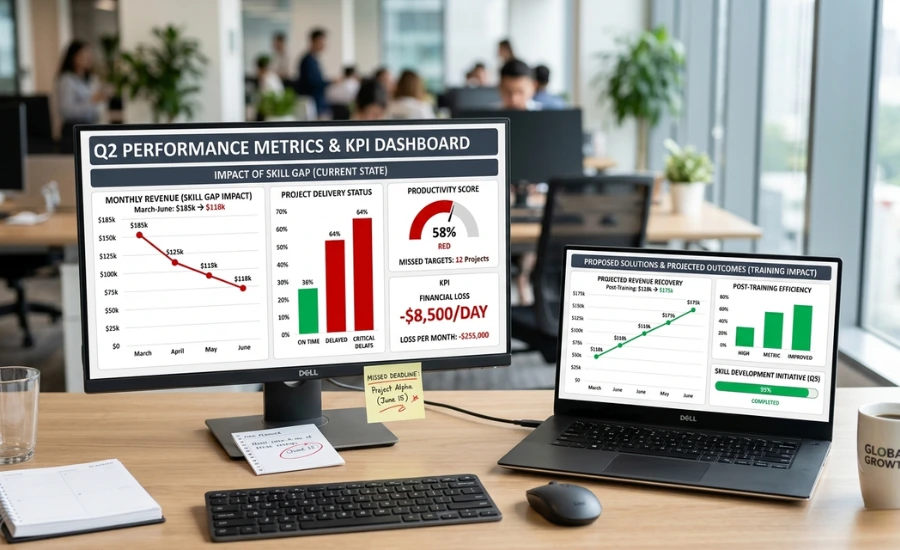
That gap isn’t just frustrating. It’s expensive. Industry research puts the daily cost of an unfilled or underperforming critical role at approximately $8,500. Across a quarter, that’s more than $765,000 in accumulated losses — productivity drain, management overhead, delayed revenue, and risk exposure piling up silently in the background.
The good news is that companies with the right workforce gap strategy are closing these gaps in days rather than months. They’re doing it through professional staffing solutions designed for speed, precision, and measurable contract staffing ROI. This blog breaks down exactly how — with specific, actionable detail you can apply immediately.
“The organizations winning in 2026 aren’t the ones with the deepest pockets. They’re the ones that learned to close skill gaps in their workforce faster than their competition.”
What It Actually Costs When You Don’t Close Skill Gaps in Your Workforce
Daily cost of gap
$8,500
Monthly impact
$255,000
Quarterly loss
$765,000
90 days
$8,500
Total accumulated loss
$765,000
Professional staffing solution (est.)
~$120,000
Net saving by closing the gap:
$645,000
Most leaders understand that skill gaps hurt productivity. Fewer realize just how many cost categories a single persistent gap touches simultaneously. Before you can build a workforce gap strategy that works, you need to see the full picture.
Direct Productivity Loss
When someone is placed in a role that exceeds their current skill level, you’re paying full compensation for reduced output. Work moves slower. Quality suffers. Errors multiply. Over a team of ten, even a 15 percent productivity deficit translates into the equivalent of one and a half ghost employees — salaries you’re paying but not benefiting from.
Management Bandwidth and Rework
Skill gaps don’t just hurt the person carrying them — they tax the entire team. Senior managers compensate by reviewing work that should be self-sufficient, re-explaining context that shouldn’t need re-explaining, and rebuilding deliverables that missed the brief. That senior bandwidth is among the most expensive in your organization. Burning it on gap coverage is a compounding loss.
Delayed Projects and Missed Revenue Windows
In product development, a skill-gap-driven delay of eight to twelve weeks can mean permanently losing a launch window to a faster competitor. In sales and operations, a gap in your analytics or technology capability means slower decisions and worse outcomes. Revenue windows are perishable. Every week your workforce gap strategy is on hold is a week of compounding competitive disadvantage.
Compliance and Risk Liability
In finance, healthcare, legal, and technology sectors, skill gaps in compliance or security roles are not just productivity problems — they are liability events waiting to happen. A single regulatory failure traced back to an undermined team can generate fines, litigation, and reputational damage that dwarfs the cost of any professional staffing solution by an order of magnitude.
Why Traditional Workforce Gap Strategy Falls Short
Most organizations default to one of two responses when a skill gap becomes visible: they launch a training program, or they post a job listing. Both have legitimate uses. Neither is a fast talent solution.
Internal training programs are valuable for long-term capability building. They are almost never a solution for a gap that is hurting a project running now. A well-designed upskilling initiative typically takes three to six months before meaningful output improvement shows up in day-to-day work. If your workforce gap strategy depends exclusively on training, you are perpetually three to six months behind the problem.
Traditional full-time hiring is even slower. In 2026, the average time-to-fill for a technical or specialized role sits between 45 and 90 days, before onboarding and before the new hire reaches full productivity. Add a two-to-four-week notice period and a four-to-six-week ramp-up, and you are easily looking at five months from identifying the gap to having a productive contributor. That timeline is simply incompatible with the pace at which business actually moves.
The companies that consistently close skill gaps in their workforce fastest have recognized something that changes everything: not every gap requires a permanent solution. Some gaps are project-specific. Some are tied to a technology cycle that will shift again in 18 months. Matching the nature of the gap to the right solution type is the first and most important step in any effective workforce gap strategy.
Key insight: A permanent hire for a temporary skill gap is not a solution. It’s a long-term cost commitment that outlives the problem it was meant to solve.
How Professional Staffing Solutions Close Skill Gaps Fast
Professional staffing solutions are purpose-built for exactly the problem we’ve been describing. When deployed correctly, they are the most direct, efficient, and ROI-positive mechanism for closing skill gaps in your workforce without the delays, costs, and commitment risks of traditional hiring.
Here is how the model works in practice and why it outperforms the alternatives for most urgent gap scenarios.
Pre-Vetted Specialists, Deployed in Days
A serious professional staffing partner does not start a search from scratch when you call with a need. They maintain an active, continuously updated pipeline of pre-screened specialists across domains — IT, engineering, data, finance, compliance, operations, and more. When you identify a gap, they match against that pipeline immediately. The difference between a mediocre staffing partner and a great one is precisely the depth and quality of this pipeline. The best partners compress what would normally be a 60-day search into a 7-to-14-day deployment.
This is the model at work through AITACS Professional Staffing Solutions a forward-looking approach where talent is continuously qualified and ready, not reactively sourced when a crisis hits.
Flexible Engagement Models for Every Gap Type
Professional staffing solutions are not one-size-fits-all, and that flexibility is a core part of their value. The right engagement model depends on the nature and duration of the skill gap:
Contract staffing for defined-duration projects or temporary capability needs bring in a specialist for exactly as long as the project requires, without ongoing employment overhead.
Contract-to-hire arrangements when you want to evaluate cultural and performance fit before committing to a permanent headcount addition.
Direct placement for roles where long-term permanence is clearly the right answer and speed to quality hire matters more than flexibility.
This menu of options means you are never over-committing resources to temporary needs or under-investing in roles that genuinely require permanent expertise. Your workforce gap strategy becomes dynamic rather than binary.
The Real Contract Staffing ROI Calculation
The ROI conversation around contract staffing frequently gets distorted because people compare the hourly or daily rate of a contractor directly to the salary of a full-time employee and stop there. That comparison is not apples-to-apples, and it systematically understates the financial case for contract staffing.
When you account for the true total cost of employment employer-side taxes, health benefits, PTO accrual, retirement contributions, recruiting fees, onboarding costs, training investment, and turnover replacement risk a full-time hire typically costs 1.25 to 1.4 times the base salary in total employment expense. For a $120,000-per-year hire, that’s $150,000 to $168,000 in real annual cost before you factor in the productivity ramp period.
Contract staffing ROI is not just about the rate comparison. It is about the total cost of the alternative — including the daily cost of leaving the gap open.
Here is where the contract staffing ROI math becomes undeniable: if your skill gap is costing the business $8,500 per day in lost productivity, delayed revenue, and management overhead, then any professional staffing solution that closes that gap for less than $8,500 per day is immediately net-positive. The question is never whether contract staffing is expensive in isolation. The question is whether it is more expensive than the alternative, and in most urgent gap scenarios, it clearly is not.
Beyond the cost side, contract staffing ROI also shows up in speed of value delivery. A specialist with exactly the skills you need, deployed in week two of your project, produces returns from day one. A new full-time hire who reaches full productivity in month four delivers the same ROI four months later. In fast-moving markets, that four-month gap is not a rounding error.
Fast Talent Solutions: What Speed Actually Requires
Speed in talent deployment is not magic. It is the product of preparation on both sides of the equation. Understanding what enables fast talent solutions helps you build your organization to take advantage of them.
Your Side: Clarity Enables Speed
The single biggest variable in time-to-deployment is the quality of the requirement you bring to a staffing partner. Vague requirements produce slow, misaligned results. Precise requirements specific skills, seniority level, project context, duration, and integration model produce fast, accurate placements. Before engaging a staffing partner, invest an hour in a proper skills gap analysis. Define what capability is missing, at what level of expertise, for how long, and in what working context. That specificity is the engine behind any fast talent solution.
Their Side: Depth Enables Speed
On the staffing partner side, speed comes from pipeline depth and domain expertise. A generalist agency with a shallow network starts a new search every time. A domain-specific professional staffing partner with deep candidate relationships, continuous qualification processes, and genuine industry knowledge can match and deploy in a fraction of the time. When evaluating staffing partners, ask specifically: how long is your average time-to-deployment for roles like ours? The answer is more diagnostic than any sales pitch.
AITACS Staffing
Ready to close your talent gap?
Get pre-vetted specialists deployed in 3–10 days. No overhead, no risk — just the right talent, exactly when you need it.
Contact Us
Free consultation · No commitment
Staff Augmentation as a Fast Talent Solution
One of the most effective fast talent solutions for technical skill gaps specifically, is staff augmentation, the model where external specialists integrate directly into your existing team rather than operating as a separate work-stream. This approach combines the deployment speed of external hiring with the cohesion of internal teamwork. Augmented professionals work within your tools, your processes, and your culture. There is no extended hand-off period and no friction between parallel tracks.
For a detailed comparison of how staff augmentation stacks up against full-time hiring across cost, speed, and risk dimensions, our analysis in IT Staff Augmentation in 2026: Faster, Cheaper, and Less Risky Than Full-Time Hiring covers the full picture.
Building a Workforce Gap Strategy That Stays Ahead of the Problem
Closing a single skill gap reactively is a short-term win. Building a workforce gap strategy that prevents gaps from becoming crises in the first place is a sustainable competitive advantage.
The organizations that do this best treat workforce planning with the same rigor they apply to financial planning. They run quarterly skills audits that map current team capabilities against the skills that upcoming projects, market shifts, and technology cycles will require. This forward-looking view gives them a lead time advantage — they are identifying gaps three to four months before they become project-blocking problems, and solving them before the damage starts.
Paired with a trusted professional staffing partner who understands your business deeply, this proactive model means you always have a clear, fast pathway to close skill gaps in your workforce. Instead of a crisis response, you are running a continuous workforce optimization cycle.
There is also a talent attraction dimension to this approach. Organizations that visibly invest in keeping skills current and that build strong professional staffing partnerships become more attractive to serious professionals. When skilled candidates evaluate opportunities, they look at whether the company has the infrastructure to keep their skills relevant. A well-run workforce gap strategy signals organizational maturity. That signal attracts better talent, which makes the strategy self-reinforcing over time.
What to Look for in Professional Staffing Solutions
Not all professional staffing solutions deliver equal results. The difference between a strong placement and a weak one is amplified when the role is critical and the gap is urgent. These are the qualities that separate partners worth trusting from vendors worth avoiding.
Domain specialization: A partner who focuses on your industry or functional area — technology, finance, engineering, operations — brings candidate quality and screening rigor that a generalist agency simply cannot match.
Pipeline depth and readiness: The best partners have pre-screened candidates who are actively available, not names in a database who need to be re-qualified on every search. Ask directly how many pre-cleared candidates they have in your target skill area right now.
Transparent time-to-deployment benchmarks: Any serious partner should be able to give you average fill times by role type. Vague answers to this question are a red flag.
Screening rigor: Technical assessments, behavioral interviews, background verification, reference checks — understand exactly what a candidate goes through before they reach you.
Flexibility across engagement models: Contract, contract-to-hire, and direct placement should all be available. A partner who only operates in one mode will push every need into that mode regardless of fit.
Long-term relationship orientation: The best staffing partners invest in understanding your business well enough to anticipate gaps before you identify them yourself. That depth transforms a vendor relationship into a strategic workforce partnership.
The Cost of Waiting Compounds Every Day
$8,500 per day is a concrete number because vague problems get deferred and concrete problems get solved. Every week you spend studying a skill gap rather than closing it is roughly $59,500 in accumulated business impact. Every month, it persists is more than $255,000. Over a quarter, the losses from a single unaddressed critical gap approach $800,000 — a figure that dwarfs the cost of any professional staffing solution many times over.
The organizations with the best track record of closing skill gaps in their workforce are not the largest or the best-funded. They are the most intentional. They have built workforce gap strategies that are proactive, not reactive. They have established partnerships with professional staffing solutions providers who can move at business speed. And they treat skill gaps with the same urgency as revenue gaps — because that is exactly what they are.
The tools exist. The fast talent solutions are available. The contract staffing ROI is demonstrable. What remains is simply the decision to close the gap.
Ready to build a workforce gap strategy that closes critical skill gaps in days, not months? Explore AITACS Professional Staffing Solutions and see how fast talent solutions translate into measurable business results.
Frequently Asked Questions
What is professional staffing and how does it differ from IT staffing?
Professional staffing refers to the recruitment and placement of non-IT, non-clinical business roles — including Administrative & Clerical, Finance & Accounting, Legal & Regulatory, Managerial, Light Industrial, and Hospitality functions. Unlike IT staffing, which focuses on software engineers, cloud architects, and data scientists, professional staffing covers the backbone roles that keep every organisation running day-to-day. AITACS maintains dedicated vertical-specialist recruiters for each function to ensure precise candidate matching.
How quickly can AITACS fill a professional staffing role?
Most clients receive their first shortlist of pre-screened, interview-ready candidates within two business days of submitting a role brief. For senior managerial or director-level placements, a curated shortlist is typically delivered within 5–7 business days. Light industrial roles with urgent needs can often be filled within 24–72 hours, thanks to AITACS's pre-screened talent pool.
Does AITACS offer contract, temp-to-hire, and direct placement staffing?
Yes. AITACS supports three flexible engagement models across all six professional staffing verticals. Contract placements cover project-based or seasonal workforce needs. Temp-to-hire lets you evaluate a candidate on contract before converting them to a permanent employee. Direct placement is a full recruitment service for long-term hires, where AITACS manages sourcing, screening, interviews, background checks, and onboarding end-to-end.
What industries does AITACS's professional staffing service cover?
AITACS delivers professional staffing across 10+ industry verticals, placing candidates in roles spanning Administrative & Clerical, Finance & Accounting, Legal & Regulatory, Managerial & Professional, Light Industrial, and Hospitality. The service supports organisations across manufacturing, financial services, legal firms, logistics, retail, and hospitality — trusted by global brands such as Capgemini, Grainger, Pure Storage, and Southern Glazer's.
How does AITACS screen candidates for professional staffing roles?
AITACS uses vertical-specialist recruiters who source candidates through professional associations, referral networks, and direct outreach — not generic job boards. Every candidate is screened against your exact criteria for skills, certifications, experience, and cultural fit before reaching your shortlist. You receive a curated list of 3–5 qualified profiles. AITACS then coordinates interviews, manages offers, runs background checks, and handles onboarding paperwork so your new hire can start without delays.
Categories
Professional Staffing
Let’s Build Your Team
Stop losing weeks to unqualified applicants. Connect with AITACS experts to find pre-screened, interview-ready candidates, reduce hiring time, and drive business growth with confidence.
Get Started