The 9 IT Skills Companies Are Paying a Premium For Right Now (2026 List)
Introduction
If you are hiring in tech right now, you already know the pain. Roles sit open for months. Resumes flood in from candidates who look good on paper but cannot pass a technical screen. And the few people who actually have the skills you need? They have three competing offers on the table.
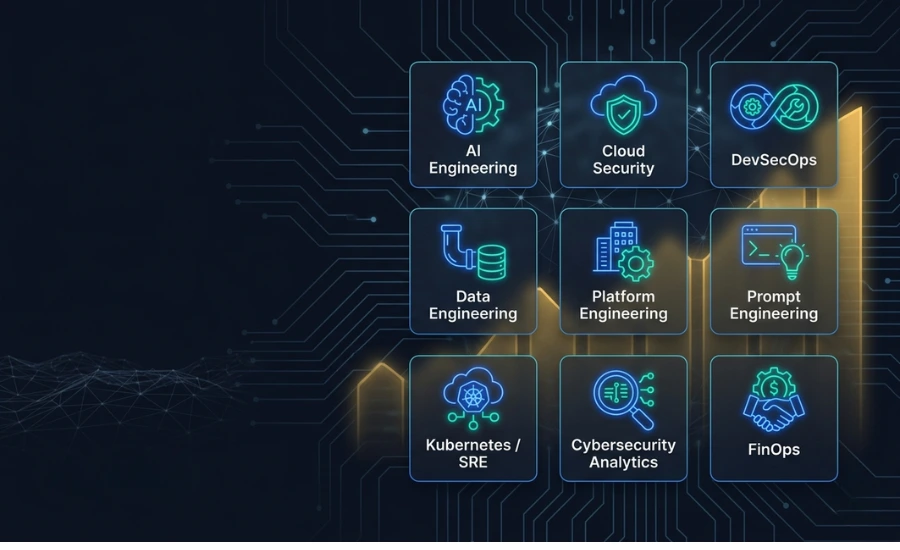
The market has shifted. In-demand IT skills in 2026 are not just about general coding ability or a CCNA from 2019. Companies are paying significant salary premiums often 20 to 40 percent above average, for professionals with very specific expertise in artificial intelligence, cloud security, and modern infrastructure. This post breaks down exactly which nine skills are commanding those premiums, why each one matters, and how your organization can actually find and hire people who have them.
Why the 2026 IT Talent Market Feels Different
Three forces converged to create the current talent crunch. First, the generative AI wave created an overnight demand for engineers who understand model deployment, prompt systems, and AI integration, a discipline that did not meaningfully exist as a job category four years ago. Second, a series of high-profile cloud breaches made boards acutely aware of cybersecurity gaps, driving urgent hiring in cloud security roles. Third, remote-first hiring created a global talent pool that sounds like good news until you realize every company on earth is fishing in the same pond.
The result: the highest paid tech skills in 2026 are concentrated in a narrow band of specializations. Generalist IT support roles have flattened in compensation, but specialists with the right certifications and hands-on experience are fielding offers well above six figures even at the mid-career level.
In-Demand IT Skills 2026 — Salary & Demand Overview
| IT Skill | Avg. Salary (US) | Common Role | Demand Level |
|---|---|---|---|
| AI / ML Engineering | $165K – $220K | AI Engineer | Very High |
| Cloud Security | $140K – $195K | CISSP, CCSP | High |
| DevSecOps | $130K – $180K | DevSecOps Engineer | High |
| Data Engineering | $125K – $175K | Data Engineer | High |
| Platform Engineering | $120K – $170K | Platform Engineer | Growing |
| Prompt Engineering | $110K – $160K | AI Specialist | Emerging |
| Kubernetes / SRE | $115K – $165K | Site Reliability Engineer | High |
| Cybersecurity Analytics | $120K – $170K | SOC Analyst L3+ | Very High |
| FinOps / Cloud Cost Opt. | $100K – $145K | FinOps Practitioner | Growing |
Source: LinkedIn Talent Insights, Dice, Glassdoor (Q1 2026 averages, US market)
The 9 IT Skills Commanding a Premium in 2026
1. AI / Machine Learning Engineering
AI engineer hiring has gone from niche to mainstream in under 24 months. Organizations are not just looking for data scientists anymore; they need engineers who can take a model from research to production, integrate it with existing APIs, and monitor its behavior in the real world. The ability to work with large language models, fine-tuning pipelines, and vector databases is now a distinct and highly compensated skill set. Average salaries in the US sit between $165,000 and $220,000 for senior roles, with equity packages pushing total compensation considerably higher at growth-stage companies.
2. Cloud Security Skills
Cloud security skills are arguably the single hottest category in enterprise IT right now. Following several public cloud breaches and the widespread adoption of multi-cloud architectures, security teams need people who understand identity and access management, zero-trust frameworks, and cloud-native threat detection. Certifications such as CISSP and CCSP add immediate credibility. Security professionals with cloud-specific expertise routinely command salaries between $140,000 and $195,000.
3. DevSecOps
DevSecOps is what happens when organizations finally stop treating security as an afterthought and start embedding it into the development pipeline. Engineers in this space know how to automate security testing, manage vulnerabilities in CI/CD workflows, and enforce policy as code. The role bridges development, operations, and security, which means practitioners who genuinely excel in all three directions are rare and expensive.
4. Data Engineering
The demand for data engineers has not cooled. If anything, the rise of AI has made clean, well-architected data pipelines more important than ever because a model is only as good as the data it trains and infers on. Engineers who can build robust pipelines in tools like dbt, Apache Spark, and cloud-native data platforms are in constant demand across industries.
5. Platform Engineering
Platform engineering emerged as organizations realized that asking every developer team to manage their own Kubernetes clusters, CI/CD pipelines, and serviceability stacks was slowing delivery to a crawl. Platform engineers build internal developer platforms essentially; they create the rails that application teams run on. It is a relatively new title but one with fast-growing compensation because it requires a rare mix of infrastructure depth and developer empathy.
6. Prompt Engineering & LLM Integration
Prompt engineering became a real job category faster than most observers expected. Beyond just crafting effective prompts, practitioners in this space design the full interaction layer between business logic and language models retrieval-augmented generation architectures, system prompt design, evaluation frameworks, and guardrail systems. As companies move from LLM experiments to production deployments, specialists who can make these systems reliable and safe command strong premiums.
7. Kubernetes & Site Reliability Engineering
Kubernetes administration and SRE skills remain persistently in demand because container orchestration is now the default infrastructure layer for cloud-native applications yet the operational complexity of running Kubernetes at scale requires genuine expertise. SREs who combine systems thinking with software engineering skills fill a critical gap and are compensated accordingly.
8. Cybersecurity Analytics (SOC / Threat Intelligence)
Beyond the perimeter tools, organizations need analysts who can interpret telemetry, investigate incidents, and make real-time decisions under pressure. SOC analysts at Level 3 and above, threat hunters, and digital forensics specialists are in tight supply. Automation has handled the low-level alert triage, which means the humans still in the loop need to be genuinely experts, and companies are paying for that expertise.
9. FinOps & Cloud Cost Optimization
Cloud spending spiraled during the growth-at-all-costs era, and now finance and engineering teams are scrambling to get it under control without sacrificing performance. FinOps practitioners who can analyze cloud usage, design tagging strategies, negotiate enterprise agreements, and build cost accountability into engineering culture are seeing their profile rise quickly. It is a newer certification pathway the FinOps Foundation launched its practitioner credential only a few years ago but adoption is accelerating fast.
Top IT Certifications & Their ROI in 2026
| Certification | Domain | Market Demand | Est. Salary Impact |
|---|---|---|---|
| AWS Solutions Architect – Pro | Cloud Architecture | High | ~$15K salary bump |
| Google Professional ML Engineer | AI / ML | Very High | ~$20K+ salary bump |
| CISSP | Cybersecurity | Very High | ~$18K salary bump |
| CKA (Kubernetes Admin) | DevOps / Platform | High | ~$12K salary bump |
| CCSP (Cloud Security) | Cloud Security | High | ~$16K salary bump |
| FinOps Certified Practitioner | Cloud FinOps | Growing | ~$10K salary bump |
Source: CompTIA IT Industry Outlook 2026, Burning Glass Technologies, Robert Half Tech Salary Guide
Top IT Certifications That Signal Premium Readiness
Certifications alone do not make a candidate, but they function as a credible signal that someone has invested in structured learning and can demonstrate a baseline of knowledge. For each of the nine skills above, there are recognized certifications that hiring managers actively filter for. The table above summarizes the credentials most likely to move a resume to the top of the pile in 2026.
One thing worth noting for hiring managers: the absence of a certification does not mean the absence of skill. Some of the strongest practitioners in AI engineering and platform engineering are largely self-taught through hands-on project work. A good technical screen is still worth more than a certificate list.
What Smart Companies Are Actually Doing to Hire These Skills
Organizations that are successfully filling these roles in 2026 share a few practices in common.
They have shortened their hiring processes. Candidates with these skills do not wait three weeks for feedback. Companies that have compressed their process to under two weeks are filling roles two to three times faster.
They are looking beyond traditional job boards. LinkedIn and Indeed still generate volume, but specialized tech communities, GitHub profiles, and referral networks produce higher-signal candidates for niche roles.
They have gotten realistic about compensation. Trying to hire an AI engineer at a 2019 software developer salary does not work. Companies that have updated their bands to reflect 2026 market reality are converting at much higher rates.
They are using IT staffing partners strategically. For specialized roles where internal recruiting bandwidth is thin, working with a staffing partner that maintains pre-vetted networks of candidates in these exact skill areas dramatically reduces time-to-hire.
📖 Related Reading
If your organization is working with a lean headcount budget but still needs top-tier technical talent, the link below explores exactly how modern teams are solving that challenge.
These Skills Won't Wait — Neither Should Your Hiring
The premium skills on this list are not getting cheaper, and the talent pool is not getting bigger. Every quarter that AI embeds itself deeper into enterprise workflows, every headline breach that forces a board-level security conversation, every engineering team that migrates to Kubernetes these are forces that widen the gap between the specialists companies need and the ones they can actually find.
If your organization has open roles in any of these nine areas, speed is your most underrated competitive advantage. The strongest candidates the AI engineers who have shipped real models to production, the cloud security architects who have built zero-trust frameworks from scratch are rarely available for more than two to three weeks before they sign somewhere else. A slow hiring process is not just a delay. It is a decision to lose.
That means having a clear role brief before you post, a compensation range that reflects 2026 market reality, and an interview process that respects a senior professional’s time. Those are not nice-to-haves. They are table stakes.
That is exactly where AITACS IT Staffing steps in. We don’t source from the same resume databases every other recruiter is scrolling through. We maintain living, actively managed networks of pre-vetted technical professionals across every skill category on this list — AI engineers, cloud security architects, DevSecOps specialists, platform engineers, and more. When you bring us a requirement, we move fast because the groundwork is already done.
Whether you need one critical hire or you’re scaling an entire engineering function, AITACS matches you with candidates who are technically validated, culturally screened, and ready to contribute from day one not someday.
AITACS Staffing
Ready to close your talent gap?
Get pre-vetted specialists deployed in 3–10 days. No overhead, no risk — just the right talent, exactly when you need it.
Contact Us
Free consultation · No commitment
Frequently Asked Questions
What are the most in-demand IT skills in 2026?
The nine skills commanding the largest salary premiums in 2026 are AI/ML engineering, cloud security, DevSecOps, data engineering, platform engineering, prompt engineering, Kubernetes/SRE, cybersecurity analytics, and FinOps. Each reflects either the AI transformation wave or the growing urgency around cloud security posture.
Which IT certifications are worth getting in 2026?
For maximum return on investment, the certifications with the strongest salary impact are the Google Professional Machine Learning Engineer certification, CISSP for cybersecurity, AWS Solutions Architect Professional for cloud, and CKA for Kubernetes. The FinOps Certified Practitioner is worth watching as cloud cost optimization becomes a board-level priority.
How long does it take to hire for these skills?
Without a targeted strategy, companies report average time-to-fill of 90 to 120 days for specialized roles like AI engineers and cloud security architects. With a dedicated IT staffing partner and a streamlined interview process, that window can typically be compressed to 15 to 30 days.
Are these skills best hired full-time or on contract?
It depends on the nature of the work. Cloud security audits, platform migrations, and AI proof-of-concept projects are often best structured as contract or contract-to-hire engagements. Ongoing product development and security operations roles typically warrant full-time investment. A hybrid model using contract specialists to fill gaps while a long-term hire comes up to speed works well for many organizations.
What is the difference between IT staff augmentation and IT outsourcing?
The key difference is control. With IT outsourcing, a third party manages the work and delivery independently. With IT staff augmentation, your internal managers direct the augmented professionals directly — they work within your team, your tools, and your processes. Augmentation gives you the speed and flexibility of external hiring without losing oversight or team cohesion.
Categories
IT Staffing
Let’s Build Your Team
Scale your IT team faster than you thought possible. Connect with AITACS experts to find the right talent, reduce hiring time, and drive business growth with confidence.
Get Started