Temporary Staffing vs Direct Hire: Choosing the Right Hiring Strategy
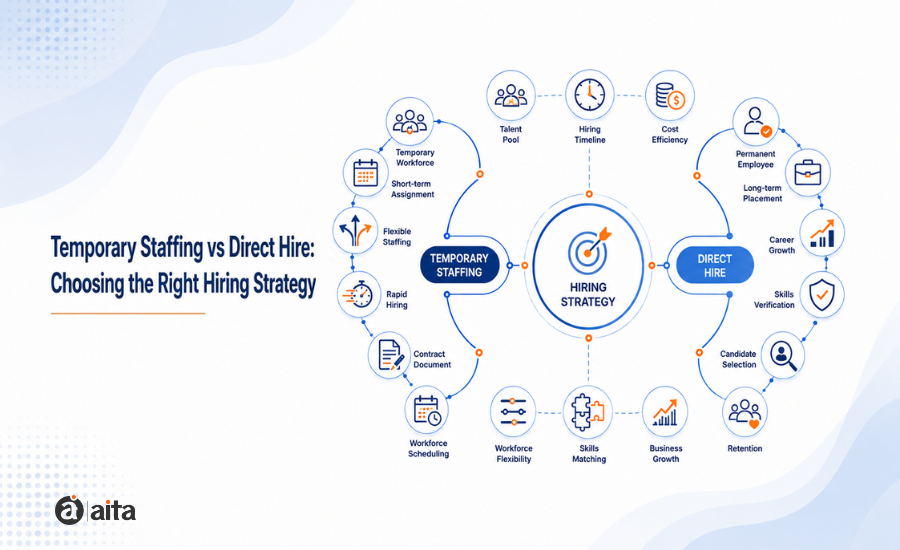
Temporary staffing has become one of the fastest, lowest-risk ways for companies to fill gaps without locking themselves into a long-term commitment they aren’t ready to make. But it isn’t always the right call, and neither is direct hire in every situation. The real question isn’t which model is better in the abstract it’s which one fits the role, the budget, and the moment your business is in right now.
Hiring managers ask this question constantly, usually under time pressure: a project just got approved, someone quit without much notice, or the business needs to test a new function before committing to it permanently. Getting the answer wrong is expensive either way either you’re paying for flexibility you didn’t need, or you’re locked into a full-time salary for work that was always going to be temporary. This guide breaks down how to tell the difference, and where a blended approach often beats picking one model and sticking with it.
What Temporary Staffing Actually Looks Like Today
Temporary staffing has moved well past the image of a receptionist filling in for two weeks. Staffing firms now place accountants, project managers, software developers, clinical coordinators, and supply chain analysts on assignments that run anywhere from a few weeks to well over a year. The defining feature isn’t the type of work it’s the structure. The worker is employed by the staffing agency, the agency handles payroll, compliance, and benefits administration, and the client company directs the day-to-day work without carrying the employer-of-record burden.
That structure is exactly why temporary staffing has become so useful for companies navigating unpredictable demand. A manufacturer ramping up for a product launch doesn’t want to hire twenty people permanently for a six-month surge. A hospital covering maternity leave doesn’t want to run a full recruitment cycle for a role that will disappear again in four months. Temporary staffing solves both problems by matching the length of the commitment to the length of the actual need.
The Case for Direct Hire
Direct hire earns its place when a role is core to how the business operates, not just to how it gets through the next quarter. A controller who will own the financial strategy for years. A senior engineer is building the product roadmap. A department head who needs authority that comes with being a permanent employee, not a contractor. These are positions where continuity, institutional knowledge, and long-term investment in the person’s growth pay off in ways a temporary arrangement can’t replicate.
There’s also a trust dimension to direct hire that’s easy to underestimate. Some roles require access to sensitive systems, client relationships, or strategic planning that companies are understandably cautious about extending to a rotating cast of contractors. And for the candidates themselves, a direct hire offer often signals a level of seriousness that helps close out competing offers from other employers particularly for senior or highly specialized talent who have options.
Direct hire also carries a retention advantage that’s easy to overlook in the middle of an urgent search. Full-time employees who see a path for growth inside the company tend to invest more in learning the business, mentoring new hires, and sticking around through rough patches. That kind of loyalty isn’t guaranteed just because someone is on payroll, but it’s rarely built through a series of short-term assignments either. When a role depends on someone knowing the history behind decisions, direct hire is usually the only structure that delivers it.
Temporary Staffing vs Direct Hire: A Side-by-Side Look
Laid out next to each other, the trade-offs become easier to weigh against your specific situation:
| Factor | Temporary Staffing | Direct Hire |
|---|---|---|
| Time to fill | Days, not weeks | Typically 4–8 weeks |
| Cost structure | Hourly bill rate, no benefits overhead | Salary + benefits + recruiting cost |
| Commitment | Defined term, easy to scale down | Long-term, harder to reverse |
| Best for | Seasonal spikes, project work, backfill, skills trials | Core roles tied to strategy, culture, and IP |
| Risk profile | Low downside if the role or fit changes | Higher cost if a mis-hire happens |
Neither column is objectively better. A high-growth startup testing a new market might lean almost entirely on temporary staffing for a year, while a healthcare system filling a director-level role will go direct hire without much debate. The point of the table isn’t to pick a winner; it’s to give you a quick gut-check against the role you’re actually trying to fill.
Where Contract Staffing Fits Into the Picture
Contract staffing sits in the middle ground, and it’s worth calling out separately because it solves a different problem than either pure temp work or a permanent hire. A contract engagement is usually tied to a defined scope or deliverable, such as a system migration, a compliance audit or a product build, rather than to covering an ongoing headcount gap. The worker might be on assignment for six months or eighteen, but the relationship is built around finishing something specific, not filling a seat indefinitely.
This distinction matters when you’re budgeting. Contract staffing lets finance teams treat labor as a project cost rather than a fixed headcount line, which is often easier to get approved and easier to unwind once the project closes. It also gives companies a genuine trial period with specialized talent engineers, analysts and project leads before deciding whether the role deserves to become permanent at all. Plenty of direct hires started out as contract placements where both sides simply liked how the arrangement was working.
AITACS Staffing
Ready to close your talent gap?
Get pre-vetted specialists deployed in 3–10 days. No overhead, no risk — just the right talent, exactly when you need it.
Contact Us
Free consultation · No commitment
Workforce Flexibility Isn't Just a Nice-to-Have Anymore
Workforce flexibility used to be treated as a secondary consideration behind cost and speed. That’s shifted. Companies that came through the last few years of demand swings, supply chain disruption, and shifting return-to-office policies have learned that the ability to scale a team up or down without a six-month lead time is a genuine competitive advantage, not just an HR convenience.
A blended workforce, a core of direct hires supported by temporary and contract staff who flex with demand, gives leadership something that an all-permanent or all-contingent model can’t: optionally. You keep institutional knowledge where it matters most while retaining the ability to respond quickly when a project ends, a market shifts, or a budget tightens. Companies building out technical teams, in particular, have found this blend useful for staying current with fast-changing skill requirements without over-hiring for a moment that will pass.
Signals That Point Toward Temporary Staffing
The need is tied to a specific event, season, or project with a known or roughly known end date.
You need someone contributing within days, not weeks.
You’re testing whether a function or role should exist at all before committing budget to it.
Budget approval for a new permanent headcount is unlikely or slow-moving right now.
The role requires a specific, narrow skill set you only need for a defined stretch of time.
Signals That Point Toward Direct Hire
The role owns strategy, client relationships, or decisions with long-term consequences.
You expect the position to exist, largely unchanged, for years.
Retention and cultural fit genuinely matter for how the role performs.
The cost of onboarding and ramp-up only pays off if the person stays.
You’re building a team where continuity of knowledge is part of the value delivered.
Common Mistakes Companies Make With This Decision
A few patterns show up again and again when this decision goes wrong, and most of them come from treating the choice as a formality rather than a real strategic call. The first is defaulting to direct hire out of habit, even when the role is genuinely temporary in nature. A finance team might insist on a permanent headcount for a six-month audit support role simply because that’s how they’ve always staffed the department, and then struggle to justify the position once the audit wraps.
The opposite mistake is just as common: keeping someone on a temporary or contract arrangement for years past the point where the role has clearly become permanent. This usually happens when a company is trying to avoid the administrative work of converting someone or when a hiring freeze quietly becomes permanent policy. It tends to backfire; the person eventually leaves for a role that offers stability, and the company loses someone who already knew the job well.
A third mistake is treating the decision as purely a cost comparison. Temporary staffing often looks cheaper on an hourly basis, and direct hire often looks cheaper once you annualized a salary against agency markup. But the real cost comparison has to include the cost of getting it wrong a re-run search, a gap in coverage, or a skilled contractor who takes their institutional knowledge to a competitor because no one made them an offer in time.
Making the Decision: A Practical Framework
When a hiring manager is stuck between the two, three questions usually cut through the noise faster than a long debate:
How certain is the demand? If you can’t confidently say this workload exists in twelve months, temporary or contract staffing protects you from a hire you’d have to unwind.
What does a mistake cost? A bad temporary placement costs you a phone call to the staffing partner. A bad direct hire costs months of lost productivity, severance, and a re-run of the entire search.
Does the role need authority a contractor can’t hold? Some positions genuinely require the standing that comes with permanent employment. If that’s the case, don’t force a temporary structure onto it just to save time.
Most companies don’t end up choosing one model exclusively. They build a workforce strategy that uses direct hire for the roles that anchor the business and temporary or contract staffing for everything that flexes with demand. That combination tends to outperform either extreme because it matches labor cost to actual need instead of guessing months in advance.
How AITACS Helps Companies Get This Right
This is exactly the kind of decision our Professional Staffing team works through with clients every week. Rather than pushing one hiring model because it’s easier to sell, we look at the role, the timeline, and the budget realities a company is actually operating under, then recommend temporary, contract, or direct hire placement based on what will genuinely serve the business, not what fills a requisition fastest.
That approach matters even more in functions where the skills required shift quickly. If you’re staffing technical or IT-adjacent roles, it’s worth reading our look at IT skills in demand, which digs into how a skills-based approach to hiring can make the temporary-versus-direct-hire decision easier by focusing on capability rather than job titles alone.
Getting the Balance Right
The companies that manage hiring well aren’t the ones with a fixed rule always direct hire, or always temp. They’re the ones who reassess the question honestly every time a role opens, weigh the real cost of getting it wrong, and stay willing to use more than one model at once. Temporary staffing, contract staffing, and direct hire aren’t competing philosophies. They’re tools, and the skill is in knowing which one the situation calls for.
If you’re weighing this decision for an open role right now, our Professional Staffing team can walk through the specifics with you and help you land on an approach that fits both the role and the budget you’re working with. Reach out to talk through what’s open and we’ll help you figure out the right fit temporary, contract, or direct hire.
Frequently Asked Questions
What is the main difference between temporary staffing and direct hire?
Temporary staffing places a worker who remains employed by a staffing agency for a defined assignment, while direct hire brings someone onto your company's own payroll as a permanent employee. The core distinction is commitment: temporary staffing scales with short-term need, while direct hire is built for roles you expect to exist long-term.
When should a company choose temporary staffing over direct hire?
Temporary staffing makes sense when the need is tied to a specific project, season, or uncertain timeline, and you need someone contributing within days rather than weeks. It's also the safer choice when you're testing whether a role should exist permanently before committing budget to it.
Is contract staffing the same as temporary staffing?
No — contract staffing is typically tied to a defined deliverable or project scope, like a system migration or compliance audit, while temporary staffing usually covers an ongoing headcount gap such as a leave of absence or seasonal spike. Both structures keep workers off your direct payroll, but they solve different problems.
Does temporary staffing cost less than direct hire?
It depends on how you measure cost. Temporary staffing avoids benefits overhead and long-term salary commitment, but direct hire avoids agency markup and the recurring cost of re-staffing the same role. The more accurate comparison factors in the cost of a mis-hire or an unfilled gap, not just the hourly rate versus the salary.
Can a temporary employee become a direct hire later?
Yes, and it's a common path — many companies use a temporary or contract placement as a trial period before extending a permanent offer. This approach lets both the employer and the candidate confirm fit before making a long-term commitment.
Categories
Professional Staffing
Let’s Build Your Team
Stop losing weeks to unqualified applicants. Connect with AITACS experts to find pre-screened, interview-ready candidates, reduce hiring time, and drive business growth with confidence.
Get Started