Talent Clouds Explained: How Enterprises Are Building Private Talent Pools to Cut Time-to-Fill by 60%
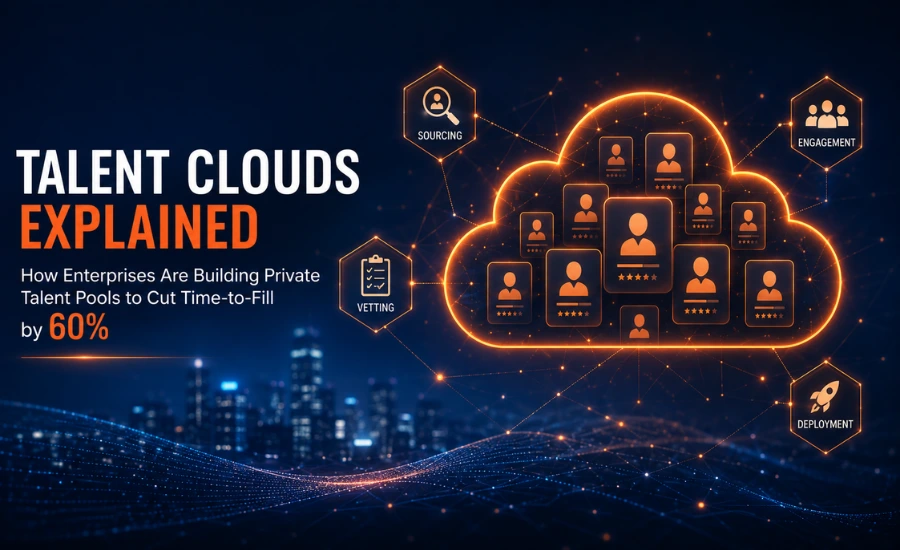
Enterprise hiring teams are under constant pressure to fill critical roles faster without sacrificing quality. That pressure is exactly why a growing number of organizations are turning to a talent cloud on-demand staffing platform instead of relying solely on job postings, agency blasts, or one-off requisitions. A talent cloud gives employers a private, continuously refreshed pool of pre-vetted candidates who can be activated the moment a need arises, cutting time-to-fill by as much as 60% compared to traditional staffing approaches.
In our previous article, we compared direct sourcing and MSP staffing models on ROI, and one theme kept surfacing: speed and talent access are now bigger differentiators than cost per hire alone. Talent clouds are the next evolution of that conversation, and this guide breaks down exactly what they are, how they work, and how enterprises are building a private talent pool strategy that keeps pace with 2026 hiring demands.
What Is a Talent Cloud?
A talent cloud is a private, curated database of pre-screened, pre-qualified candidates that an organization or its staffing partner maintains and continuously nurtures, so roles can be filled from an existing warm pool rather than starting a search from zero. Unlike a resume database or applicant tracking system, a talent cloud is actively managed: candidates are ranked by skill, availability, and engagement level, and relationships are kept warm through regular touchpoints even when there is no open role to fill.
AITACS Staffing
Ready to close your talent gap?
Get pre-vetted specialists deployed in 3–10 days. No overhead, no risk — just the right talent, exactly when you need it.
Contact Us
Free consultation · No commitment
Why Traditional Staffing Models Fall Short in 2026
Traditional staffing still starts a search cold every time a requisition opens. Recruiters source, screen, and negotiate from scratch, which is precisely the multi-week bottleneck enterprises are trying to eliminate. Even Managed Service Provider (MSP) programs, which centralize vendor management and reporting, are frequently limited by the depth of the vendor bench behind them rather than a truly owned talent pipeline.
The result is a familiar pattern: hiring managers wait weeks for viable candidates, contingent workforce costs climb as urgency drives premium rates, and high-performing candidates accept offers elsewhere while approvals move through the pipeline. A curated talent cloud addresses each of these pressure points by shifting sourcing from reactive to continuous.
How a Talent Cloud On-Demand Staffing Platform Works
A mature talent cloud on-demand staffing platform runs on a repeatable lifecycle rather than a one-time search. The visual below outlines the four stages that move talent from initial sourcing to active deployment.
The Talent Cloud Lifecycle
01
SOURCE & VET
Identify pre-screened talent across specialized skill pools.
➜
02
CURATE
Build a ranked private talent cloud based on role and skills.
➜
03
ENGAGE
Maintain relationships and keep qualified talent deployment-ready.
➜
04
DEPLOY
Activate and place talent in days instead of weeks.
A curated, on-demand talent cloud replaces one-off hiring with a continuously engaged private talent pool.
Each stage builds on the last. Sourcing and vetting establish quality at the door. Curation organizes talent into ranked, skill-mapped segments so the right person surfaces instantly when a role opens. Engagement keeps candidates warm through check-ins, project updates, and relationship-building, so they are not cold contacts by the time a role becomes available. Deployment is the payoff: because the groundwork is already done, activation happens in days instead of weeks.
Talent Cloud vs. Traditional Staffing vs. MSP-Only Sourcing
The table below compares how a curated talent cloud stacks up against traditional staffing and MSP-only sourcing across the criteria enterprise talent leaders care about most.
| Capability | Traditional Staffing | MSP-Only Model | Talent Cloud Platform |
|---|---|---|---|
| Talent Visibility | Reactive, req-by-req | Vendor-dependent | Continuous, pre-vetted pool |
| Average Time-to-Fill | 35–45 days | 25–35 days | 12–18 days |
| Candidate Relationship | One-time transaction | Managed by vendors | Ongoing, warm engagement |
| Cost Predictability | Variable, markup-heavy | Program fees apply | Transparent, on-demand |
| Scalability for Surges | Slow to mobilize | Moderate | Rapid activation |
The Time-to-Fill Impact: 2026 Benchmark Data
Time-to-fill reduction in 2026 is the metric enterprise talent leaders are watching most closely, and the data shows why talent clouds are gaining ground. Organizations relying on traditional staffing models average roughly 42 days to fill a role. MSP-only sourcing narrows that to about 31 days. A fully operational talent cloud model, by contrast, brings average time-to-fill down to roughly 17 days, a reduction of close to 60% against the traditional baseline.
Building a Private Talent Pool Strategy: 5 Steps
Standing up an effective private talent pool strategy is a deliberate process, not a byproduct of posting jobs more often. These five steps reflect how enterprise talent teams are approaching it in 2026:
Map recurring roles and skill families first, since talent clouds deliver the most value for positions your organization fills again and again.
Consolidate past applicants, silver-medalist candidates, and alumni into a single, actively managed pool instead of letting them go cold in an ATS.
Define engagement cadences (quarterly check-ins, project updates, skills newsletters) so candidates stay warm between roles.
Layer in skills-based ranking and availability tracking so recruiters can filter to ready-now candidates in minutes, not days.
Partner with a staffing provider that already operates a curated talent cloud, so you inherit a warm pipeline instead of building one from scratch.
What Makes a Curated Talent Cloud Different from a Resume Database
A resume database is passive; a curated talent cloud is active. The difference comes down to three things: verification, ranking, and relationship. Every profile in a curated talent cloud has been vetted for skills and availability, ranked against real role requirements, and kept current through ongoing outreach. That combination is what turns a static list of names into an on-demand talent pool that can actually be deployed on short notice.
How AITACS Talent on Demand Powers Your Talent Cloud
AITACS built its Talent on Demand solution specifically to give enterprises access to a curated talent cloud without the lead time of building one internally. Instead of starting each search cold, clients tap into a continuously engaged pool of pre-vetted professionals across IT, professional, pharma and healthcare, and blended workforce categories, ready to activate as soon as a need is confirmed.
For organizations that already use direct sourcing or MSP programs, a talent cloud is not a replacement, it is a force multiplier that fills the speed and relationship gaps those models often leave behind.
Frequently Asked Questions
What is a talent cloud in staffing?
A talent cloud is a private, continuously managed pool of pre-vetted candidates that an organization or staffing partner keeps warm and ready to deploy, rather than sourcing new candidates from scratch for every open role.
How much can a talent cloud reduce time-to-fill?
Enterprise benchmark data from 2026 shows organizations using a mature talent cloud model average roughly 17 days to fill a role, compared to about 42 days under traditional staffing, a reduction of close to 60%.
Is a talent cloud the same as an applicant tracking system?
No. An applicant tracking system stores applications passively. A talent cloud is actively curated, with candidates ranked, verified, and kept engaged through ongoing outreach so they can be redeployed quickly.
Which roles benefit most from a private talent pool strategy?
Recurring or high-volume roles, seasonal surge positions, and hard-to-fill specialized skill sets see the biggest time-to-fill improvements, since the talent pool is already built before the requisition opens.
How does a talent cloud complement an existing MSP program?
A talent cloud adds a continuously warm, owned pipeline on top of an MSP's vendor network, closing the speed and relationship gaps that vendor-dependent sourcing alone often cannot solve.
Categories
Talent On Demand
Let’s Build Your Workforce
Streamline hiring with AITACS Talent On Demand solutions. Access pre-screened, deployment-ready specialists, reduce hiring delays, and scale your workforce faster with flexible staffing support tailored to your business needs.
Get Started