Rapid Deployment Staffing: Filling Critical Roles Within 48 Hours
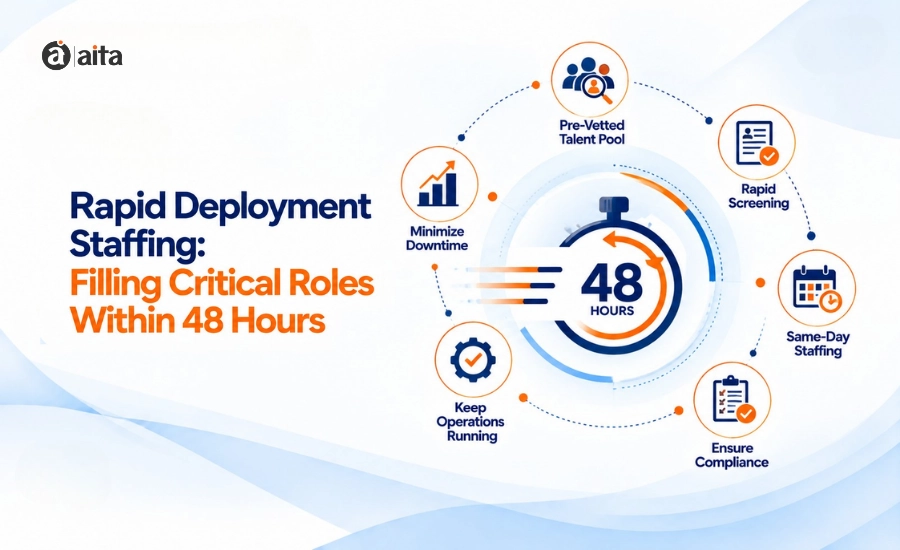
Rapid deployment staffing is what a plant manager reaches for when a lead machine operator walks out on Monday and a customer shipment is due Thursday. It is also what an IT director needs when the only person who understands a legacy billing system gives two days’ notice. Waiting six weeks for a standard search is not an option in either case, and the cost of an empty seat grows by the hour.
The good news is that critical roles can often be filled much faster than most hiring teams assume. The catch is that “48 hours” means different things depending on who is saying it, and the businesses that get the best results are the ones who understand exactly what can and cannot happen in that window.
What Rapid Deployment Staffing Actually Means
Rapid deployment staffing is a hiring approach designed to put qualified people into critical roles in days rather than weeks. It is not a shortcut around screening. It works because most of the slow, repeatable steps, such as sourcing, skills checks, and compliance paperwork, are completed before a specific request ever arrives.
That is the real difference from a standard search. A traditional requisition starts from zero: write the job description, post it, wait for applicants, schedule interviews. Rapid deployment starts from a bench of people who are already screened, already known to the recruiter, and already open to short-notice work.
Identification, Placement, and Deployment Are Three Different Clocks
This is where promises tend to fall apart, so it is worth being precise. A staffing partner may use the 48-hour figure to describe any of three milestones:
Identification: qualified candidates are found and a shortlist reaches the hiring manager.
Placement: the client selects a candidate, and the candidate accepts the assignment.
Deployment: the worker has cleared required checks, has system access, and is physically or virtually working.
Identification within 48 hours is realistic for many roles when a vetted pool exists. Placement within 48 hours is achievable when the client decides quickly. Deployment within 48 hours is possible for some roles, but it depends on factors such as background screening turnaround, licensing or credential verification, and whether equipment and access are ready. Any partner who guarantees all three for every role is over promising.
AITACS Staffing
Ready to close your talent gap?
Get pre-vetted specialists deployed in 3–10 days. No overhead, no risk — just the right talent, exactly when you need it.
Contact Us
Free consultation · No commitment
When Businesses Need Emergency Staffing
Not every open role justifies emergency staffing. Standard hiring is cheaper and usually produces a more deliberate match when time allows. Rapid deployment earns its place when the cost of delay is clearly higher than the cost of speed. Common situations include:
A sudden resignation or no-show in a role that cannot sit empty, such as a shift supervisor, payroll specialist, or clinical technician.
An unexpected spike in volume, such as a large order, a seasonal rush, or a patient census surge.
A project that is slipping and needs specialized skills added quickly to protect a deadline.
A compliance, audit, or regulatory deadline that requires qualified hands immediately.
Planned leave that became unplanned, such as a medical absence with no notice.
Picture a regional distributor whose warehouse supervisor leaves the week before peak season. Hiring a permanent replacement may take two months, but the floor still needs a supervisor on Monday. A contract supervisor placed quickly can stabilize operations while the longer search for a permanent hire continues. That pairing, fast coverage now and deliberate hiring later, is one of the most practical uses of urgent hiring.
How Fast-Track Recruitment Works Behind the Scenes
Speed in staffing is rarely about recruiters working faster on a blank page. It comes from preparation done long before the call comes in. Three pieces matter most.
Pre-Vetted Talent Pools and Expedited Talent Sourcing
Expedited talent sourcing depends on having people ready to go. A strong partner maintains pools of candidates who have already been interviewed, skills-checked, and confirmed as available for short-notice assignments. When a request comes in, the recruiter is searching a known group rather than posting an ad and hoping.
This is the same principle behind a flexible, on-demand model, which we cover in On-Demand Staffing: How to Scale Your Workforce Up or Down Fast. Businesses that build a relationship with a partner before a crisis tend to see faster, cleaner results than those calling for the first time in the middle of one.
Rapid Screening Without Cutting Corners
Fast-track recruitment compresses the timeline, not the standards. In practice, that usually means running steps in parallel rather than one after another. Skills validation, reference checks, and background screening can begin while the client is reviewing the shortlist, instead of waiting until a candidate is chosen.
It also means screening against the criteria that actually matter for the role. A same-day request for an accounts payable clerk should test invoice processing and the client’s system, not run a generic personality assessment. Clear must-haves keep the process fast and the match accurate.
What Runs in Parallel Inside a 48-Hour Window
Illustrative timeline. Actual timing varies by role, credentials, and client approvals.
Shortlist reaches client
Candidate accepts
Worker starts
Source from vetted pool
Hours 0 to 10
Skills checks and references
Hours 4 to 20
Client reviews shortlist
Hours 10 to 24
Background and credential checks
Hours 8 to 44
Day-one access and onboarding prep
Hours 16 to 46
0h
12h
24h
36h
48h
Running steps in parallel, not in sequence,
is what makes a compressed timeline possible.
Same-Day Staffing: What Makes It Possible and When It Is Not
Same-day staffing is real for certain roles, usually high-volume or skills-standard positions such as warehouse associates, administrative support, general labor, and some clerical or customer service work. It becomes far less likely for roles that require licensing, security clearances, extended background checks, or specialized certifications.
A good partner will tell you which category your request falls into at the start. If a role cannot realistically be deployed in 48 hours, an honest timeline and an interim option, such as a qualified temporary worker, are more useful than a promise that will be missed.
What Slows a 48-Hour Placement Down
Most delays in rapid deployment are not caused by recruiters. They tend to come from a handful of predictable bottlenecks, and many sit on the client side.
Slow approvals. A shortlist that waits a day for sign-off has already used half the window.
Vague requirements. If the hiring manager cannot say what the worker must be able to do on day one, screening drifts and candidates get rejected for the wrong reasons.
Pending checks. Background screening, drug testing, and credential verification each have their own turnaround.
Day-one readiness. A worker who is placed but has no badge, login, equipment, or supervisor is not truly deployed.
Contract and rate friction. Negotiating terms from scratch while the clock runs eats hours that pre-agreed rate cards would save.
The practical takeaway is that businesses control more of the timeline than they think. Pre-approving rates, naming a single decision-maker, and preparing access in advance can save more time than any recruiting technique.
A Practical Playbook for Critical Role Backfill
Critical role backfill goes smoother when the hiring side has a repeatable routine. Here is a straightforward sequence that works across most industries:
Define the non-negotiables. List the three to five skills, certifications, or experience levels the worker must have on day one. Everything else is secondary.
Name one decision-maker. Choose a single person who can approve the shortlist and the offer within hours, with a backup if they are unavailable.
Brief the partner thoroughly. Share the real work environment, the systems used, the shift pattern, and what has gone wrong in the role before.
Run checks in parallel. Ask that screening, verification, and paperwork start as soon as candidates are shortlisted, not after final selection.
Prepare day-one access. Arrange badge, logins, equipment, and a named point of contact before the worker arrives.
Plan the next step. Decide whether the fast placement is a bridge to a permanent hire or a contract assignment, so expectations are clear for everyone.
Businesses that handle this kind of coverage regularly often build a standing arrangement rather than starting over each time. AITACS’s talent on demand solutions are designed around that idea, giving hiring teams a ready bench to draw from when a critical role opens without warning.
Costs, Limitations, and Compliance Considerations
Speed has a price, and being upfront about it helps businesses decide when it is worth paying.
What Rapid Deployment Costs
Faster turnaround can carry higher rates or fees than a standard search. A partner is maintaining pre-vetted pools, covering extended recruiter hours, and processing compliance steps quickly, and those costs are usually reflected in pricing. The right comparison is not rapid versus standard hiring in the abstract. It is the premium for speed against the daily cost of the empty role, whether that is missed output, overtime for the remaining team, or delayed revenue.
Limitations Worth Knowing
Accelerated hiring involves trade-offs. The evaluation window is shorter, so the odds of a less-than-perfect fit are higher than in a long search. Candidates may need time to ramp up on company-specific systems. And roles that need deep institutional knowledge rarely suit a 48-hour fill, which makes rapid deployment better for bridging a gap than replacing a long-tenured specialist.
Compliance Does Not Pause for Urgency
Employment eligibility verification, required background screening, and any licensing or certification checks still need to be completed, and they vary by role, industry, and location. Worker classification also matters. Whether someone is engaged as a contract worker or a temporary employee affects tax, benefits, and liability, and a rushed engagement is exactly when mistakes happen. A reliable partner builds these steps into the fast process instead of skipping them, and the client should confirm that during selection.
Choosing a Partner for Urgent Hiring
Not every staffing firm can support fast turnarounds, and the differences show up quickly under pressure. A few questions separate the prepared from the hopeful:
Do you maintain pre-vetted pools for the roles I hire, or do you start each search from scratch?
What does your 48-hour timeline cover: shortlist, placement, or full deployment?
How are background, credential, and eligibility checks handled when the timeline is tight?
Who is my point of contact outside normal business hours?
What happens if the first candidate does not work out?
Specific, confident answers to these questions are a good sign. Vague reassurance is not. A partner that is candid about what can and cannot be done in 48 hours is usually the one that delivers when it matters.
Frequently Asked Questions
What is rapid deployment staffing?
Rapid deployment staffing is a hiring model built to place qualified workers into critical roles within days instead of weeks. It relies on pre-vetted talent pools, streamlined screening, and parallel onboarding steps so the worker can start quickly once the client approves.
Can a critical role really be filled within 48 hours?
Sometimes, but it depends on the role. A shortlist or accepted offer within 48 hours is realistic when a vetted candidate pool exists. A worker physically starting in 48 hours also requires cleared background checks, any needed credentials, and day-one access to systems.
What is the difference between emergency staffing and urgent hiring?
Emergency staffing usually means immediate coverage for a sudden gap, often through temporary or contract workers. Urgent hiring is broader and can include permanent roles that need to be filled faster than a standard search, though usually on a longer timeline than emergency coverage.
Does same-day staffing cost more than standard staffing?
Often yes. Faster turnaround can carry premium rates because it requires pre-built talent pools, extended recruiter hours, and quick compliance checks. The added cost is worth weighing against the daily cost of leaving a critical role empty.
What slows down a 48-hour placement?
The most common delays are slow internal approvals, vague job requirements, pending background or credential checks, and missing system access on day one. Most of these sit on the client side and can be reduced with advance preparation.
Categories
Talent On Demand
Let’s Build Your Workforce
Streamline hiring with AITACS Talent On Demand solutions. Access pre-screened, deployment-ready specialists, reduce hiring delays, and scale your workforce faster with flexible staffing support tailored to your business needs.
Get Started