Cloud Migration Staffing: Building the Team for Your AWS or Azure Move
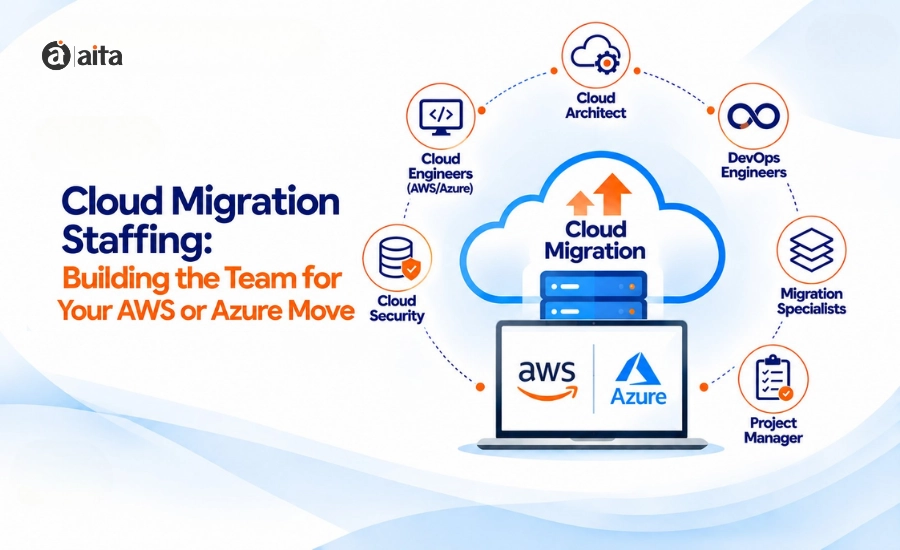
Cloud migration staffing decides whether an AWS or Azure move finishes on schedule or stalls halfway through. Picture a mid-sized company whose data center lease ends in nine months. It hires two capable infrastructure engineers, buys the cloud subscription, and starts moving workloads. By month four, it discovers that nobody on the team has designed the network foundation, connected the cloud back to the office, or set up the access controls an auditor will ask about.
The technology is rarely the problem. Both platforms are mature and well documented. What breaks migrations is a team with the wrong mix of skills, or the right skills arriving in the wrong order. Getting that mix right is a hiring problem before it becomes an engineering one.
What Cloud Migration Staffing Means
Cloud migration staffing is the process of recruiting and organizing the specialists needed to move applications, data, and infrastructure from on-premises systems, or from another provider, into a cloud platform such as AWS, Azure, or Google Cloud. It covers architects, engineers, security specialists, and project leadership, and it is usually timed to the phases of the migration rather than filled all at once.
That makes it different from traditional IT hiring in three practical ways:
It is time-bound. Most migration roles are needed intensely for months, not years, which changes how you plan headcount and budget.
It is platform-specific. A systems administrator with ten years of general experience is valuable, but may not have designed a cloud environment from scratch.
It is phase-dependent. An architect is needed before the first workload moves. Migration specialists peak in the middle. Operations skills matter most at the end.
Treating a migration like a routine infrastructure project, with a single job posting for a generic cloud engineer, is the most common way teams end up under-skilled in the areas that matter.
Essential Cloud Migration Roles
Every migration is different, but a handful of roles appear in nearly all of them. Smaller projects may combine several, though no role on this list should be left unowned.
Cloud Architects
The architect designs the landing zone, which is the foundation that includes networking, identity, security boundaries, and cost controls. They also decide how each workload should move: lift and shift, modify for the cloud, rebuild, replace, or retire. Cloud architect recruitment should come first because every later hire depends on decisions made here.
When screening, look for someone who has designed an environment, not only operated one. Ask them to explain a trade-off they made and what they would change now.
AWS Talent and Azure Engineers
Platform engineers build what the architect designs: compute, storage, databases, networking, and monitoring. This is where platform depth matters most. Azure engineer hiring often favors candidates with a Microsoft background, since many Azure migrations involve Windows Server, SQL Server, and Microsoft identity services. AWS talent tends to be drawn from a wider mix of backgrounds, including Linux, containers, and web-scale applications.
DevOps and Automation Engineers
DevOps engineers make the environment repeatable. They write infrastructure as code, build deployment pipelines, and make sure a second environment can be created without anyone clicking through a console from memory. Without this role, migrations tend to produce one-off configurations that nobody can safely change.
Cloud Security Engineers
Security belongs in the design phase, not the final week. A cloud security engineer handles identity and access, encryption, logging, and alignment with whatever compliance frameworks the business must meet. Fixing access models after workloads are live is far harder than designing them correctly at the start.
Migration Specialists and Project Managers
Cloud migration specialists handle discovery, dependency mapping, data transfer, and cutover planning. They know which applications can move easily and which have hidden dependencies that will break on migration day. A project or program manager sits alongside them, coordinating business owners, change windows, and communication, which is often where migrations quietly succeed or fail.
AWS vs Azure Staffing Requirements
The concepts overlap, but the tools, terminology, and certifications do not. The table below summarizes the differences hiring managers most often need to account for.
| Factor | AWS | Azure |
|---|---|---|
| Common certifications | AWS Certified Solutions Architect, DevOps Engineer Professional, Security Specialty | Azure Administrator, Azure Solutions Architect Expert, Azure Security Engineer, DevOps Engineer Expert |
| Native migration tooling | AWS Application Migration Service, Migration Hub | Azure Migrate |
| Infrastructure as code | CloudFormation, Terraform | Bicep, ARM templates, Terraform |
| Identity and access | IAM | Microsoft Entra ID, Azure role-based access control |
| Often a strong background fit | Linux, containers, open-source stacks, web-scale applications | Windows Server, SQL Server, Microsoft 365 and Active Directory environments |
Certification names and exam codes change over time, so verify the current versions before writing a job description.
Skills transfer partly between platforms. A strong AWS architect can learn Azure, but not by the first sprint. For implementation roles, match the candidate to the platform you are actually using. For architects, cross-platform experience is a genuine advantage, especially if a multi-cloud strategy is on the horizon.
What About GCP Staffing?
GCP staffing follows the same logic, with one practical difference: in many markets, the pool of engineers with hands-on Google Cloud migration experience is smaller. It tends to be strongest in data analytics and Kubernetes-heavy environments. If your plan includes Google Cloud, start sourcing earlier and be open to remote candidates.
Building an Effective Cloud Transformation Team
A cloud transformation team works best as a small core group with specialists added as each phase demands. Here is how the needs typically shift:
- Assess and plan: architect, migration specialist, security engineer, and project manager.
- Build the foundation: architect, platform engineers, DevOps engineer, and security engineer.
- Migrate workloads: migration specialists, platform engineers, application owners, and testers.
- Optimize and operate: operations or reliability engineers and someone responsible for cloud cost management.
As a hypothetical example, consider a company moving a few dozen applications over about a year. A sensible shape might include one architect, two or three platform engineers, a DevOps engineer, a part-time security engineer, a migration lead, and a project manager, with the engineer count rising during the heaviest migration months. The exact numbers depend on application complexity, not application count.
Phased staffing is not unique to cloud work. The same principle applies to other large system projects, as we explain in ERP Staffing: Finding Specialized Talent for SAP, Oracle, and Workday, where talent needs also change from design through go-live.
Collaboration matters as much as composition. Pair contractors with internal employees so knowledge stays in the business. Embed migration specialists with application owners early. Require documentation as part of the work, not as an afterthought once the contractors have left.
Common Cloud Hiring Challenges
Four problems come up repeatedly in cloud hiring, and most can be reduced with planning.
Experienced talent is scarce. Companies are competing for people who have completed real migrations, not just studied for exams, and cloud providers, consultancies, and product companies all recruit from the same pool.
Certifications can overstate experience. A certificate shows that someone studied a platform. It does not show that they handled a failed cutover or untangled a dependency nobody documented. Treat certifications as a starting signal, never the final one.
Timelines are tight. A standard search plus notice periods can run longer than a migration deadline allows, especially when a lease, license, or contract renewal sets the date. This is where early planning pays off.
Budgets drift toward the wrong roles. Senior architects cost more, so some teams under-hire at the top and over-hire engineers. That usually costs more later, in rework.
Technical screening is also a bottleneck. Recruiters and HR teams cannot always judge cloud depth on their own, so a technical reviewer needs to be part of the process, whether internal or through a specialized partner.
Cloud Migration Staffing Models
Choosing how to engage talent is as important as choosing whom to hire. The four common models each suit different situations.
| Model | Best for | Strengths | Watch-outs |
|---|---|---|---|
| Contract staffing | Defined build or migration phases | Fast to start, flexible scale | Knowledge can leave with the contractor |
| Permanent hiring | Long-term ownership and operations | Retains knowledge, builds internal capability | Slower, higher fixed cost |
| Staff augmentation | Adding specific skills to an existing team | Keeps your team in control of the work | Needs strong internal technical management |
| Project-based staffing | A defined scope with a delivery team | Predictable scope and outcomes | Less flexibility if scope changes |
Most organizations blend models: a permanent architect or technical owner, supported by contract engineers for the build. If you are weighing flexibility against commitment, our guide on scaling your workforce up or down covers the broader trade-offs.
Best Practices for Hiring Cloud Specialists
These practices consistently improve hiring outcomes for cloud roles:
Hire the architect first. Involve them in screening later hires, since they know what the design actually requires.
Write requirements around workloads, not buzzwords. “Migrated SQL Server databases to Azure” tells you far more than “Azure experience.”
Use scenario-based interviews. Ask candidates to walk through migrating a legacy application, including networking, security, cutover, and rollback.
Add a practical exercise. A short architecture review or hands-on task, respectful of the candidate’s time, reveals more than a list of services.
Ask about what went wrong. Experienced engineers can describe a migration problem and how they fixed it. Candidates without that experience usually cannot.
Verify certifications and references. Check current certification status and speak with someone who worked with the candidate on a migration.
Plan for after go-live. Decide who will run the environment before hiring contractors, so knowledge transfer is built into the plan.
Workforce planning ties these together. Map when each skill is needed, start sourcing the hardest roles first, and avoid hiring everyone on the same day just because the project kicked off.
AITACS Staffing
Ready to close your talent gap?
Get pre-vetted specialists deployed in 3–10 days. No overhead, no risk — just the right talent, exactly when you need it.
Contact Us
Free consultation · No commitment
How IT Staffing Partners Support Cloud Migration
A specialized partner shortens the slowest parts of the process. It maintains networks of cloud professionals, screens for platform-specific skills, and can place talent on contract or permanent terms depending on the phase.
That is the value of specialized cloud technology staffing: recruiters who understand the difference between an architect and an engineer, or between an Azure administrator and someone who has actually led a migration, can pre-screen before candidates reach your team.
A partner does not replace internal technical ownership. Someone in your organization still needs to define the architecture and accept the work. What strong IT staffing solutions provide is access to qualified people faster, along with help on engagement models, compliance paperwork, and replacements if a placement does not work out.
When evaluating partners, ask how they screen cloud skills, how many placements they have made in AWS, Azure, and GCP roles, and how they handle a contractor who leaves mid-project. Specific answers are a good sign.
Staff the Migration Before You Start It
Successful cloud migrations tend to share one trait: the team was planned before the first workload moved. The right architect, a realistic mix of AWS or Azure skills, security from day one, and a clear plan for life after go-live all start with hiring decisions, not technical ones.
Whether you build the team internally, bring in contractors, or combine both, the earlier you map the roles and timeline, the fewer surprises you face halfway through.
If you are planning an AWS, Azure, or multi-cloud move and want to talk through the roles you will need, connect with AITA Consulting Services’ IT staffing team to discuss your timeline and the cloud skills your project requires.
Frequently Asked Questions
What is cloud migration staffing?
Cloud migration staffing is the process of recruiting and organizing the specialists needed to move applications, data, and infrastructure into a cloud platform such as AWS, Azure, or Google Cloud. It covers architects, engineers, security specialists, and project leadership, usually timed to the phases of the migration.
Which roles do you need for an AWS or Azure migration?
Most migrations need a cloud architect, platform engineers with AWS or Azure experience, a DevOps or automation engineer, a cloud security engineer, a migration specialist, and a project manager. Smaller projects may combine roles, but architecture and security should never be left uncovered
Should you hire contractors or permanent employees for a cloud migration?
Many organizations blend both. Permanent staff, especially an architect or technical owner, keep knowledge in the business after go-live, while contractors or augmented staff add build capacity for the peak of the project. The right mix depends on timeline, budget, and who will run the environment afterward.
Are AWS and Azure skills interchangeable?
Only partly. Core cloud concepts such as networking, identity, and automation carry across platforms, but services, tooling, and certifications differ. A strong AWS architect can learn Azure, though not on day one, so implementation roles should be matched to the platform being used.
How do you evaluate a cloud engineer's technical skills?
Scenario-based interviews work better than trivia. Ask candidates to walk through migrating a real legacy application, including networking, security, cutover, and rollback. Hands-on exercises, architecture reviews, and reference checks on past migration projects add further evidence beyond certifications.
Categories
IT Staffing
Let’s Build Your Team
Scale your IT team faster than you thought possible. Connect with AITACS experts to find the right talent, reduce hiring time, and drive business growth with confidence.
Get Started