Executive Search vs Staffing Agency: What's the Difference?
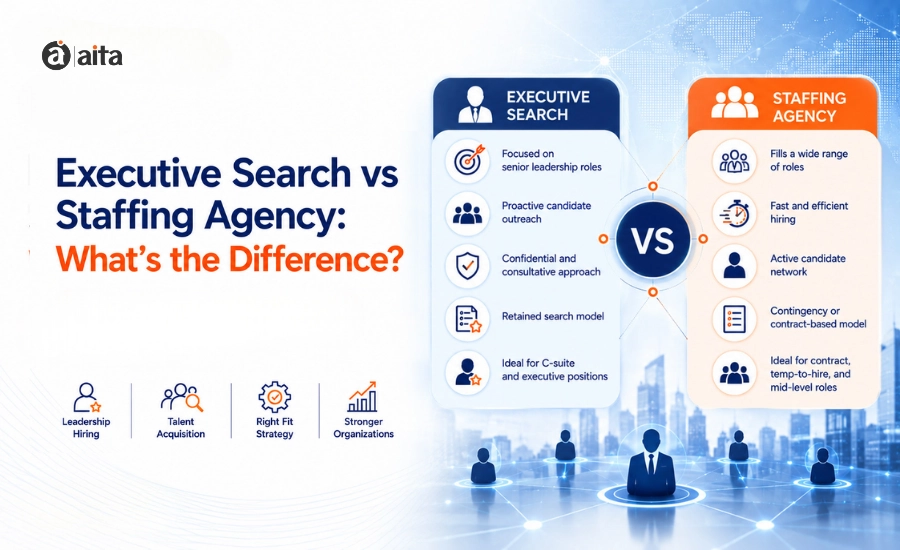
Executive search and staffing agency work get grouped together far more often than they should, and the confusion costs companies real money. A business that hires a contingency staffing firm to fill a Chief Financial Officer role usually ends up disappointed, and a business that engages a retained search firm to fill twelve warehouse supervisor positions has almost certainly overpaid for the privilege. Both models are legitimate. They are built for entirely different problems.
The distinction matters most when a company is hiring at senior levels for the first time, or when leadership turnover forces a decision quickly. Knowing which model fits the role in front of you saves weeks of wasted effort and, in some cases, prevents a bad hire in a seat where mistakes are expensive to undo.
What Executive Search Actually Involves
Executive search is a targeted, consultative process focused on senior leadership positions, typically at the vice president level and above. Rather than posting a job and reviewing applicants, an executive recruiter builds a map of the market, identifies people currently performing similar roles at comparable organizations, and approaches them directly.
The work is slower by design. A search consultant spends real time upfront understanding the company’s strategy, the reasons the role exists, and the specific leadership qualities that will succeed in that particular culture. Only after that groundwork does candidate outreach begin.
Most executive search engagements are retained, meaning the client pays a portion of the fee upfront and additional portions at defined milestones. That structure exists because the search firm is committing significant research and consulting hours before a single candidate is presented.
Why C-Suite Hiring Works Differently
C-suite hiring rarely involves candidates who are actively looking. The strongest chief operating officer for a manufacturing company is, more often than not, already running operations somewhere else and not browsing job boards on weekends.
Reaching that person requires a different approach entirely. It means research, warm introductions, and a conversation that begins with a genuinely compelling opportunity rather than an application form. It also often requires discretion, particularly when a company is quietly planning to replace a current executive who does not yet know the search is underway.
Confidentiality is a practical requirement in these situations, not a luxury. A leaked search can damage internal morale, unsettle customers, and occasionally affect investor confidence. Search firms build their processes around protecting that information.
What a Staffing Agency Does Well
Staffing agencies solve a different problem: filling roles efficiently, at volume, and often at speed. They maintain active candidate networks, screen continuously, and can frequently present qualified people within days of receiving a requisition.
The model works particularly well for contract roles, temp-to-hire arrangements, and permanent positions from individual contributors through mid-level management. A company that needs six accountants, three project coordinators, and a systems analyst is far better served by a staffing partner than by a retained search firm.
Fee structures are usually contingency-based for permanent placements, meaning the agency is paid only when a hire is made, or based on an hourly markup for contract workers. That structure lowers the client’s upfront risk, though it also means the agency is often working several searches simultaneously rather than dedicating exclusive attention to one.
Specialized Staffing Sits Somewhere in Between
The line between the two models blurs in technical and niche fields, where the talent pool is small enough that even mid-level roles require proactive sourcing rather than reactive screening.
This shows up clearly in enterprise technology hiring. Filling a certified Workday or SAP consultant role, as covered in ERP Staffing: Finding Specialized Talent for SAP, Oracle, and Workday, often demands the same targeted outreach that executive search relies on, even though the position sits well below the C-suite. The determining factor is scarcity of talent, not seniority of title.
Executive Search vs Staffing Agency: A Side-by-Side Comparison
The table below outlines the practical differences hiring leaders weigh most often when deciding which partner to engage.
| Factor | Executive Search | Staffing Agency |
|---|---|---|
| Roles covered | C-suite, VP, and board-level leadership positions | Individual contributors through mid-level management |
| Engagement model | Typically retained, with fees paid in stages | Usually contingency or hourly markup on placements |
| Sourcing approach | Proactive outreach to passive candidates already employed elsewhere | Active candidate pools, job boards, and existing talent networks |
| Typical timeline | Several weeks to several months | Days to a few weeks |
| Candidate volume | A small, deeply vetted shortlist | Multiple qualified candidates for comparison |
| Confidentiality | Often high, especially for replacement searches | Generally open and publicly posted |
How to Decide Which Model Fits Your Role
The choice usually comes down to four questions worth answering honestly before contacting any partner.
Which Hiring Models Fits Your Role?
Points to Executive Search
Points to Staffing Agency
1. Strategic weight
How much does this hire
shape company direction?
Sets direction for a business
unit or function
unit or function
Executes within an existing
structure
structure
2. Candidate availability
Are the right people
actively job searching?
Mostly passive, already
employed elsewhere
employed elsewhere
Healthy pool of active
candidates in market
candidates in market
3. Cost of a mis-hire
What happens if this
appointment goes wrong?
Lost momentum, team
turnover, a second search
turnover, a second search
Recoverable with a
replacement hire
replacement hire
4. Confidentiality
Does the search need to
stay private?
Replacing a current leader
or a sensitive transition
or a sensitive transition
Role can be posted
openly
openly
First, how much does this specific hire affect company strategy? A role that sets direction for a department or business unit justifies a more intensive search than one that executes within an established structure.
Second, are the right candidates likely to be actively looking? If the answer is no, contingency recruiting will struggle, because that model depends largely on candidates who are already in motion.
Third, how costly is a mistake? Senior leadership hiring errors tend to surface slowly and cost far more than a salary, factoring in lost momentum, team turnover, and the time required to run a second search.
Fourth, does the search need to stay confidential? If yes, that alone narrows the decision significantly toward retained search.
When Retained Search Is Worth the Investment
Retained search makes the most sense when a role is difficult to fill, strategically important, and unlikely to attract the right person through open posting. Board-level appointments, first-time executive roles at growing companies, and turnaround leadership hires all fit that description.
The retained model also gives a client leverage that contingency arrangements do not. Because the firm has committed to one search rather than juggling several, clients can reasonably expect regular market updates, detailed candidate assessments, and a consultant who pushes back when a job specification is unrealistic.
That said, retained search is not automatically better. It is more expensive, it takes longer, and for a role with a healthy active candidate market, the additional cost buys very little that a strong staffing partner would not already deliver.
Leadership Recruitment Beyond the Executive Tier
Leadership recruitment does not begin and end at the C-suite. Directors, senior managers, and functional leads often carry substantial responsibility, and getting those hires wrong creates the same downstream problems as a poor executive appointment, just on a smaller scale.
Many organizations underinvest at this level. They apply a high-touch process to a handful of executive roles while filling the layer directly beneath with whatever process happens to be fastest. That gap tends to show up eighteen months later in retention numbers.
A more useful framing is to match process intensity to role impact rather than to job title. Some director-level positions warrant a search approach closer to executive hiring, while some vice president roles in well-supplied markets do not.
Building a Succession Planning Talent Pipeline
Succession planning talent is the piece most companies acknowledge is important and then postpone indefinitely. The result is predictable: when a senior leader resigns unexpectedly, the organization scrambles, and the search happens under time pressure that almost guarantees a compromise.
Companies that handle transitions well tend to maintain ongoing relationships with a small number of external candidates for critical roles, even when no opening exists. They also develop internal successors deliberately rather than assuming the obvious internal candidate will be ready when needed.
A good search partner supports both sides of that work. Market mapping conversations, even when they do not lead to an immediate hire, give leadership teams a clearer picture of who is available and what compensation looks like at that level.
AITACS Staffing
Ready to close your talent gap?
Get pre-vetted specialists deployed in 3–10 days. No overhead, no risk — just the right talent, exactly when you need it.
Contact Us
Free consultation · No commitment
Questions Worth Asking Any Search Partner
Regardless of which model a company chooses, a few questions separate capable partners from ones that will waste a quarter of your time.
Ask how they source candidates for roles like yours specifically, not in general terms. Ask how many searches a consultant carries at once, since that number directly affects how much attention yours receives. Ask what happens if the first shortlist misses, and whether the engagement includes additional rounds.
It is also reasonable to ask about off-limits policies, meaning which companies the firm cannot recruit from due to existing client relationships. A search firm with extensive restrictions in your industry may have a smaller usable candidate universe than it initially appears.
Where Professional Staffing Fits Into the Picture
Most organizations need both models at different moments, and the practical question is less about choosing one permanently than about knowing which to reach for when a specific need arises.
AITACS’s professional staffing services cover the broad range of roles that sit between high-volume hiring and top-tier executive appointments, including accounting and finance, human resources, operations, and administrative leadership positions. That middle band is where many companies feel the most pressure and receive the least specialized support.
Working with a partner that handles both directions matters when needs shift, which they typically do. A team that starts with a contract project manager and later needs a director of operations benefits from a staffing relationship that already understands its structure and culture. Our professional staffing Services builds that continuity into how engagements are structured rather than treating each requisition as an isolated transaction.
Frequently Asked Questions
What is the difference between executive search and a staffing agency?
Executive search is a consultative, usually retained process focused on senior leadership roles, where recruiters proactively approach candidates who are already employed elsewhere. A staffing agency fills roles more quickly and at higher volume, typically on a contingency or hourly markup basis, using active candidate pools for positions from individual contributors through mid-level management.
When should a company use retained executive search instead of contingency recruiting?
Retained search makes the most sense when a role is strategically important, difficult to fill, and unlikely to attract the right candidate through an open job posting. It is also the better fit when a search must stay confidential, such as when a company plans to replace a current executive who has not yet been informed.
How long does an executive search typically take?
Executive searches generally run longer than standard staffing placements, often several weeks to several months, because the process begins with market research and strategy work before any candidate outreach happens. Staffing agency placements, by contrast, can often produce qualified candidates within days.
Is executive search only for C-suite positions?
No. While executive search is most associated with C-suite and VP-level roles, the same targeted approach often applies to director-level positions and specialized technical roles where the talent pool is small. The deciding factor is usually scarcity of qualified candidates and the strategic impact of the role, rather than job title alone.
What should companies ask before hiring an executive recruiter?
Useful questions include how the firm sources candidates for that specific type of role, how many searches each consultant handles simultaneously, and what happens if the first shortlist does not produce a hire. It is also worth asking about off-limits policies, since existing client relationships can restrict which companies a firm is able to recruit from in your industry.
Categories
Professional Staffing
Let’s Build Your Team
Stop losing weeks to unqualified applicants. Connect with AITACS experts to find pre-screened, interview-ready candidates, reduce hiring time, and drive business growth with confidence.
Get Started