ERP Staffing: Finding Specialized Talent for SAP, Oracle, and Workday
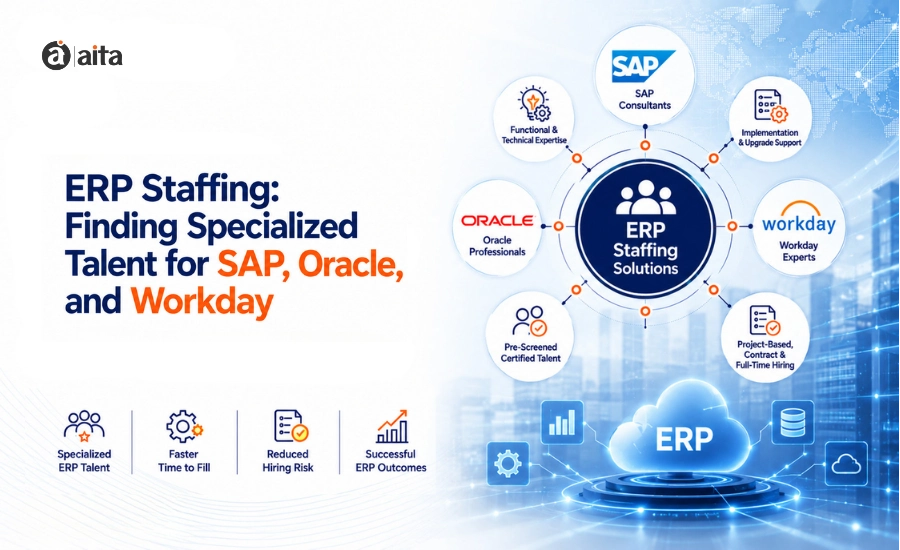
ERP staffing has become one of the harder hiring problems facing IT and HR leaders today, mostly because the talent pool for these systems is narrow and the cost of a bad hire is high. A company migrating to SAP S/4HANA or rolling out a new Workday module doesn’t need a generalist. It needs someone who has actually configured that specific system before, ideally more than once, and who understands how a botched implementation can quietly derail an entire finance or HR function for months.
That specificity is exactly what makes ERP staffing different from most other technical hiring. A capable software engineer can often pick up a new programming language within weeks. ERP systems don’t work that way. SAP, Oracle, and Workday each have their own configuration logic, module ecosystems, and implementation quirks, and someone who’s spent five years deep in Oracle Cloud isn’t automatically ready to walk into a Workday project on day one.
Why ERP Staffing Requires a Different Approach
Most technical recruiting focuses on programming languages, frameworks, and general problem-solving ability. ERP staffing works differently because the systems themselves are the specialization. A candidate’s resume might list “SAP” as a skill, but that tells you almost nothing about whether they’ve handled a Materials Management module, an FI/CO configuration, or a full greenfield implementation versus a system upgrade.
This is where a lot of internal hiring teams run into trouble. Without someone on staff who’s lived through an ERP implementation themselves, it’s genuinely difficult to tell a strong candidate from someone who’s memorized the right keywords. A recruiter who understands the difference between a functional consultant and a technical consultant, or between an implementation partner and an ongoing support resource, is going to screen far more effectively than one working from a generic job description template.
The Real Cost of a Mis-Hire in ERP Projects
ERP implementations are expensive and slow to unwind. Bringing on the wrong consultant for a Workday deployment doesn’t just cost a salary or contract rate. It can push back a go-live date, introduce configuration errors that surface months later, or require a second round of hiring to fix what the first person got wrong. Because these projects often touch payroll, financial reporting, or supply chain operations, a mistake tends to ripple outward in ways that are hard to contain.
That’s part of why organizations increasingly lean on specialized staffing partners for these roles rather than relying entirely on internal recruiting. It’s not that internal teams aren’t capable. It’s that ERP staffing benefits from a recruiter who has already built relationships with SAP, Oracle, and Workday professionals and can vet technical depth before a candidate ever reaches a hiring manager’s desk.
SAP Consultant Hiring: What to Look For
SAP consultant hiring tends to be the most complex of the three, largely because SAP’s ecosystem is so broad. A single SAP project might need functional consultants for finance, logistics, or HR modules, alongside technical consultants who handle ABAP development, integration, or Basis administration.
The mistake many hiring managers make is treating “SAP experience” as a single qualification. In practice, the questions worth asking are much more specific. Has this person worked on S/4HANA specifically, or only on older ECC systems? Have they been through a greenfield implementation, a brownfield conversion, or primarily support and maintenance work? Do they understand the business processes behind the modules they configure, or only the technical configuration screens?
Consultants who can speak fluently about both the technical build and the business impact tend to be rarer, and they’re usually the ones worth paying a premium for. A finance-focused SAP consultant who doesn’t understand how their configuration choices affect month-end close is going to create problems that only show up after go-live.
Oracle Recruitment: Navigating Cloud and On-Premise Skill Gaps
Oracle recruitment carries its own complications, largely driven by the industry’s ongoing shift from on-premise E-Business Suite to Oracle Cloud (Fusion) applications. Plenty of experienced Oracle professionals built their careers on EBS and haven’t made the jump to Cloud yet, while newer consultants may have deep Cloud expertise but limited exposure to the on-premise environments many companies are still running.
This creates a real skills gap that hiring managers need to plan around rather than ignore. If a company is mid-migration, running both EBS and Fusion simultaneously, it may need two distinct types of talent rather than assuming one Oracle consultant can competently handle both. Being upfront about this during the hiring process, rather than discovering the mismatch three months into a project, saves everyone time and frustration.
Oracle recruitment also benefits from asking candidates about specific modules rather than the platform in general. Financials, Supply Chain Management, and HCM each require different depth of knowledge, and a consultant strong in one area isn’t necessarily equipped for another.
Workday Talent: A Tight and Competitive Market
Workday talent is arguably the hardest of the three to source right now. Workday’s certification process is rigorous, the partner ecosystem is smaller than SAP’s or Oracle’s, and demand has grown quickly as more mid-size and large enterprises move their HR and finance systems onto the platform. Certified Workday consultants, particularly those with implementation experience rather than just support experience, are in short supply relative to demand.
This scarcity means companies hiring for Workday roles need to move faster and be more flexible on engagement structure than they might for other ERP systems. Waiting weeks to make a decision on a strong Workday candidate often means losing them to a competing offer. It also means that building relationships with a staffing partner who maintains an active bench of Workday-certified professionals, rather than starting a search from scratch each time, becomes a genuine competitive advantage.
NetSuite Consultants and the Mid-Market Gap
NetSuite consultants deserve a mention here too, since NetSuite has become the default ERP choice for a large segment of the mid-market that doesn’t need the scale of SAP or Oracle but has outgrown basic accounting software. The demand for NetSuite consultants has grown alongside this shift, but the talent pool remains smaller and less mature than the ecosystems around the bigger three platforms.
Companies hiring NetSuite consultants often find that the best candidates come from boutique implementation partners or from professionals who’ve built their careers specifically around the platform, rather than from consultants who list NetSuite as one of several ERPs they’ve touched briefly. Depth matters more than breadth here, the same way it does across enterprise systems recruitment generally.
Building an ERP Implementation Staffing Plan
ERP implementation staffing works best when it’s planned in phases rather than treated as a single hiring event. Most implementations move through distinct stages, and the talent needed at each stage is different.
During the planning and design phase, companies typically need functional consultants who can translate business requirements into system configuration. During build and testing, technical consultants and developers take on more of the workload. Post-go-live, the need shifts again toward support resources who can handle issues as they surface and train end users on the new system.
ERP Implementation Staffing Roadmap
Talent needs shift as a project moves through each phase
Planning & Design
Functional consultants
translate business
requirements into
system configuration
Build & Testing
Technical consultants
and developers carry
the heaviest share
of the workload
Go-Live
Combined functional
and technical coverage
for cutover and
issue resolution
Ongoing Support
Support resources
handle issues and
train end users on
the new system
Source: AITACS ERP staffing framework
Trying to staff an entire implementation with one type of consultant, or assuming the same people who handled the build will be equally effective at ongoing support, often leads to mismatched skills at the wrong phase of the project. A staffing plan that maps talent needs to project phases, built before the project kicks off rather than reactively, tends to produce far better outcomes.
This kind of phased approach also plays well with a flexible staffing model, where a company brings in specialized consultants for the duration of a specific phase rather than committing to permanent headcount for skills that may not be needed once the implementation stabilizes. ERP projects are a natural fit for this kind of scaling, since the intensity of resource needs shifts significantly from design through go-live and into steady-state support.
Contract vs Permanent: Which Model Fits ERP Roles?
This question comes up constantly, and the honest answer is that it depends on the phase and the role. Implementation-specific roles, particularly ones tied to a defined project timeline, are often better suited to contract engagements. The skills needed to configure and launch a system aren’t always the same skills needed to run it day to day once it’s live.
Permanent hires make more sense for ongoing system administration, continuous improvement work, and roles where institutional knowledge of the company’s specific configuration and business processes adds real long-term value. A permanent ERP administrator who understands why certain customizations were made three years ago is worth far more than a new hire starting from scratch.
Many organizations end up blending both approaches, bringing in contract consultants for the implementation itself and using that engagement as a proving ground to identify candidates worth converting to permanent roles once the system stabilizes.
Common ERP Staffing Mistakes to Avoid
A few patterns show up repeatedly when ERP hiring goes wrong, and most of them are avoidable with a bit more discipline in the process.
The first is treating platform experience as a single checkbox rather than probing for module depth, project type, and version. A resume that says “10 years of SAP” could mean deep S/4HANA finance expertise or it could mean scattered support tickets across half a dozen older systems. The two are not interchangeable, and only a detailed conversation reveals the difference.
The second is underestimating how long a proper search takes for niche platforms like Workday or NetSuite, then compressing the hiring timeline once a project deadline starts closing in. Rushed searches tend to produce weaker matches, because there simply isn’t time to verify depth of experience against what the project actually needs.
The third is failing to plan for the handoff between implementation and support. Consultants who are excellent at building a system aren’t always the right fit for maintaining it, and assuming the same team will stay engaged indefinitely often leaves companies scrambling once the initial contract ends.
AITACS Staffing
Ready to close your talent gap?
Get pre-vetted specialists deployed in 3–10 days. No overhead, no risk — just the right talent, exactly when you need it.
Contact Us
Free consultation · No commitment
Why Enterprise Systems Recruitment Needs Specialized Partners
Enterprise systems recruitment is not a volume game. It’s a depth game. A staffing partner who places dozens of general IT roles a month but rarely touches ERP work isn’t going to have the network, the screening process, or the market knowledge to move quickly on a Workday or SAP search.
Our IT staffing services are built around understanding these distinctions rather than treating enterprise systems talent as interchangeable with general software development roles. That means asking the right technical questions during screening, understanding the difference between implementation and support work, and maintaining relationships with consultants across SAP, Oracle, Workday, and NetSuite so that when a search starts, it isn’t starting from zero.
Whether the need is a single specialized consultant for a six-month implementation or a broader team to support an ongoing ERP transformation, working with a partner who understands these systems in depth tends to produce faster placements and fewer costly mismatches down the line.
Getting Started with ERP Staffing
ERP staffing rewards preparation. Companies that wait until a project is already behind schedule to start searching for talent almost always end up settling for whoever is available rather than who is genuinely qualified. Building a relationship with a staffing partner before the next implementation, upgrade, or migration lands on the calendar puts a company in a much stronger position when the need becomes urgent.
If your organization is planning an SAP, Oracle, Workday, or NetSuite project and needs specialized talent that can hit the ground running, connect with our IT staffing team to talk through your timeline and the specific skills your implementation requires.
Frequently Asked Questions
What makes ERP staffing different from general IT staffing?
ERP staffing is more specialized because the systems themselves are the qualification, not just general programming or IT skills. A candidate needs hands-on experience with the specific platform, such as SAP, Oracle, or Workday, along with the particular modules and implementation type a project requires, rather than broad technical ability alone.
How long does it typically take to hire a qualified SAP or Workday consultant?
Timelines vary based on how niche the platform and module are, with Workday and NetSuite searches generally taking longer than SAP or Oracle due to smaller talent pools. Searches move fastest when a staffing partner already maintains an active bench of certified consultants rather than starting from scratch once a project need arises.
Should ERP consultants be hired as contractors or permanent employees?
It depends on the phase of the project. Implementation-specific work tied to a defined timeline is usually better suited to contract engagements, while ongoing system administration and continuous improvement roles benefit more from permanent hires who build institutional knowledge of the company's specific configuration over time.
What questions should hiring managers ask to vet ERP consultant experience?
Effective screening goes beyond asking whether a candidate has "SAP" or "Oracle" experience. It's more useful to ask which specific modules they've configured, whether they've worked on greenfield implementations versus system upgrades or support, and whether they understand the business processes behind the technical configuration they perform.
Why is Workday talent harder to find than SAP or Oracle talent?
Workday's certification process is more rigorous and its partner ecosystem is smaller than SAP's or Oracle's, while demand has grown quickly as more enterprises adopt the platform for HR and finance. This combination of limited supply and rising demand makes certified, implementation-experienced Workday consultants scarcer relative to other ERP systems.
Categories
IT Staffing
Let’s Build Your Team
Scale your IT team faster than you thought possible. Connect with AITACS experts to find the right talent, reduce hiring time, and drive business growth with confidence.
Get Started