On-Demand Staffing: How to Scale Your Workforce Up or Down Fast
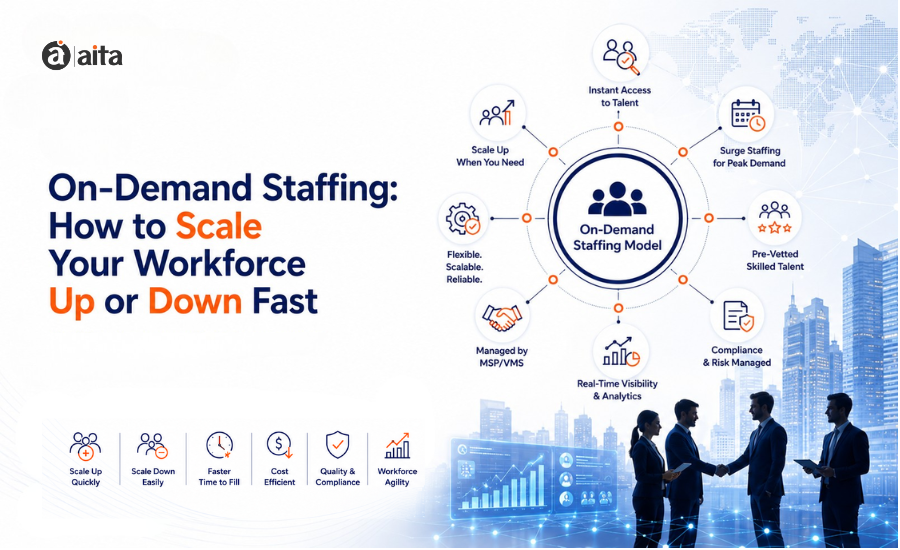
On-demand staffing has become one of the most practical tools available to companies that need to move fast without over committing to permanent headcount. When a warehouse needs forty extra hands for six weeks, or a product team needs three engineers to hit a launch date, a six-week hiring cycle simply isn’t realistic. A flexible workforce model closes that gap by matching the right people to the right work, for exactly as long as the work requires it.
For HR leaders, talent acquisition teams, and workforce planners, the appeal becomes obvious the first time a staffing crunch hits. Nobody wants to explain to leadership why a shipment is late because the warehouse is three people short. Just as few want a headcount budget weighed down by permanent hires who sit idle once the busy season passes. On-demand staffing sits in the middle of those two problems, offering enough structure to move quickly and enough flexibility to avoid over committing.
What On-Demand Staffing Actually Means
At its core, on-demand staffing is the ability to bring in qualified workers, whether contract, temp-to-hire, or project-based, within days instead of weeks. Just as important, it lets you release that capacity as soon as the need passes. It differs from generic temp staffing, which usually fills routine, ongoing gaps rather than sudden spikes.
On-demand staffing is built around variability. It assumes your workforce needs will rise and fall throughout the year, and it gives you a mechanism to respond in real time instead of scrambling after the fact.
The model works because it separates two things traditional hiring usually bundles together: the need for labor and the commitment to permanent employment. A company can bring in on-demand talent for a defined window, such as a product launch, a seasonal rush, or an unexpected departure, without taking on the long-term cost of a full-time hire.
AITACS Staffing
Ready to close your talent gap?
Get pre-vetted specialists deployed in 3–10 days. No overhead, no risk — just the right talent, exactly when you need it.
Contact Us
Free consultation · No commitment
The Business Case for a Flexible Workforce
Finance teams support on-demand staffing for a reason that has little to do with convenience. It converts a fixed cost into a variable one. Full-time headcount carries benefits, payroll tax, severance risk, and the sunk cost of training someone who might only be needed for a few weeks a year. A flexible workforce model lets a business pay for labor only when that labor is actually being used.
Operations leaders value it for a different reason: speed. A well-built staffing pipeline can source, screen, and place workers within days. That matters when a client contract lands unexpectedly or a key employee gives two weeks’ notice in the middle of a critical project.
Surge Staffing During Peak Demand
Surge staffing is the clearest example of this model in action. Retailers preparing for the holiday season, logistics companies managing a spike in shipping volume, and call centers bracing for a product launch all face the same challenge. Demand is temporary, but the work still has to get done properly.
Hiring twenty permanent employees for a six-week surge usually means twenty layoffs six weeks later. That approach is expensive, disruptive to team morale, and often avoidable with better planning.
A strong surge staffing plan starts well before the surge hits. Companies that handle peak periods smoothly typically line up a staffing partner months in advance, with role requirements, pay rates, and start dates already agreed upon. Companies that scramble in week one of the surge are usually the ones reaching out to a staffing partner for the first time that same week.
Seasonal Workforce Scaling Without the Overhead
Seasonal workforce scaling is closely related but slightly different. It is predictable and recurring, tied to a calendar rather than a single unexpected event. Agriculture, hospitality, tax preparation, and e-commerce fulfillment all follow known seasonal patterns, which means the staffing plan can be built as a repeatable process rather than reinvented every year.
Many companies treat each season as a one-off hiring push instead of building a standing bench of workers who return year after year. A staffing partner that tracks performance data across seasons can flag strong returning talent before the busy period even starts, which shortens ramp-up time considerably.
What an Elastic Staffing Model Looks Like in Practice
An elastic staffing model is more than simply bringing on more temporary workers. It is a structured approach to workforce planning that treats labor capacity the way a technology team treats server capacity: scaled to actual demand, monitored continuously, and adjusted without a lengthy approval process each time.
In practice, this usually involves a few components working together.
A pre-vetted talent pool covers roles that get filled repeatedly, so the search doesn’t start from zero every time. Clear service-level agreements with a staffing partner define time-to-fill, quality standards, and escalation paths in advance. Forecasting is built on real historical data, such as order volume or project pipeline, rather than guesswork. A conversion pathway also exists for standout contract workers a company may want to bring on permanently.
Companies that build this infrastructure once tend to reuse it for years. The first surge is always the hardest because the system is being built while the crunch is already underway. After that, scaling up or down starts to feel closer to flipping a switch than launching a new hiring project.
On-Demand Talent vs Traditional Hiring: Key Differences
It helps to be direct about where on-demand talent works best and where traditional hiring still makes more sense. The table below breaks down the main differences hiring managers should weigh when deciding between the two.
| Factor | Traditional Hiring | On-Demand Staffing |
|---|---|---|
| Best suited for | Strategic, ongoing roles requiring institutional knowledge | Time-bound projects, seasonal spikes, uncertain demand |
| Time to fill | Typically several weeks to a few months | Often days, depending on role complexity |
| Cost structure | Fixed cost, including benefits and long-term overhead | Variable cost, tied to actual usage |
| Commitment level | Long-term employment relationship | Defined engagement window |
| Risk if demand shifts | Layoffs or redeployment challenges | Engagement simply ends or scales down |
| Typical use case | Finance director, VP of engineering, core leadership roles | ERP implementation, warehouse ramp-up, data migration project |
Traditional hiring is the right choice for roles that are strategic and ongoing, where continuity and cultural investment matter more than speed. On-demand talent fits situations where the work itself is time-bound or the required skills are needed only for a defined project.
These approaches are not competitors. Most well-run organizations use both, choosing the model that fits each role rather than defaulting to one approach across the board.
Building Workforce Agility Into Your Hiring Strategy
Workforce agility is not something a company adds during a crisis. It is a capability built ahead of time, the same way any other operational strength is developed. A few practical steps make the biggest difference.
Start by mapping variability. Reviewing the last two or three years of demand data usually reveals patterns in headcount needs by season, project, or department. Most companies are surprised by how predictable their “unpredictable” spikes actually are.
Pre-negotiate rates and terms with a staffing partner before a crisis forces the conversation. Waiting until the pressure is on almost always costs more than agreeing on a rate card in advance.
Standardize onboarding for contract talent. A contract worker who cannot access systems or badge into the building on day one is not actually helping the business move faster.
Track performance across engagements, not just within a single one, so it becomes clear which workers and which roles are worth building a longer relationship around.
Partnering With an MSP for Speed and Compliance
For companies managing staffing across multiple vendors, departments, or locations, coordination overhead can quietly erode the speed advantage that on-demand staffing is supposed to deliver. This is where a managed service provider model earns its place.
AITACS’s MSP/VMS staffing services centralize vendor management, standardize compliance across every contingent worker, and give hiring managers a single point of contact instead of a dozen scattered agency relationships.
The compliance piece deserves more attention than it usually gets. Worker misclassification, inconsistent background check standards, and gaps in insurance coverage are the kinds of problems that stay hidden until an audit or a claim forces the issue. A properly run MSP/VMS staffing program builds those safeguards into the process itself, rather than relying on each hiring manager to catch problems individually.
This model is covered in more detail in Managed Service Provider Staffing: Future Trends Every Enterprise Should Know, a useful read for any organization evaluating whether to consolidate its contingent workforce program.
Common Challenges and How to Solve Them
On-demand staffing is not without friction, and the real challenges are worth naming rather than glossing over them.
Ramp-up time still exists, even in a flexible model. A contract worker still needs training, system access, and context before becoming fully productive. The fix is not to skip onboarding. It is to build a lightweight, repeatable onboarding process designed specifically for short-tenure workers, separate from the one used for permanent hires.
Quality can be inconsistent when working with the wrong partner. Not every staffing agency screens candidates the same way. It helps to ask potential partners directly about their vetting process, their fill rate on similar roles, and their retention numbers for placed workers, not just their price per hour.
Internal teams sometimes resist working alongside contract staff, particularly if they are worried about job security or feel contract workers are less invested. This is more of a management and communication issue than a staffing issue, and it is worth addressing directly rather than hoping it resolves on its own.
Budget owners can lose track of true cost when contingent spend is scattered across departments and invoices. Centralizing that visibility, often through the same MSP structure mentioned above, resolves this cleanly.
Industries Getting the Most Value From On-Demand Staffing
Certain industries have leaned into on-demand staffing more than others, mainly because their demand curves are naturally uneven.
Logistics and warehousing see order volume swing sharply around holidays and promotional periods. Healthcare faces ongoing need for clinical and administrative support tied to patient volume and seasonal illness. Technology teams often need specialized skills for a defined window, such as a migration, a platform build, or a security audit. Manufacturing schedules shift with contract wins and raw material availability. Professional services firms see client engagements arrive in waves rather than a steady stream.
If a business resembles any of these patterns, with demand that rises and falls in a way that can be tracked even loosely, on-demand staffing is worth building into the standard operating model rather than treating as an emergency measure.
How AITACS Supports On-Demand Staffing Needs
AITACS built its talent on-demand offering around a simple reality: hiring managers rarely have the luxury of a six-week search when the work is already at the door. Pre-screened talent pools across IT, professional, and industrial roles mean that when a client calls with a surge staffing need, the search does not start from a blank page.
For organizations managing staffing at scale, whether across multiple locations, multiple vendors, or a mix of contingent and permanent workers, the MSP/VMS staffing services add the governance layer that keeps a flexible workforce from turning into an administrative headache. Compliance, reporting, and vendor consolidation run through one system instead of a patchwork of spreadsheets and separate agency contracts.
Frequently Asked Questions
How quickly can a business scale up with on-demand staffing?
Timelines vary by role complexity, but a well-prepared staffing partner with a pre-vetted talent pool can typically place qualified workers within days rather than weeks. Speed depends heavily on whether rates, requirements, and onboarding steps were agreed upon in advance, rather than negotiated during the crunch itself.
What industries benefit most from on-demand staffing?
Industries with uneven or seasonal demand see the most value, including logistics and warehousing, healthcare, technology, manufacturing, and professional services. These sectors typically experience predictable spikes tied to holidays, patient volume, project cycles, or client engagement waves, making a flexible workforce model a natural fit.
Can on-demand workers be converted to permanent employees?
Yes. Many staffing programs build a conversion pathway into the engagement from the start, allowing a business to bring on standout contract workers permanently after evaluating their performance on the job. This lets companies vet fit and skill in a real working environment before making a long-term commitment.
What risks should a company watch for with on-demand staffing?
The main risks are inconsistent quality from an unvetted staffing partner, gaps in worker classification or compliance, and losing visibility into total contingent spend when it's scattered across departments. These risks are typically addressed through a structured vendor evaluation process and centralized program governance, such as an MSP model.
How does seasonal workforce scaling differ from surge staffing?
Seasonal workforce scaling is predictable and recurring, tied to a known calendar period such as a holiday rush or tax season. Surge staffing responds to a specific, often less predictable event, like an unexpected contract win or a sudden spike in order volume. Both rely on the same on-demand staffing infrastructure, but seasonal scaling can be planned further in advance.
Categories
Talent On Demand
Let’s Build Your Workforce
Streamline hiring with AITACS Talent On Demand solutions. Access pre-screened, deployment-ready specialists, reduce hiring delays, and scale your workforce faster with flexible staffing support tailored to your business needs.
Get Started