Managed Service Provider Staffing: Future Trends Every Enterprise Should Know
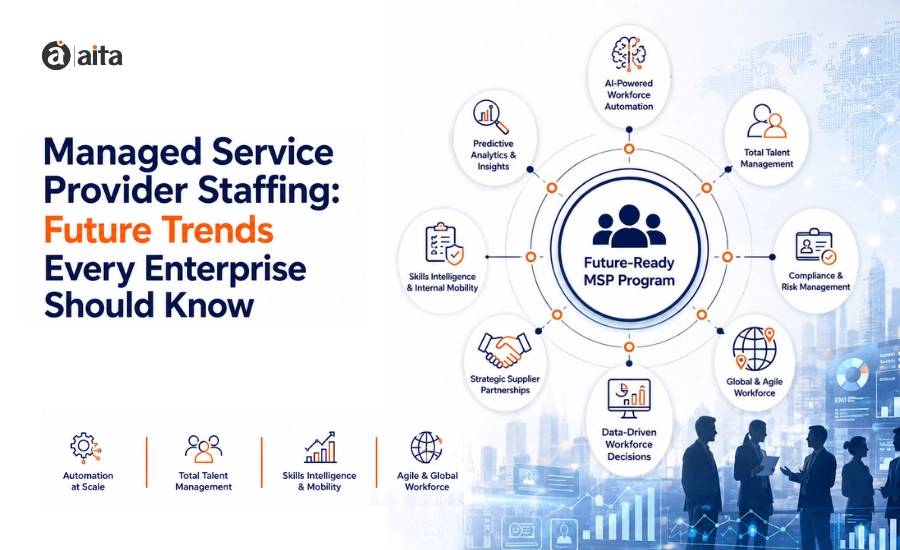
Managed service provider staffing has quietly become one of the most consequential decisions an enterprise makes about its contingent workforce, and the programs that looked cutting-edge five years ago are starting to show their age. The MSP model itself isn’t going anywhere the core value of centralized supplier management, rate discipline, and compliance oversight is as relevant as ever. What’s changing is what enterprises expect that management layer to deliver actually, and the gap between forward-looking programs and stagnant ones is widening faster than most procurement teams have noticed.
We’ve watched enough MSP programs evolve, stall, or get rebuilt from scratch to recognize the pattern. The organizations getting ahead aren’t necessarily spending more. They’re paying closer attention to where the model is heading and adjusting their expectations of a program before the gap between “adequate” and “outdated” becomes a real competitive disadvantage.
Where Managed Service Provider Staffing Started and Where It's Going
The original case for an MSP was straightforward: too many suppliers, too little visibility, and rates that varied wildly depending on who happened to answer the phone first. Centralizing that under one program with a rate card, standardized requisitions, and consolidated reporting solved a real, immediate problem for enterprises managing contingent labor across multiple business units.
That foundational value hasn’t disappeared. But the bar has moved. Enterprises running large contingent workforces now expect an MSP program to do more than enforce rate discipline and track compliance they expect it to actively inform workforce strategy, adapt to hybrid and distributed teams, and integrate with the broader talent ecosystem instead of operating as a siloed procurement function bolted onto HR.
Workforce Automation Is Reshaping Program Expectations
Workforce automation has moved well past being a nice-to-have feature buried in an MSP’s technology stack. It’s increasingly the baseline enterprises expect before they’ll even consider a program mature.
Automated Requisition Routing and Approval
Manual requisition routing, where a hiring manager submits a request that then bounces through several approval layers via email is quickly becoming the exception rather than the norm in well-run programs. Automated routing that applies pre-set approval rules based on role, budget, and department has cut meaningful time out of the front end of the hiring process, and enterprises are starting to treat this as table stakes rather than a differentiator.
Predictive Analytics for Workforce Planning
The more interesting shift is in how automation is being used proactively rather than reactively. Instead of simply reporting on what already happened spend by supplier, fill rate by department modern MSP platforms increasingly surface predictive signals: which roles are likely to see turnover based on historical patterns, where supplier performance is trending downward before it becomes a visible problem, and which departments are quietly building up unmanaged spend outside the program.
This kind of forward-looking visibility changes the conversation between procurement and business units. Instead of explaining after the fact why costs ran over budget, workforce planning teams can flag the trend early enough to do something about it actually.
Automated Compliance Monitoring
Compliance tracking has followed a similar trajectory to what’s happened across healthcare and other regulated staffing categories automated systems now flag expiring certifications, missing documentation, or classification risk continuously rather than during periodic manual audits. For enterprises operating across multiple states or countries, where compliance requirements vary significantly by jurisdiction, this kind of continuous monitoring has become close to essential rather than optional.
Enterprise Staffing Is Becoming More Fragmented and More Integrated at the Same Time
This sounds contradictory, but it’s an accurate description of where enterprise staffing is headed. Workforces are fragmenting across more categories: full-time employees, contractors, freelancers, statement-of-work vendors, and increasingly workers sourced through talent marketplaces or direct sourcing programs. At the same time, enterprises want all of that fragmented activity managed through a single, integrated view rather than a patchwork of disconnected systems.
The Rise of Total Talent Management
Total talent management, the practice of managing all categories of labor, not just traditional contingent staffing, under one strategic framework, has moved from a niche concept to something large enterprises are actively building toward. This means an MSP program increasingly needs visibility into full-time hiring trends, not just contract labor, to give workforce planners an accurate picture of where the organization’s actual talent gaps are and which category of labor makes the most sense to fill them.
Direct Sourcing as a Complement to Traditional Staffing
More enterprises are building direct sourcing programs maintaining their own curated talent pools of pre-vetted contractors and former employees as a complement to traditional supplier-based contingent staffing. A well-integrated MSP program now needs to manage both channels cohesively, applying the same rate discipline and compliance standards to direct-sourced talent as it does to supplier-placed talent, rather than letting direct sourcing become an ungoverned side channel.
Multi-Country Program Consolidation
Global enterprises are increasingly consolidating MSP programs that used to run independently by region into unified global structures, even while allowing for local compliance and market-specific rate variation. This gives leadership a genuine global view of contingent labor spend and risk, something that was nearly impossible when regional programs operated as separate silos with different reporting standards.
What This Means for Supplier Relationships
As MSP programs get more sophisticated, the relationship between the program and its supplier base is shifting too, and enterprises that don’t adapt their supplier strategy risk falling behind on both cost and candidate quality.
Where MSP Programs Are Headed
Traditional MSP
- Reactive spend reporting
- Historical compliance audits
- Broad, transactional supplier lists
Next-Generation MSP
- Predictive workforce analytics
- Continuous compliance monitoring
- Fewer, deeper strategic suppliers
Traditional MSP
- Siloed regional programs
- Contract labor only
- Candidate experience an afterthought
Next-Generation MSP
- Consolidated global programs
- Total talent management
- Candidate experience actively measured
Fewer, Deeper Supplier Relationships
The trend among leading enterprise programs is toward a smaller number of strategically selected suppliers who receive more volume and more visibility into upcoming hiring needs rather than a sprawling supplier list where every agency gets an equal, thin slice of opportunity. Suppliers who are treated as genuine partners given real forecasting data and consistent, meaningful volume tend to prioritize a program’s requisitions and invest more in candidate quality than those competing in a crowded, transactional pool.
Supplier Performance Data Driving Real Consequences
Scorecards have existed in MSP programs for years, but historically many of them were tracked without much operational consequence. That’s changing. Enterprises are increasingly using supplier performance data to actively reallocate volume, adjust rate tiers, and in some cases exit underperforming relationships entirely rather than letting mediocre suppliers continue receiving requisitions out of habit or inertia.
The Growing Role of Candidate Experience in Program Design
Enterprise MSP programs have historically been designed around the company’s needs cost control, compliance, reporting with candidate experience treated as a secondary consideration at best. That’s shifting, particularly in tight labor markets for specialized skills, where candidates have real choice about which opportunities they pursue.
Programs that create friction for candidates slow scheduling, unclear communication about where they stand in the process, generic and impersonal interactions lose strong talent to competitors with a smoother process, even when the underlying role and compensation are comparable. This mirrors a pattern we’ve seen play out clearly in specialized hiring categories where speed and candidate experience genuinely determine outcomes; in our piece on how AI is improving hiring speed and compliance in healthcare recruitment, the same tension between moving fast and keeping the process personal shows up clearly, and the lesson applies just as directly to large-scale enterprise staffing programs.
Forward-looking MSP programs are starting to track candidate experience metrics alongside traditional cost and compliance data time from application to first response, communication consistency across suppliers, and candidate satisfaction where it’s measured. This reflects a recognition that a program optimized purely for cost and compliance, while ignoring the experience of the people actually going through it, will eventually struggle to attract the talent the enterprise needs most.
AITACS Staffing
Ready to close your talent gap?
Get pre-vetted specialists deployed in 3–10 days. No overhead, no risk — just the right talent, exactly when you need it.
Contact Us
Free consultation · No commitment
What Slows Programs Down From Adapting
Understanding these trends is one thing. Actually, evolving a program to reflect them is harder, and a few recurring obstacles show up across enterprises trying to modernize.
Legacy technology contracts locking programs into outdated platforms. Many enterprises are running MSP programs on technology chosen years ago, with contract terms that make switching costly or operationally disruptive in the near term. This doesn’t mean an immediate platform change is the answer, but it does mean enterprises should understand what their current technology can and can’t support before assuming a strategic shift is even feasible within the existing contract.
Internal stakeholders measuring success by different standards. Procurement teams often prioritize cost control above all else, while business unit leaders care more about fill speed and candidate quality, and HR is focused on compliance and total workforce visibility. Without alignment on what “success” actually means across these groups, a program can improve by one measure while stakeholders elsewhere perceive it as stagnant or even worse.
Data spread across disconnected systems. Predictive analytics and total talent visibility both depend on clean, centralized data. Enterprises where contingent labor data sits in one system, full-time hiring data sits in an entirely separate HRIS, and direct sourcing activity isn’t tracked centrally at all will struggle to get meaningful predictive insight no matter how advanced the analytics layer claims to be. Data consolidation is often the glamorous prerequisite that has to happen before any of the more visible improvements become possible.
Underestimating the change management involved. Moving to a more consolidated, automated program changes how hiring managers, suppliers, and internal teams interact with the process day to day. Programs that treat this purely as a technology rollout, without investing in training and clear communication about why the change is happening, tend to see slower adoption and more resistance than the technology itself would predict.
Practical Steps for Enterprises Preparing for What's Next
None of these shifts require an enterprise to overhaul its entire program overnight, but a few deliberate steps position an organization to adapt as the model continues to evolve.
Audit What’s Actually Being Measured Today
Many enterprise programs report extensively on cost and fill rate but have very little visibility into predictive indicators, candidate experience, or how direct-sourced talent compares to supplier-placed talent. Understanding what’s currently being tracked and what’s missing is the starting point for deciding where a program needs to evolve.
Evaluate Whether the Supplier Base Matches Strategic Priorities
A supplier list built five or ten years ago may not reflect where the organization’s talent needs actually sit today. Reviewing supplier performance against current priorities, rather than assuming the existing list is still optimal, often reveals opportunities to consolidate toward stronger, more strategic relationships.
Assess Readiness for Total Talent Visibility
Even if full total talent management isn’t a near-term goal, enterprises benefit from understanding how much visibility they currently have into full-time hiring alongside contingent labor. Identifying and closing that gap gradually makes an eventual move toward integrated workforce planning far less disruptive when the organization is ready for it.
Bringing It Together
Managed service provider staffing isn’t being replaced by anything the fundamental value of centralized oversight, rate discipline, and compliance management remains as important as it’s ever been. What’s changing is the sophistication enterprises expect from that oversight: predictive rather than purely historical reporting, integration across increasingly fragmented labor categories, deeper and more strategic supplier relationships, and a genuine accounting for candidate experience rather than treating it as someone else’s problem.
Enterprises that treat their MSP program as a static, “set it and forget it” function are likely to find themselves behind competitors who are actively evolving their approach to workforce automation, supplier strategy, and total talent visibility. The organizations staying ahead aren’t necessarily the ones with the biggest budgets; they’re the ones paying attention to where the model is headed and adjusting deliberately rather than reactively.
If your organization is evaluating whether its current MSP program is built for where enterprise staffing is headed, or you’re weighing what a next-generation program should actually include, it’s worth a conversation with a partner who’s tracking these shifts closely. Our team at AITA Consulting Services works with enterprises through our MSP/VMS staffing services to build programs that combine the rate discipline and compliance rigor of a traditional MSP with the forward-looking workforce automation and candidate experience focus that enterprise staffing increasingly demands. Reach out to talk through what a future-ready program could look like for your organization.
Frequently Asked Questions
What is managed service provider staffing?
Managed service provider staffing refers to a program management model where a dedicated provider oversees an enterprise's contingent workforce, including supplier management, rate discipline, compliance oversight, and consolidated reporting across the organization.
How is workforce automation changing MSP programs?
Workforce automation is shifting MSP programs from reactive reporting toward predictive analytics, automated requisition routing, and continuous compliance monitoring, allowing enterprises to identify workforce risks and trends before they become costly problems.
What is total talent management in enterprise staffing?
Total talent management is a strategic approach that manages all categories of labour full-time employees, contractors, freelancers, and direct-sourced talent under one integrated framework rather than treating each category separately.
Why are enterprises consolidating supplier relationships in MSP programs?
Enterprises are moving toward fewer, deeper supplier relationships because strategic suppliers who receive consistent volume and forecasting data tend to prioritize requisitions and deliver stronger candidate quality than a large, transactional supplier list.
Does candidate experience matter in enterprise MSP programs?
Yes. In competitive labor markets, candidates have real choice, and MSP programs with slow scheduling or inconsistent communication lose strong talent to competitors with a smoother process, even when compensation is comparable.
Categories
MSP/VMS Staffing
Let’s Build Your Workforce
Streamline hiring with AITACS MSP/VMS staffing solutions. Access pre-screened, interview-ready talent, reduce time-to-hire, improve vendor management, and scale your workforce with confidence.
Get Started