Healthcare Recruitment: How AI Improves Hiring Speed and Compliance
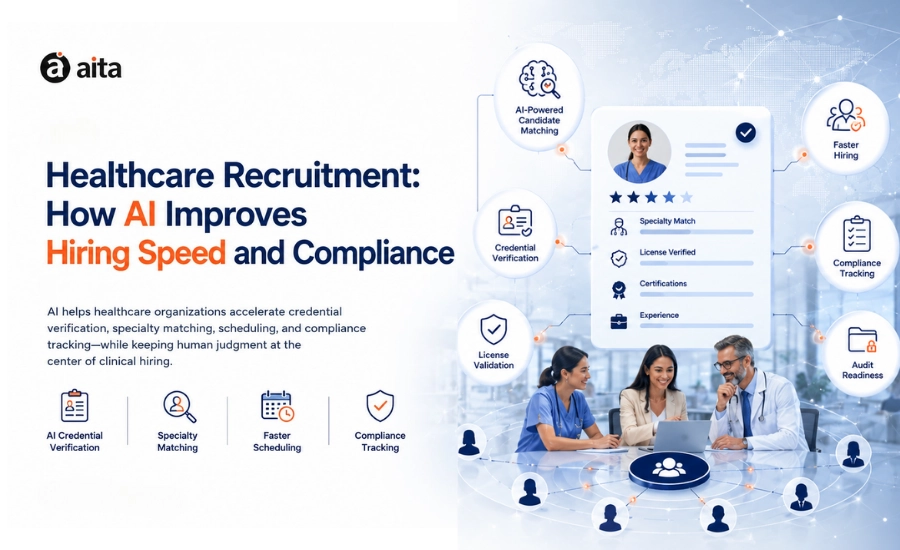
Healthcare recruitment runs on a tighter margin for error than almost any other staffing category. A slow hiring process doesn’t just mean an empty seat on an org chart it means a unit running short-staffed, a clinic turning away patients, or a hospital leaning on expensive travel contracts to cover a gap that shouldn’t have existed for as long as it did. At the same time, every credential, license, and background check has to be verified correctly, because the cost of getting compliance wrong in a clinical setting isn’t hypothetical.
We’ve worked with healthcare organizations juggling both pressures at once hire fast, hire clean. For years, those two goals pulled against each other. Speeding up screening usually meant cutting corners somewhere, and thorough compliance checks took time nobody had to spare. What’s changed recently is that AI healthcare hiring tools have started closing that gap, not by replacing the judgment clinical hiring requires, but by handling the repetitive verification work that used to slow everything down.
Why Healthcare Recruitment Carries Unique Pressure
Most industries can absorb a slow hire. Healthcare generally can’t, and the reasons go beyond simple staffing math.
The Cost of an Open Position Compounds Daily
An unfilled nursing role or a vacant physician seat doesn’t just sit quietly on a requisition list. It shows up as overtime for the staff covering the gap, as patient load stretched thinner than it should be, and eventually as burnout that pushes other staff toward leaving too. Every week a critical clinical role stays open, the pressure on the rest of the team increases, which makes the next departure more likely rather than less.
Compliance Isn’t Optional or Flexible
Every clinical hire needs verified licensures, often across multiple states for organizations operating in more than one region. Background checks, malpractice history, immunization records, and specialty certifications all need to be confirmed before someone touches a patient, and none of that can be shortcut without real legal and safety exposure. A hiring process that moves fast by skipping steps isn’t actually faster it’s just deferring the risk to a worse moment.
The Talent Pool Is Genuinely Tight
Certain specialties ICU nursing, certain physician sub-specialties, skilled pharmacy roles have a real shortage of qualified candidates relative to open positions. When the pool is already tight, a slow or clunky hiring process pushes strong candidates toward whichever organization gets back to them first with a clear next step. Healthcare recruitment often loses good candidates not because the offer was worse, but because someone else moved faster.
Where AI Genuinely Speeds Up Healthcare Hiring
AI healthcare hiring tools work best when they’re applied to the parts of the process that are repetitive, high-volume, and rule-base not the parts that require clinical judgment about who’s actually the right fit for a unit or team.
Credential Verification at Scale
Credential verification used to mean a recruiter manually confirming license status, checking for disciplinary actions, and cross-referencing certifications across multiple state and federal databases a process that could take days per candidate when done by hand. Automated verification tools now check licensures status, NPI records, sanctions lists, and certification validity in a fraction of that time, flagging discrepancies for human review rather than requiring a person to manually search every database for every candidate.
This matters more than it might seem at first glance. A recruiter who used to spend an entire afternoon verifying five candidates can now review flagged exceptions on twenty, spending their time on the cases that actually need judgment instead of the ones that are simply confirming a clean record.
Resume and Credential Matching for Specialty Roles
Healthcare roles often require highly specific combinations of licensure, certification, and clinical experience a med-surg nurse with a particular EMR system background, a pharmacist with a specific compounding certification. Matching software can scan candidate profiles against these specific requirements far faster than manual resume review, surfacing qualified candidates that a keyword search in a traditional applicant tracking system might miss entirely because the terminology didn’t match exactly.
Scheduling Across Complex Clinical Calendars
Healthcare interviews often need to work around clinical shifts, not standard nine-to-five availability. Automated scheduling tools that account for shift patterns and coordinate across multiple interviewers a nurse manager, a department director, sometimes a peer interviewer have cut meaningful time out of a process that used to involve extended phone tag before an interview could even get on the calendar.
Onboarding Documentation and Compliance Tracking
Beyond the initial hire, AI-assisted systems can track certification expiration dates, flag upcoming license renewals, and manage the documentation trail that healthcare compliance requires on an ongoing basis. This turns compliance from a periodic scramble into something monitored continuously, which matters enormously during audits or accreditation reviews.
Where Human Judgment Still Has to Lead
None of this automation replaces the clinical and interpersonal judgment that determines whether a candidate is actually right for a role, a unit, and a patient population.
AI Handles
- Credential and license verification
- Sanctions and background database checks
- Specialty resume and skill matching
- Interview scheduling across shifts
- Certification expiration tracking
- Routine status update messages
- Ongoing compliance documentation
Humans Lead
- Assessing clinical judgment and bedside manner
- Evaluating unit and team culture fit
- Reviewing flagged credential exceptions
- Compensation and relocation conversations
- Handling sensitive candidate situations
- Final hiring decisions
- Building candidate relationships
Assessing Clinical Judgment and Bedside Manner
No algorithm can evaluate how a nurse will handle a difficult family conversation, how a physician communicates a hard diagnosis, or how someone performs under the specific pressure of a busy emergency department. These are read through structured interviews, reference checks with former supervisors, and sometimes clinical simulation exercises all of which require experienced healthcare hiring professionals, not software.
Evaluating Team and Unit Fit
A candidate can be technically excellent and still be a poor fit for a specific unit’s culture, pace, or leadership style. An ICU that runs lean and fast needs a different temperament than a slower-paced outpatient clinic, even if both roles technically require the same certifications. Recognizing this kind of fit takes a recruiter or hiring manager who understands the specific team, not just the job description.
Navigating Sensitive Conversations
Compensation negotiations, relocation discussions, and conversations about why a candidate left a previous clinical role all require the kind of nuanced, empathetic communication that automation shouldn’t touch. A candidate weighing a move that affects their family and career trajectory deserves a real conversation with someone who can answer honest questions, not a templated message.
This mirrors a broader pattern we’ve seen across professional hiring generally: the technical and interpersonal sides of recruitment both matter, and neither one should be sacrificed for the other. We explored this balance in more depth in our piece on why soft skills matter more than ever in professional recruitment, where the same principle holds true automation handles volume and consistency, but the human evaluation of fit and communication style still determines whether a hire actually works out.
AITACS Staffing
Ready to close your talent gap?
Get pre-vetted specialists deployed in 3–10 days. No overhead, no risk — just the right talent, exactly when you need it.
Contact Us
Free consultation · No commitment
Building a Compliant, Fast Healthcare Hiring Process
Organizations that get this right tend to follow a similar structure: automate the verification and logistics work, and protect the time saved for the parts of hiring that genuinely need a person.
Standardize Verification Before Adding Speed
Before layering automated tools onto an existing process, it helps to have clearly defined verification standards what counts as a disqualifying gap, what triggers manual review, how discrepancies get escalated. Tools applied to an undefined process just automate the inconsistency that was already there.
Keep a Compliance Officer or Credentialing Specialist in the Loop
Automated flags are only useful if someone qualified reviews them promptly. Organizations that let automated verification alerts sit unrelieved for days lose most of the speed advantage the tooling was supposed to provide. The system works best as a triage layer, not a replacement for the credentialing specialist’s judgment on edge cases.
Audit the Matching Criteria Regularly
Just as with any AI-assisted screening tool, credential and resume matching software can develop blind spots if the criteria it’s working from go stale a certification requirement that’s no longer accurate, or a matching algorithm that consistently misses qualified candidates because of how their experience is documented. Reviewing this periodically prevents strong candidates from silently falling out of the pipeline.
Protect Recruiter Time for Candidate Relationships
The entire point of automating verification and scheduling is to free up recruiter time for the conversations that actually move a hire forward answering a candidate’s questions honestly, addressing hesitations about relocation or shift structure, and making sure the offer process feels personal rather than transactional. If automation frees up time that just gets absorbed into more requisitions per recruiter, the candidate experience gains nothing.
What This Looks Like for Multi-State and Multi-Facility Organizations
The complexity multiplies for healthcare systems operating across multiple states or facility types, since licensure requirements, background check standards, and even certification recognition can vary by jurisdiction. A credential that clears easily in one state might require additional verification steps in another, and organizations managing dozens of open clinical roles across different locations need consistency in how those differences get handled.
This is where centralized, technology-supported credentialing tends to outperform a patchwork of facility-by-facility processes. A unified system that tracks jurisdiction-specific requirements and applies them consistently reduces the risk of a compliance gap slipping through simply because one location’s process wasn’t as rigorous as another’s. For organizations without the internal infrastructure to build this kind of system themselves, partnering with a staffing provider that already has it in place closes the gap far faster than building it from scratch.
Common Pitfalls Worth Avoiding
A few recurring mistakes show up when healthcare organizations adopt AI-assisted hiring tools without thinking through the process changes that need to happen alongside them.
Treating automated screening as a final decision rather than a first pass. Verification software is excellent at flagging discrepancies, but the decision about whether a flagged item disqualifies a candidate still belongs to a credentialing professional who understands the context. Automated rejection without human review risks screening out qualified candidates over minor, explainable gaps.
Rolling out new tools without training the team using them. A credentialing specialist who doesn’t fully understand how the matching or verification tool works will either over-trust it or ignore it entirely, both of which undermine the point of adopting it. Training time upfront pays for itself quickly.
Failing to plan for edge cases. International credentials, career gaps for legitimate reasons like military service or caregiving, and non-traditional career paths into healthcare all require judgment that generic verification rules won’t handle well by default. Building a clear escalation path for these cases prevents good candidates from getting lost in an automated process that wasn’t designed with their situation in mind.
Losing sight of candidate experience during the transition. Candidates notice when a hiring process feels impersonal, even if it’s faster. Healthcare candidates in particular, who are often being recruited by multiple organizations simultaneously, respond to a process that feels efficient and respectful of their time not one that feels like they’re being processed by a system rather than considered by people.
Bringing It Together
Healthcare recruitment doesn’t have to choose between speed and compliance, even though it’s felt that way for a long time. AI healthcare hiring tools have made real progress on the repetitive, high-volume parts of the process credential verification, specialty matching, scheduling across clinical calendars freeing up recruiters and hiring managers to spend their time where clinical and interpersonal judgment genuinely matter.
Organizations that get this balance right aren’t the ones automating everything indiscriminately. They’re the ones being deliberate about which parts of hiring benefit from technology and which parts still need a person paying close attention particularly around credential verification, where the margin for error is thinnest.
If your organization is trying to move faster on healthcare hiring without loosening compliance standards, it’s worth a conversation with a staffing partner who’s built that balance into their process already. Our team at AITA Consulting Services works with healthcare organizations through our pharma and healthcare staffing services to combine efficient credential verification with the clinical hiring judgment that keeps both patients and compliance teams protected. Reach out to talk through what a faster, cleaner hiring process could look like for your organization.
Frequently Asked Questions
How does AI improve healthcare recruitment?
AI improves healthcare recruitment by automating high-volume, rule-based tasks like credential verification, license and sanctions checks, specialty resume matching, and interview scheduling, freeing recruiters to focus on clinical judgment and candidate relationships.
Can AI replace credential verification staff in healthcare hiring?
No. AI tools can verify licenses, certifications, and sanctions records at scale, but flagged discrepancies and edge cases still require review by a qualified credentialing specialist who understands the full context.
Why is healthcare recruitment slower than other industries?
Healthcare recruitment involves mandatory licensure verification, background checks, and specialty credentialing that can't be skipped, combined with a genuinely tight talent pool in certain specialties, which extends time-to-fill compared to less regulated industries.
What should healthcare organizations automate first in hiring?
Credential verification and interview scheduling are typically the best starting points, since they are repetitive, rule-based, and time-consuming when done manually, while decisions about clinical fit should remain with experienced hiring staff.
How do multi-state healthcare systems manage credentialing consistency?
Multi-state healthcare systems typically rely on centralized, technology-supported credentialing platforms that track jurisdiction-specific licensure and background check requirements, reducing the risk of inconsistent compliance standards across locations.
Categories
Pharma & Healthcare Staffing
Let’s Build Your Team
Connect with AITACS to find pre-vetted healthcare and pharma professionals, reduce hiring time, and ensure uninterrupted patient care.
Get Started