IT Staffing Services: Contract or Permanent Hiring: Which Is Better?
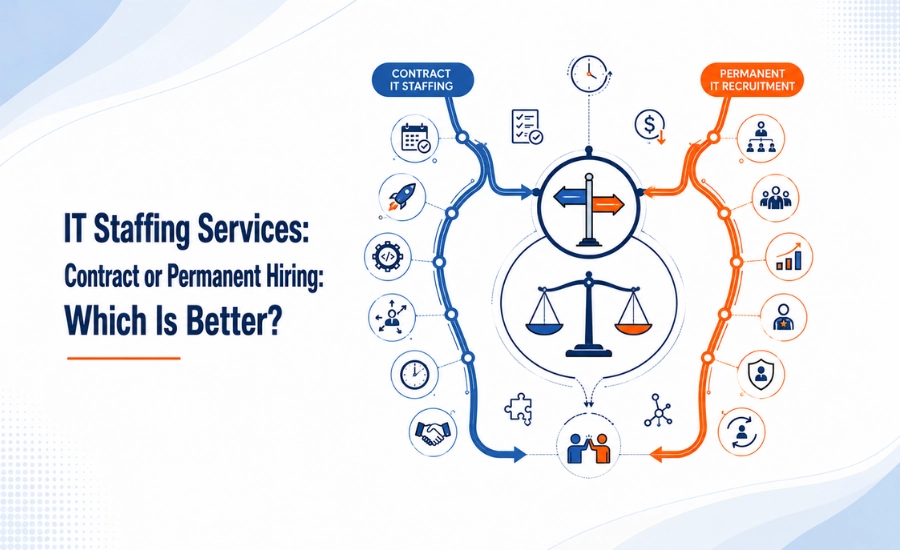
IT staffing services exist precisely because this question doesn’t have a one-size-fits-all answer. A hiring manager staring down a critical system migration with a six-month deadline needs something entirely different from a CTO trying to build out a core engineering team for the next five years. Both are legitimate hiring problems. Both get solved through staffing. But the path that gets each of them to a good outcome looks nothing alike.
We’ve placed candidates on both sides of this equation long enough to know the debate isn’t really “contract versus permanent” as competing philosophies. It’s a matching exercise matching the shape of the work to the shape of the commitment. Companies that get this wrong usually aren’t making a bad hire; they’re making the right hire for the wrong hiring model.
What Contract IT Staffing Actually Solves
Contract IT staffing exists for work that has a defined start and end, even if that end date isn’t perfectly clear on day one. Think system implementations, platform migrations, compliance-driven projects with regulatory deadlines, or a temporary spike in workload that doesn’t justify a permanent headcount increase.
The appeal is straightforward: speed and flexibility. A contract hire can typically start within days or a couple of weeks rather than the six-to-ten week cycle a permanent search often takes, especially for specialized technical roles. There’s no long-term compensation commitment, no severance calculus if the project wraps early, and no awkward conversation six months later about whether the role is still needed.
Where Contract Hiring Shows Its Strengths
Specialized, short-term technical expertise. Not every company needs a full-time Kubernetes architect or a dedicated data migration specialist. If the need is real but temporary, bringing in a contractor with deep, specific expertise is far more cost-effective than hiring permanently and then searching enough ongoing work to justify the role.
Budget flexibility across fiscal years. Contract labor is typically an operating expense rather than a headcount commitment, which gives finance teams more room to scale up or down as project budgets shift. This matters more than people realize when a company is managing multiple concurrent initiatives with different funding sources.
Testing a role before committing to it. Sometimes, a company isn’t fully sure whether a position needs to exist permanently. A contract-to-hire arrangement lets both sides evaluate fit the company sees the work in practice, and the candidate gets a real look at the team and culture before signing on long-term.
Where Contract Hiring Falls Short
Contract arrangements aren’t free of trade-offs. Contractors typically bill at a premium hourly or day rate compared to the equivalent salaried position, so short projects are efficient but extended ones can quietly cost more than a permanent hire would have. There’s also a knowledge continuity problem: when a contractor’s engagement ends, so does their institutional knowledge, unless documentation and hand off are treated as seriously as the technical work itself. And contractors, understandably, don’t always invest emotionally in company culture or long-term strategy the way a permanent employee might their focus is the deliverable in front of them, which is exactly what they were hired to prioritize.
What Permanent IT Recruitment Is Built For
Permanent IT recruitment makes sense when the work itself is ongoing and the value of institutional knowledge compounds over time. A core platform owner, a security lead responsible for long-term architecture decisions, or a team lead managing people as much as technology these are roles where continuity isn’t a nice-to-have, it’s the point.
The Case for Building In-House
Institutional knowledge that doesn’t walk out the door. A permanent engineer who’s spent three years inside a codebase understands not just how something was built, but why certain decisions were made and what’s been tried before. That context is genuinely hard to replicate with rotating contract talent, no matter how skilled individual contractor is.
Cultural investment and team cohesion. Permanent employees have a stake in how the team functions over the long run, not just how a single project turns out. That shows up in mentorship, in cross-team collaboration, and in the kind of proactive problem-spotting that only comes from someone who plans to be around when the consequences of today’s decisions show up next quarter.
Lower cost over long time horizons. For roles that will exist indefinitely, the total cost of a salaried employee even accounting for benefits, taxes, and overhead is usually lower than paying a premium contract rate for the same role year after year. The math flips when the horizon is genuinely short-term, but for a role your organization will need in three years and five years, permanent hiring tends to win.
Where Permanent Hiring Falls Short
The trade offs run the other direction here. Permanent searches take longer, particularly for niche or senior technical roles where the qualified candidate pool is small and competitive. Compensation commitments are harder to unwind if business needs shift, and a bad permanent hire is considerably more expensive and disruptive to correct than a bad contract placement. There’s also less flexibility to scale the team down quickly if a project gets cancelled or budgets tighten unexpectedly.
How to Actually Decide Between Them
Most companies don’t need a rigid policy that says “we only hire contract” or “we only hire permanent.” The better approach is evaluating each open role against a consistent set of questions.
Start With the Shape of the Work
Ask whether the role exists because of a project with a defined endpoint or because of an ongoing function the business will need indefinitely. A migration to a new ERP system has a finish line. Maintaining and evolving that ERP system afterward does not. The former points toward contract IT staffing; the latter points toward permanent IT recruitment.
Weigh the Knowledge Retention Cost
Some roles carry institutional knowledge that’s expensive to lose. If a position touches core architecture decisions, security posture, or long-term technical strategy, the cost of that knowledge walking out the door at the end of an engagement should weigh heavily in the decision even if the immediate task looks temporary.
Factor In Time-to-Fill Pressure
If a critical gap needs to be filled in weeks rather than months, contract staffing is almost always the faster path, particularly for specialized skill sets. Permanent searches for senior technical talent routinely take six to twelve weeks or longer once you factor in interview rounds, reference checks, and negotiation. If the business genuinely can’t wait that long, that reality should shape the decision as much as any theoretical preference for permanent hires.
AITACS Staffing
Ready to close your talent gap?
Get pre-vetted specialists deployed in 3–10 days. No overhead, no risk — just the right talent, exactly when you need it.
Contact Us
Free consultation · No commitment
Consider the Contract-to-Hire Middle Ground
When there’s genuine uncertainty about whether a role should be permanent, contract-to-hire arrangements offer a practical bridge. The company gets to see real performance before committing to a long-term salary and benefits package, and the candidate gets to evaluate whether the role and team are actually a fit. This works best for roles where the immediate need is clear but the long-term staffing model isn’t.
Where Technology Fits Into the Decision
The volume and speed of today’s hiring process has changed how companies evaluate both contract and permanent IT staffing services. Screening tools can rapidly match technical skill sets to project requirements, and scheduling automation has cut a meaningful chunk of time out of the interview process for both hiring paths. But the decision itself whether a role should be filled on a contract or permanent basis still comes down to human judgment about the shape of the work and the organization’s long-term needs. We covered this balance between automation and human decision-making in more depth in our piece on AI in talent acquisition and keeping hiring processes personal, where the same principle applies: tools speed up the process, but they don’t replace the strategic call.
A Practical Framework for Mixed Teams
Speed matters for the next open req, but the companies that consistently win cybersecurity talent treat hiring as an ongoing relationship-building exercise, not a series of one-off fire drills.
That means staying in touch with strong candidates even when there’s no current opening, so the next req doesn’t start from zero. It means tracking which sourcing channels actually produce hires versus which just produce applicant volume. And it means revisiting job requirements regularly since the tools and frameworks security teams rely on shift quickly enough that a two-year-old job description can already be out of date.
Organizations that pair this long-term approach with a trusted staffing partner tend to fill roles faster and retain hires longer simply because the candidates entering the pipeline were never randomly sourced they were already a fit for the kind of work and culture the team offers.
It also helps to loop in the security team itself when shaping hiring strategy, not just HR or talent acquisition. Analysts and engineers often know which certifications carry real weight in practice, which interview questions actually separate strong candidates from ones who interview well but struggle on the job, and which competitors are quietly poaching from the local talent pool. That frontline insight rarely makes it into a job description unless someone deliberately asks for it and it tends to make the difference between a hire who ramps up in weeks versus one who takes months to become fully productive.
Signs a Blended Model Might Fit Your Organization
Project workload fluctuates significantly across quarters, but core system maintenance remains constant
Specialized technical skills are needed periodically, not continuously
Budget cycles favor operating expense flexibility over fixed headcount growth
The organization is scaling and isn’t yet certain which roles will become permanent functions
Common Mistakes Companies Make With This Decision
A handful of patterns show up repeatedly when a contract-versus-permanent decision goes wrong, and almost none of them are about the candidates themselves.
Defaulting to permanent hiring out of habit. Some organizations treat permanent recruitment as the “serious” way to hire and contract staffing as a fallback for when they can’t fill a role fast enough. That mindset leads to permanent hires for genuinely temporary work, which creates an awkward conversation months later when the project wraps and the role no longer has a clear purpose.
Underestimating how long a permanent search will take. Teams under deadline pressure sometimes commit to a permanent search assuming it will move faster than it does, only to fall behind schedule and scramble for contract coverage anyway at which point they’re paying for both a stalled search and an urgent contract placement.
Treating contract talent as disposable rather than strategic. Contractors who are well-integrated into a team, given clear context, and treated as genuine collaborators tend to deliver stronger, more consistent work than those who are handed a ticket queue and left alone. The engagement model affects the outcome regardless of employment classification.
Not planning knowledge transfer from day one. Waiting until a contractor’s final week to think about documentation and handoff is too late. Building knowledge transfer into the engagement from the start shared documentation, pair programming with permanent staff, recorded architecture decisions protects the organization regardless of how the engagement ends.
Making the Call With Confidence
There’s no universal right answer to contract versus permanent IT recruitment, and any staffing partner who tells you otherwise is selling a template, not a strategy. The right call depends on the nature of the work, how much institutional knowledge the role carries, how quickly the position needs to be filled, and how confident the organization is in the role’s long-term shape.
What matters most is treating the decision deliberately, role by role, rather than defaulting to whatever hiring model was used last time. A company that builds this evaluation into its hiring process rather than treating every open role the same way ends up with a workforce that’s both cost-efficient and resilient to change.
If your team is weighing contract versus permanent for an upcoming role, or trying to build a longer-term staffing strategy that blends both, it’s worth a conversation with a partner who places both. Our team at AITA Consulting Services works across the full spectrum of IT staffing services, helping organizations match the right hiring model to the actual shape of the work not the other way around. Reach out to talk through what the right mix looks like for your team
Frequently Asked Questions
What's the main difference between contract and permanent IT staffing?
Contract IT staffing fills defined, project-based needs with a clear or eventual end date, while permanent IT recruitment fills ongoing roles where continuity, institutional knowledge, and long-term team investment matter most.
Is contract IT staffing more expensive than permanent hiring?
Contract roles typically bill at a premium hourly or day rate, making them cost-effective for short projects but potentially more expensive than a salaried employee over an extended, ongoing engagement.
What is contract-to-hire in IT staffing?
Contract-to-hire is an arrangement where a candidate starts as a contractor with the option to convert to a permanent employee after a trial period, letting both the company and candidate evaluate fit before committing long-term.
How long does permanent IT recruitment typically take?
Permanent searches for senior or specialized technical roles routinely take six to twelve weeks or longer, factoring in interview rounds, reference checks, and negotiation, compared to days or weeks for a contract placement.
Can a company use both contract and permanent IT staffing at the same time?
Yes. Many organizations use a blended workforce model, staffing core ongoing functions permanently while using contract talent for project surges, specialized short-term needs, and coverage gaps.
Categories
IT Staffing
Let’s Build Your Team
Scale your IT team faster than you thought possible. Connect with AITACS experts to find the right talent, reduce hiring time, and drive business growth with confidence.
Get Started