AI in Talent Acquisition: Smarter Hiring Without Losing the Human Touch
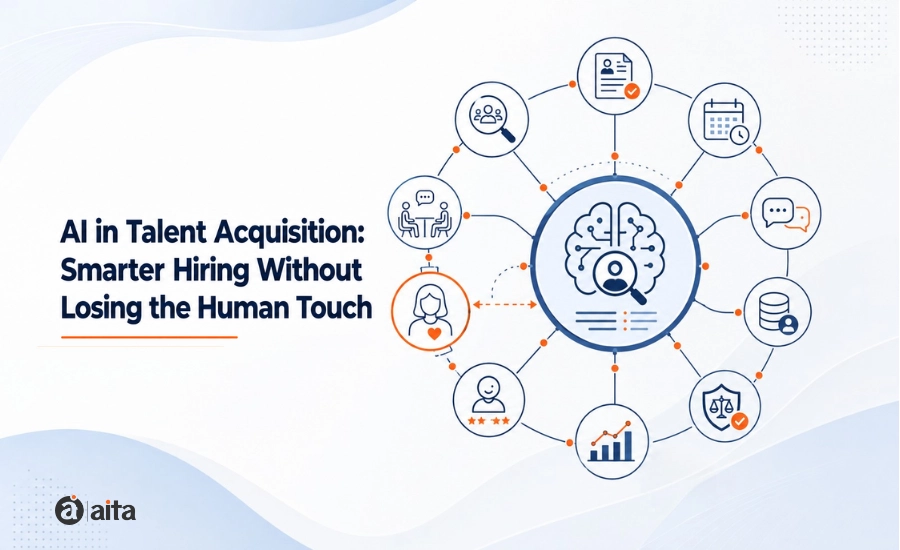
AI in talent acquisition has moved past the pilot-program phase. It’s now sitting inside applicant tracking systems, screening tools, and scheduling platforms that recruiters touch every single day, whether they realize it or not. The question most hiring leaders are actually wrestling with isn’t whether to use it that decision has largely been made for them by the tools already embedded in their stack. The real question is how to use it without turning the hiring process into something that feels cold, transactional, and easy for good candidates to walk away from.
We’ve watched staffing teams adopt these tools with wildly different results. Some cut their time-to-fill dramatically while candidates still describe the process as personal and well-communicated. Others automated their way into a pipeline that technically moves fast but quietly loses strong candidates who felt like they were talking to a wall. The difference almost never comes down to which software they bought. It comes down to where they drew the line between automation and human judgment.
Where AI Actually Helps in Hiring Today
Strip away the marketing language and AI recruiting tools generally do a handful of things well: they process volume, they spot patterns, and they remove some of the manual grunt work that used to eat entire afternoons. That’s genuinely useful. It’s just not the whole hiring process, and treating it like it is tends to backfire.
AITACS Staffing
Ready to close your talent gap?
Get pre-vetted specialists deployed in 3–10 days. No overhead, no risk — just the right talent, exactly when you need it.
Contact Us
Free consultation · No commitment
Resume Screening and Initial Matching
This is where most organizations start, and for good reason. Sorting through hundreds of applications for a single role by hand is slow and inconsistent two recruiters reviewing the same stack of resumes will flag different candidates depending on what caught their eye that day. AI hiring software applies consistent criteria across every application, surfacing candidates whose experience and skills actually match the role rather than relying on keyword luck or how a resume happens to be formatted.
The catch is that matching algorithms are only as good as the criteria they’re trained on. If a job description is vague or the historical hiring data reflects old biases, the tool will faithfully replicate those problems at scale instead of catching them. Screening software narrows a pool; it shouldn’t be trusted to make the final call on who’s worth talking to.
Scheduling and Communication Logistics
Coordinating interview times across multiple hiring managers, time zones, and candidate availability used to be one of the biggest hidden time drains in recruiting. Automated scheduling tools have quietly solved a genuinely annoying problem, and few candidates seem to mind an automated calendar link replacing three days of email back-and-forth.
Automated status updates fall into the same category telling a candidate their application was received, or that they’ve moved to the next round, doesn’t need a human typing it out each time. What does need a human touch is anything involving rejection, negotiation, or a candidate asking a specific question about the role. Automating those interactions is where companies start losing candidates who felt like a number.
Sourcing and Talent Pool Building
Recruitment automation has changed how sourcing teams identify passive candidates. Tools that scan professional networks and internal databases for people matching a skill profile can surface candidates a recruiter would never have found manually, especially for niche technical roles where the qualified pool is genuinely small. This is sourcing support, not a replacement for the outreach itself a templated message that’s obviously automated does more damage to a company’s employer brand than sending fewer, better-targeted messages by hand.
Where the Human Touch Still Wins
None of this means automation should stop at logistics. The interesting tension in AI in talent acquisition right now is figuring out which parts of the process actually benefit from a human being present, and which parts were only ever manual because there was no better option before.
Reading Between the Lines in an Interview
Software can score a resume against a job description, but it can’t gauge whether someone will thrive on a particular team, handle ambiguity well, or communicate clearly under pressure. Those signals show up in conversation in how someone answers a follow-up question they didn’t prepare for, or how they talk about a project that didn’t go well. Experienced recruiters develop an instinct for this over years of interviews, and no algorithm has matched it yet, despite plenty of vendors claiming otherwise with sentiment-analysis features layered onto video interviews.
Selling the Role and the Company
Top candidates, especially in competitive fields, are usually fielding more than one offer. The recruiter who can speak honestly about team dynamics, answer a pointed question about growth trajectory, or address a candidate’s specific hesitation is doing something automation genuinely cannot replicate. Candidates can tell the difference between a scripted pitch and someone who actually knows the hiring manager and the team culture.
Handling Sensitive Conversations
Rejections, salary negotiations, counteroffers, candidates withdrawing late in the process these moments define how a company is remembered, win or lose. A candidate who gets rejected by a form email is far less likely to reapply for a future role or refer someone else than one who gets a brief, genuine explanation from a person. Staffing firms that protect this part of the process, even as they automate everything around it, tend to build stronger long-term talent pipelines.
Building an AI-Assisted Hiring Process That Doesn't Feel Robotic
The organizations getting this right generally follow a similar pattern: automate the repetitive, high-volume steps and keep a person involved at every point where judgment or relationship-building actually matters.
Map the Process Before Adding Tools
Before layering AI hiring software onto an existing workflow, it helps to map out every step candidates go through, from application to offer, and mark which ones are purely administrative versus which ones involve real evaluation or relationship-building. Screening resumes, scheduling interviews, and sending status updates are administrative. Interviewing, negotiating, and closing are not. Tools bolted onto a process without this distinction tend to automate the wrong things.
Set Response-Time Standards, Not Just Automation Rules
A common mistake is assuming that faster automated responses automatically mean a better candidate experience. Speed matters, but so does substance. A same-day auto-reply that says nothing meaningful isn’t better than a slightly slower message from a recruiter that actually answers a candidate’s question. The goal should be fast and substantive, not fast instead of substantive.
Audit for Bias Regularly
AI recruiting tools trained on historical hiring data can inherit whatever patterns existed in that data, including patterns nobody intended to create. This isn’t a one-time setup task job requirements shift, candidate pools shift, and a tool that was fair when it launched can drift over time. Staffing teams that take this seriously build in regular audits of who’s getting screened out and why, rather than assuming the software is neutral by default.
Keep a Human in the Loop for Every Rejection
This one is simple and consistently overlooked: even when screening is automated, the actual rejection message a candidate receives should come from a process that a person has reviewed and approved, if not written directly. It costs very little time relative to the goodwill it preserves, particularly for candidates who made it past an initial screen and invested real time in the process.
Common Mistakes That Undermine Otherwise Good Tools
A lot of the frustration companies feel with AI hiring software isn’t really about the software. It’s about how it gets deployed.
Turning on every feature at once is one of the more common missteps. A team that rolls out automated screening, automated scheduling, and automated messaging simultaneously has no way to isolate what’s actually working versus what’s quietly driving candidates away. Phasing in one capability at a time, watching the metrics, and adjusting before adding the next one produces far better long-term results than a full-stack launch.
Letting the tool set the tone of communication is another. Default messaging templates that ship with most platforms tend to sound exactly like what they are generic and automated. Rewriting those templates to sound like an actual person on the recruiting team, even when the sending is automated, makes a measurable difference in how candidates describe their experience.
Ignoring candidate feedback about the process itself rounds out the list. Post-interview surveys and exit-of-pipeline feedback often surface friction points a scheduling tool that’s confusing on mobile, a screening question that felt irrelevant that never show up in a time-to-fill dashboard. Companies that treat this feedback as a regular input, rather than an afterthought, tend to catch problems before they show up as declined offers.
What This Looks Like in Practice for Growing Companies
Companies without a dedicated internal recruiting team often face a harder version of this balancing act. They don’t have the bandwidth to build custom screening criteria, audit hiring data for bias, or maintain the kind of high-touch candidate communication that protects the employer brand all while also trying to fill roles quickly enough to keep projects moving.
This is one of the reasons flexible staffing support has become more valuable rather than less as recruitment automation has matured. Having access to recruiters who already know how to blend AI-assisted sourcing and screening with genuine candidate relationships means a company doesn’t have to choose between speed and experience. Our Talent on Demand services are built around exactly this kind of flexibility giving companies scalable recruiting support that uses the right tools for volume and logistics while keeping real people responsible for the parts of hiring that actually determine whether an
Frequently Asked Questions
What does AI in talent acquisition actually do?
AI in talent acquisition typically handles high-volume, repetitive tasks such as resume screening, interview scheduling, candidate status updates, and sourcing pattern-matching — freeing recruiters to focus on interviewing, negotiating, and building candidate relationships.
Will AI recruiting tools replace human recruiters?
No. AI recruiting tools are effective at processing volume and spotting patterns, but they cannot replicate the judgment, empathy, and relationship-building that determine whether a strong candidate accepts an offer. The most effective hiring processes combine both.
What's the risk of relying too heavily on AI hiring software?
The main risks are inherited bias from historical hiring data, a candidate experience that feels impersonal, and losing strong candidates who disengage from an overly automated process. Regular audits and a human-reviewed rejection process help mitigate these risks.
How can a company measure whether its AI-assisted hiring process is working?
Beyond time-to-fill, companies should track offer acceptance rate, candidate satisfaction scores, and new-hire retention at six and twelve months. If speed improves while these other metrics decline, automation may be interfering with candidate experience.
What's the difference between recruitment automation and AI recruiting?
Recruitment automation generally refers to rule-based workflow tools like scheduling and status updates. AI recruiting refers to tools that use pattern recognition and machine learning, such as resume matching or sourcing algorithms. Many modern platforms combine both.
Categories
Talent On Demand
Let’s Build Your Workforce
Streamline hiring with AITACS Talent On Demand solutions. Access pre-screened, deployment-ready specialists, reduce hiring delays, and scale your workforce faster with flexible staffing support tailored to your business needs.
Get Started