Professional Staffing Services: The True Cost of a Bad Hire
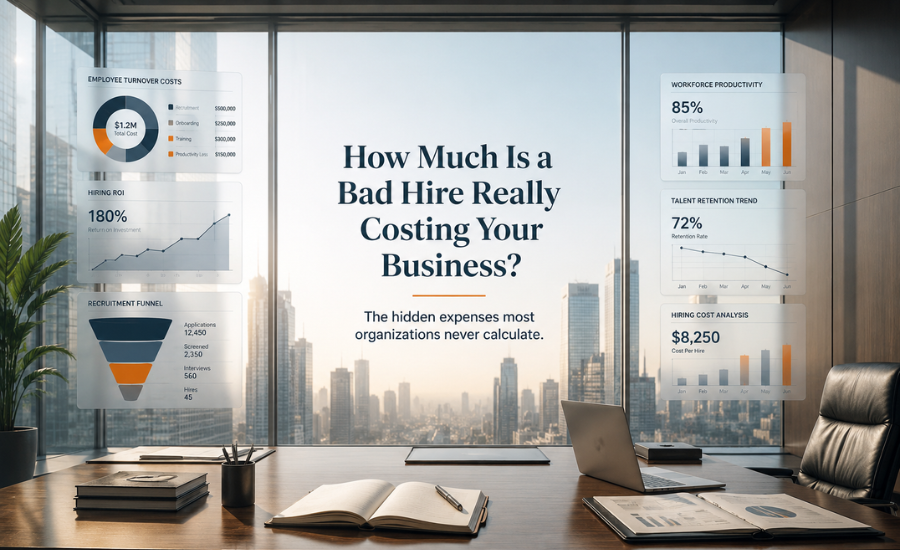
Every hiring manager has a story about the hire that looked perfect on paper and fell apart within months. That’s exactly why professional staffing services exist not as a convenience for busy HR teams but as a structural defense against a mistake that keeps costing money long after the offer letter is signed. A wrong hire rarely announces itself on day one. It shows up later, in missed deadlines, in a team that’s quietly frustrated, in a client relationship that never quite recovers.
Most companies underestimate what a bad hire actually costs because they only look at the number on the paycheck. The real damage runs much deeper, and once you start adding it up, the case for a disciplined, expert-led hiring process becomes hard to ignore.
What Counts as a “Bad Hire,” Really
A bad hire isn’t only someone who gets terminated for poor performance. It’s also the employee who technically meets expectations but never fits the team, the one who leaves within the first year, or the one whose skills gap wasn’t caught until a project was already behind schedule. Roughly three out of four employers admit to having made at least one hiring mistake, and most never go back to calculate what it actually cost them.
That’s the uncomfortable part. The financial damage from a hiring mistake is almost always underestimated because it’s scattered across departments, budgets, and timelines rather than showing up as one clean line item.
The Real Price Tag Behind a Bad Hire
The U.S. Department of Labor has long used a baseline figure suggesting that a bad hire costs at least 30% of that employee’s first-year salary. On a $75,000 role, that’s over $22,000 gone before you even factor in what else was lost. SHRM’s research pushes that number much higher once you account for the full replacement cycle recruiting, onboarding, lost productivity, and severance can push total costs to 50% or even 200% of annual salary, depending on seniority.
For a mid-level employee earning $85,000, that range translates to somewhere between $42,000 and $170,000. For a senior or executive hire, the number can climb past $400,000. These aren’t outlier estimates from a single source they show up consistently across SHRM benchmark data, Department of Labor guidance, and staffing industry research.
Direct Costs Are Just the Starting Point
A quality hire strategy isn’t about hiring faster it’s about hiring with more confidence at the point of offer. That confidence comes from three things most internal hiring processes struggle to sustain at scale: Internal teams can build all of this but it takes dedicated recruiting infrastructure most companies only need in bursts, which is precisely the gap professional staffing partners are built to fill.
Indirect Costs Are Where the Real Damage Happens
This is the part most budgets never capture. Managers dealing with an underperforming employee can lose close to a fifth of their own working time trying to course-correct the situation, according to research from Robert Half. That’s time not spent coaching high performers, planning strategy, or serving clients.
Then there’s team morale. A weak hire on a small team doesn’t just under perform individually their gaps get absorbed by everyone around them. Deadlines slip, resentment builds, and your best people start quietly wondering if they should be somewhere else. Gallup’s disengagement research has tied this kind of dynamic to measurable drops in both productivity and profitability at the business-unit level, not just for the one role in question.
AITACS Staffing
Ready to close your talent gap?
Get pre-vetted specialists deployed in 3–10 days. No overhead, no risk — just the right talent, exactly when you need it.
Contact Us
Free consultation · No commitment
How Employee Turnover Multiplies the Damage
A bad hire and employee turnover feed each other in a cycle that’s easy to underestimate. When someone doesn’t work out, you’re not just losing a salary you’re restarting an entire hiring process from scratch, and your cost-per-hire clock resets at full price. If that new hire leaves within the first year, which happens more often than most leadership teams want to admit, you’ve effectively paid twice for the same seat.
There’s a compounding effect that’s easy to miss, too. Turnover in one role often triggers turnover in adjacent roles. Employees who inherit a struggling colleague’s workload or who watch a hire fail because onboarding was rushed start to lose confidence in the process itself. Companies that have tightened their screening at the top of the funnel have seen first-year turnover drop by double digits, proof that the fix isn’t working harder after a bad hire, it’s preventing the bad hire from happening in the first place.
It’s also worth separating two different problems that get lumped together under “turnover.” Voluntary turnover a good employee leaving for a better offer is often a compensation or growth-path issue. Turnover tied to a bad hire is different: it’s a screening and fit issue, and it tends to cluster around the same failure points every time a rushed interview process, a job description that didn’t match the actual day-to-day work, or a manager who didn’t have time to onboard properly. Once you can tell those two categories apart, the fix for each one becomes much more obvious.
Recruitment ROI: A Better Way to Frame the Decision
Most hiring conversations focus on cost, the placement fee, the salary and the time-to-fill. Recruitment ROI frames the question: what’s the return on the investment you’re making in a person, not just the expense of finding them?
A strong ROI framework weighs the full cost of a hire (recruiting spend, onboarding, ramp-up time) against the value that hire generates once they’re productive revenue contribution, retained clients, projects delivered on time, knowledge transferred to the team. When you calculate it this way, a slightly higher recruiting fee for a properly vetted, well-matched candidate almost always looks cheap compared to the alternative.
This is where a lot of internal hiring processes fall short. Internal teams are often measured on time-to-fill, which creates pressure to close a role quickly rather than correctly. A staffing partner working under a different incentive structure one built around retention and long-term fit, not just a fast placement tends to produce a better recruitment ROI because the two goals are actually aligned.
Why Professional Staffing Services Reduce Bad-Hire Risk
This is precisely the problem professional staffing services are built to solve. A staffing partner with deep bench strength and structured vetting processes isn’t just filling a seat faster they’re applying a level of screening rigor that most internal teams don’t have the bandwidth to replicate for every single role.
At AITACS, that means combining industry-specific sourcing with a screening process built around fit, not just credentials on a resume. Skills verification, structured interviews, reference checks that go beyond a formality, and a real understanding of the client’s team dynamics all factor into who actually gets presented as a candidate. It’s a disparate approach from posting a job and hoping the right person applies.
This matters just as much for specialized and technical roles. When a company is trying to fill a hard-to-source IT staffing position, the cost of getting it wrong is even higher the skills gap is harder to spot in a resume screen, and the ramp-up time for a replacement stretches even longer. The same logic applies to security-sensitive roles, where a mismatched hire can create real operational risk; our earlier piece on cybersecurity staffing walks through how that risk compounds in technical environments specifically.
Professional staffing services also absorb a layer of risk that internal HR teams often carry alone. Contract-to-hire arrangements, for instance, let a company evaluate real on-the-job performance before making a permanent commitment which is one of the most effective ways to reduce the odds of a costly mismatch in the first place.
Practical Steps to Protect Your Hiring Pipeline
A few habits consistently separate companies with low mis-hire rates from companies that keep repeating the same expensive mistakes:
Define success before you post the role. Vague job descriptions produce vague candidate pools. Get specific about what the first 90 days should actually look like.
Weight cultural and team fit as heavily as technical skill. Skills gaps can be trained. Fundamental mismatches in work style or values rarely resolve themselves.
Use structured interviews, not conversational ones. Consistent questions across candidates make it far easier to compare apples to apples.
Track your actual cost-per-bad-hire. Most companies never calculate this number, which means they never build the internal case for investing more upfront in getting it right.
Lean on partners who specialize. A staffing partner focused on IT, professional, or healthcare talent brings pattern recognition that’s difficult to build in-house, especially for roles you only fill once every few years.
The Conclusion
A bad hire is rarely one bad decision it’s usually the result of a rushed process, an unclear success profile, or a screening step that got skipped under time pressure. The good news is that every one of those failure points is fixable, and the fix doesn’t have to slow down your hiring timeline.
If your team is tired of absorbing the cost of hires that don’t work out, it might be time to bring in a partner who treats every placement like it has to last. AITACS’s professional staffing services are built around exactly that rigorous vetting, industry-specific expertise, and a process designed to get it right
Frequently Asked Questions
How much does a bad hire actually cost a company?
Estimates vary by role and seniority, but a widely cited Department of Labor baseline puts the cost at roughly 30% of a bad hire's first-year salary, with SHRM data showing total costs can reach 50% to 200% of annual salary once recruiting, onboarding, and lost productivity are included.
What's the difference between cost-per-hire and cost of a bad hire?
Cost-per-hire measures what it takes to fill a role successfully. Cost of a bad hire measures the loss when that role has to be filled again, meaning the cost-per-hire investment is essentially paid twice for the same seat.
How do professional staffing services lower the risk of a bad hire?
By applying structured, industry-specific vetting, skills verification, behavioural interviews, and reference checks before a candidate is ever presented to the client, along with options like contract-to-hire that let companies evaluate performance before committing permanently.
Does employee turnover always trace back to a bad hire?
Not always, but a significant share does. Mismatched hires are more likely to leave voluntarily within the first year, and their presence can also push existing team members toward the door if it goes unaddressed.
How much does a bad hire actually cost a company?
Estimates vary by role and seniority, but a widely cited Department of Labor baseline puts the cost at roughly 30% of a bad hire's first-year salary, with SHRM data showing total costs can reach 50% to 200% of annual salary once recruiting, onboarding, and lost productivity are included.
Categories
Professional Staffing
Let’s Build Your Team
Stop losing weeks to unqualified applicants. Connect with AITACS experts to find pre-screened, interview-ready candidates, reduce hiring time, and drive business growth with confidence.
Get Started