The Blended Workforce Is Here: How Companies Are Mixing Full-Time, Freelance, and On-Demand Talent in 2026
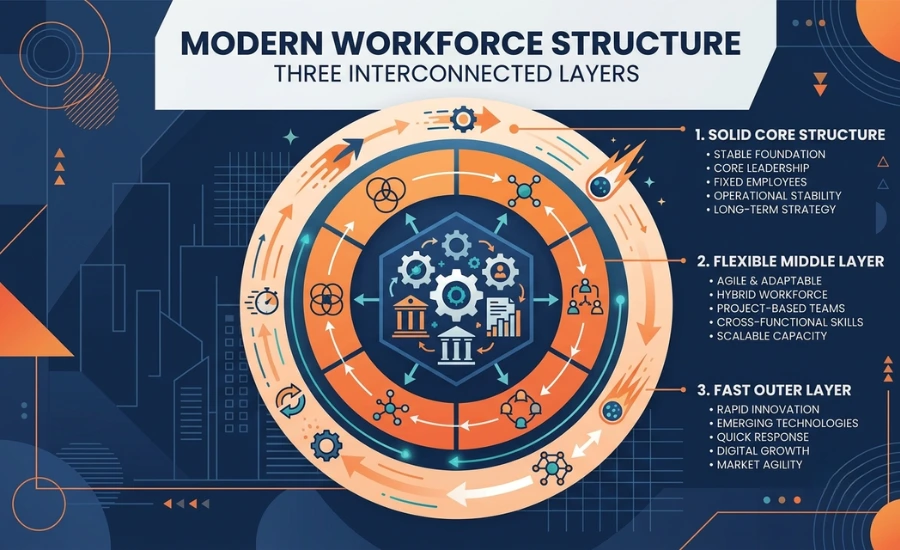
The nine-to-five, one-headcount-model-fits-all approach to staffing is fading fast. In its place, a blended workforce strategy is taking hold, one where full-time employees, freelance specialists, and on-demand talent operate side by side, each deployed where they create the most value. This is not a temporary reaction to hiring freezes or budget pressure. It is becoming the default operating model for companies that need to move quickly without overbuilding permanent headcount.
For businesses evaluating their workforce strategy heading into 2026, the question is no longer whether to blend talent types, but how to design that mix deliberately, often starting with a flexible Talent on Demand layer that can scale up or down without adding friction to the core business.
Why the Blended Workforce Model Is Gaining Ground in 2026
Several forces are converging at once. Skill requirements are shifting faster than traditional hiring cycles can keep up with, especially in technology, healthcare, and specialized professional roles. Budget owners want cost structures that flex with revenue rather than sitting fixed on the books. And employees themselves increasingly prefer flexible, project-based, or contract arrangements over rigid full-time roles.
Put together, these pressures are pushing companies toward a workforce that is intentionally layered rather than uniformly full-time. A blended workforce model lets a company keep its strategic core stable while building a flexible ring of freelance and on-demand talent around it ready to expand or contract as conditions change. It is the same shift driving companies to invest in total talent intelligence and MSP programs, since a layered workforce is only manageable with full visibility into who is doing the work, regardless of employment type.
AITACS Staffing
Ready to close your talent gap?
Get pre-vetted specialists deployed in 3–10 days. No overhead, no risk — just the right talent, exactly when you need it.
Contact Us
Free consultation · No commitment
What a Blended Workforce Actually Looks Like
A well-designed blended workforce is built in three distinct layers, each with a different purpose:
Full-time core staff — the people who own institutional knowledge, lead strategy, and carry the culture of the organization.
Freelance and contract specialists — brought in for defined projects, niche technical skills, or work that does not justify a permanent hire.
On-demand talent — deployed within days to cover sudden volume spikes, seasonal surges, or urgent backfills without a lengthy hiring process.
The goal is not to replace full-time staff with contractors. It is to match each type of work with the workforce layer best suited to deliver it, so the company is never overstaffed in slow periods or understaffed when demand spikes.
Comparing the Three Workforce Layers
| Workforce Layer | Best Use Case | Speed to Deploy | Cost Structure | Ideal For |
|---|---|---|---|---|
| Full-Time Core Staff | Strategic, long-term functions | Slowest (weeks to months) | Salary + benefits, fixed | Leadership, core operations |
| Freelance / Contract Talent | Project-based specialist work | Moderate (days to weeks) | Contract rate, variable | Skill gaps, defined projects |
| On-Demand Talent | Sudden volume or urgent coverage | Fastest (24–72 hours) | Usage-based, flexible | Seasonal surges, backfills |
How to Design a Hybrid Workforce Model That Actually Works
Building an effective hybrid workforce model starts with mapping work, not headcount. Instead of asking “how many people do we need,” the more useful question is “what type of work is this, and which workforce layer is built to deliver it.”
1. Map roles by volatility and specialization
Stable, recurring, strategic work belongs with full-time staff. Work that spikes seasonally, requires a narrow technical skill for a limited time, or needs to launch fast is a better fit for freelance or on-demand talent.
2. Build the technology and process layer before scaling the flexible workforce
A flexible workforce mix only works smoothly when onboarding, access provisioning, time tracking, and knowledge transfer are standardized. Companies that scale freelance and on-demand talent without this foundation tend to lose the speed advantage they were trying to gain.
3. Set clear governance early
Decide upfront who can engage on-demand talent, what approval thresholds apply, and how classification is documented. This keeps the flexible workforce mix compliant as it grows across departments.
Making a Freelance-Plus-Full-Time Strategy Work Without Friction
The most common failure point in a freelance-plus-full-time strategy is treating contract talent as an afterthought rather than an integrated part of delivery. When freelance specialists are looped into planning late, given incomplete context, or excluded from the tools full-time staff use daily, the arrangement creates more overhead than it saves.
Companies that get this right tend to do three things consistently: they define scope and deliverables clearly before engagement begins, they give freelance talent the same access to relevant systems and information as employees working the same project, and they protect intellectual property and confidential data through clear contractual terms rather than informal trust.
What to Watch: Compliance and Classification Risk
A blended workforce introduces more moving parts, and with them, more compliance exposure. Classifying contract or on-demand workers, inconsistent onboarding documentation, and unclear reporting lines are the most common issues that surface as the flexible portion of a workforce grows. None of these are reasons to avoid a blended model; they are reasons to build it with a staffing partner who manages classification, documentation, and compliance as a core part of delivery rather than an afterthought.
Building Your Blended Workforce Strategy with AITACS
AITACS helps organizations design and staff every layer of a blended workforce from full-time placements to freelance specialists to rapid on-demand deployment through our Talent on Demand solutions. Our pre-vetted talent pipeline and streamlined onboarding process mean businesses can scale their flexible workforce mix up or down without sacrificing speed, quality, or compliance.
Frequently Asked Questions
What is a blended workforce?
A blended workforce combines full-time employees, freelance or contract specialists, and on-demand talent within a single organization, matching each type of work to the workforce layer best suited to deliver it.
How is a blended workforce different from a hybrid workforce model?
The terms are often used interchangeably. Both describe a workforce strategy that mixes permanent staff with flexible talent sources freelance, contract, and on-demand, rather than relying on full-time hiring alone.
How fast can on-demand talent be deployed?
With a pre-vetted talent pipeline in place, on-demand talent can typically be deployed within 24 to 72 hours, compared to weeks or months for a traditional full-time hire.
Does using freelance and on-demand talent increase compliance risk?
It can, if classification and documentation are not managed carefully. Partnering with a staffing provider that handles compliance as part of workforce design significantly reduces that risk.
Is a blended workforce model right for every company?
Most companies benefit from some degree of workforce blending, but the right mix of full-time, freelance, and on-demand talent depends on how volatile and specialized the underlying work is.
Categories
Talent On Demand
Let’s Build Your Workforce
Streamline hiring with AITACS Talent On Demand solutions. Access pre-screened, deployment-ready specialists, reduce hiring delays, and scale your workforce faster with flexible staffing support tailored to your business needs.
Get Started