Is Your Contingent Workforce Program Bleeding Money? What an MSP Partnership Fixes
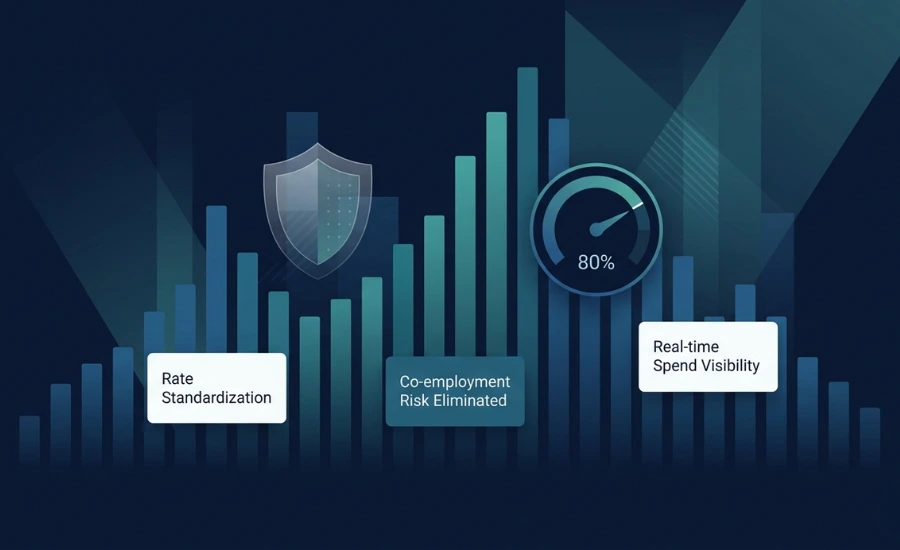
Most organizations don’t realize their contingent workforce program is costing them more than it should until they try to explain the numbers to a CFO. The markup inconsistencies, the duplicate vendor invoices, the compliance gaps that only surface during an audit these are not one-off mistakes. They are systemic failures that compound quietly over months and years.
If your contingent workforce program has grown organically adding staffing vendors as hiring needs emerged, tracking hours in spreadsheets, processing invoices manually there is a high probability you are leaving significant money on the table.
An MSP partnership (Managed Service Provider) is specifically built to fix this. Not just to add process overhead, but to deliver measurable cost control, speed, visibility, and risk reduction across your entire non-employee workforce. In this guide, we break down exactly where contingent programs leak money, how an MSP partnership stops the bleed, and how to audit your own program before costs spiral further.
The Hidden Costs of an Unmanaged Contingent Workforce Program
The most dangerous costs in a contingent workforce program are the ones that never appear in a single line item. They are distributed across departments, masked by operational urgency, and rarely challenged because “that’s just how staffing works.” Here’s where the money actually disappears:
1. Uncontrolled Vendor Markup Rates
When procurement and hiring managers independently engage staffing agencies, there is no pricing consistency. One department may be paying 22% markup on IT contractors while another pays 35% for the same skill set just because no one negotiated a standard rate card. Over a $2M annual contingent spend, a 10% markup variance equals $200,000 in avoidable costs.
2. Co-Employment Risk and Compliance Exposure
Workers classified as independent contractors or temporary staff who have been engaged beyond safe tenure thresholds create significant legal exposure particularly in states with aggressive co-employment laws. Without centralized oversight, many organizations simply don’t know when they’re in violation until a lawsuit or audit forces the issue.
3. Slow Time-to-Fill Driving Productivity Loss
When there is no managed vendor process, hiring managers spend hours coordinating requisitions across multiple agencies, reviewing inconsistent resumes, and chasing interview schedules. Industry benchmarks put the average time-to-fill for contingent roles at 14–21 days in unmanaged programs. Every day, a critical seat sits empty is a direct productivity cost.
4. Invoice Processing and Payroll Errors
Manual timesheet approval processes are a breeding ground for billing errors. Duplicate invoices, over-billed hours, and unapproved role upgrades are common in programs that haven’t implemented a VMS (Vendor Management System). These errors rarely get caught in real time they get flagged in annual audits, if ever.
5. No Program-Level Visibility
Perhaps the most strategic cost: the inability to make informed decisions. When workforce spend is fragmented across dozens of cost centers and vendors, leaders cannot answer basic questions how many contractors are on-site right now? What’s the average cost per hour by skillset? Which vendors are actually performing? Without answers, planning is reactive and expensive.
📖 Related Reading
Discover why specialized staffing cuts healthcare hire time from 70 days to 21 — without compliance risk.
What Does an MSP Partnership Actually Do?
An MSP partnership places a specialized provider at the center of your contingent workforce operations. The MSP manages vendor relationships on your behalf, implements and administers a VMS platform, standardizes your processes, and serves as a single point of accountability for your entire non-employee workforce.
This is not simply outsourcing your staffing headaches. A strong MSP partnership restructures how talent flows through your organisation faster, cheaper, and with full visibility.
AITACS Staffing
Ready to close your talent gap?
Get pre-vetted specialists deployed in 3–10 days. No overhead, no risk — just the right talent, exactly when you need it.
Contact Us
Free consultation · No commitment
Vendor Rationalization and Rate Card Standardization
A competent MSP will audit your existing vendor relationships and consolidate them into a tiered preferred supplier list. Rate cards are negotiated at scale, not per-requisition which immediately compresses markup costs. Vendors who don’t perform against SLAs get demoted or removed. Competition is structured, not accidental.
VMS Implementation and Spend Management
The VMS is the operational backbone of an MSP program. Requisitions flow through a single digital channel. Time and attendance is automated. Invoicing is consolidated and reconciled in real time. Finance gets one clean report instead of chasing 15 vendor statements. The technology pays for itself quickly through billing error elimination alone.
Compliance and Risk Management
The MSP becomes the compliance owner for your contingent workforce. Tenure tracking, background check documentation, I-9 verification, and insurance certificate collection are all centralized. Co-employment risk is monitored and managed proactively rather than reactively.
Talent Pool Development and Faster Fill Times
Because MSPs manage high volumes across clients, they maintain warmed-up talent pools for high-frequency roles. Pre-vetted, pre-onboarded candidates can be deployed in days rather than weeks. For organizations with consistent or cyclical staffing patterns, this speed advantage compounds into substantial cost savings on productivity.
Reporting, Analytics, and Total Talent Management
Modern MSP partnerships deliver workforce intelligence that most internal teams simply cannot build. Real-time dashboards show headcount by classification, spend by department, fill rates by vendor, and time-to-fill trends. This data powers strategic decisions, including whether to convert high-performing contractors to permanent staff, which is the foundation of a true total talent management approach.
Cost Comparison: Without MSP vs. With MSP Partnership
The table below illustrates the operational and financial differences across key program dimensions:
| Cost Area | Without MSP Partnership | With MSP Partnership |
|---|---|---|
| Markup Rates | 15–30% variance across vendors; unmonitored | Standardized rate cards; 10–20% average savings |
| Time-to-Fill | 14–21 days average | 7–12 days with pre-vetted talent pools |
| Compliance Risk | High — fragmented tracking across agencies | Centralized audit trail; co-employment risk reduced |
| Invoice Processing | Manual, error-prone; 3–5 days per cycle | Automated via VMS; same-day reconciliation |
| Workforce Visibility | Siloed; no real-time headcount data | Live dashboards; full spend transparency |
| Program ROI | Difficult to measure; reactive decisions | Trackable KPIs; proactive workforce planning |
How to Audit Your Contingent Workforce Program in 30 Minutes
Before engaging an MSP partner, it helps to understand the current state of your program. A contingent workforce program audit does not require a consultant. You need to ask six questions and be honest about the answers.
-
How many staffing vendors are currently active?
-
Do you have a standardized rate card across all of them?
-
Can you pull a real-time report of all active contractors on-site today?
-
Is time and attendance tracked digitally with approval workflows?
-
How long does your average contractor requisition take to fill?
-
Do you have centralized compliance documentation for all non-employees?
If you answered “no” or “I’m not sure” to more than two of these questions, your program has structural gaps that an MSP workforce management model is designed to close.
Contingent Workforce Program Audit: Warning Signs and MSP Fixes
| Audit Category | Warning Signs to Watch | MSP Fix |
|---|---|---|
| Vendor Management | 10+ active vendors with no rate consistency | Preferred vendor list with SLA-driven tiers |
| Spend Visibility | Finance can't report contingent spend by department | VMS integration; real-time spend dashboards |
| Time & Attendance | Manual timesheets; frequent disputes | Digital T&A with auto-approvals |
| Onboarding Speed | New contractors waiting 2+ weeks to start | Standardized onboarding playbooks; <5 days |
| Compliance Tracking | No centralized I-9 / background check logs | MSP holds single source of truth for all records |
| Contract Renewals | Extensions happening informally via email | VMS-triggered alerts; structured renewal workflow |
What to Look for in an MSP Partner
Not all MSPs are built the same. Some are staffing agencies that have added a “managed” layer on top of their core business. Others are purpose-built program management firms with deep VMS expertise and industry-specific talent networks. When evaluating an MSP partnership, prioritize the following:
-
Industry-specific talent networks — particularly critical in IT, pharma, and healthcare, where credential and skill requirements are non-negotiable
-
VMS platform flexibility — can they support your existing system, or will they impose a proprietary platform that creates lock-in?
-
Transparency in pricing — MSP fees should be clearly structured, not hidden inside vendor markups
-
Scalability — the partner should demonstrate capacity to grow with your program, not just handle current volume
-
Compliance track record — especially for organizations operating in regulated industries
AITACS delivers MSP/VMS staffing solutions with specialized talent pools across IT and life sciences.
MSP Partnerships and Total Talent Management: The Strategic Angle
Forward-thinking workforce leaders are moving beyond contingent management in isolation toward total talent management a unified approach that treats permanent and non-permanent workers as part of a single talent ecosystem. An MSP partnership is the operational foundation that makes this possible.
When your contingent program has real visibility, standardized data, and consistent processes, you can do things that fragmented programs simply cannot: forecast workforce needs by quarter, compare cost-per-outcome across employee and contractor populations, identify your top-performing contractors for permanent conversion, and build workforce plans that actually hold up under scrutiny.
This strategic layer is where the real ROI of an MSP partnership materializes. The cost savings from rate card compression and invoice automation are real, but the compounding advantage comes from decision-making powered by clean, centralized workforce data.
Frequently Asked Questions
What is an MSP partnership in contingent workforce management?
An MSP (Managed Service Provider) partnership is an arrangement where an external firm manages your organization's contingent workforce program end-to-end including vendor management, requisition processing, time and attendance, compliance, invoicing, and reporting. The MSP typically operates a VMS platform and serves as a single point of accountability for all non-employee labor.
How much can an MSP partnership save on contingent workforce costs?
Savings vary by program maturity and spend volume, but organizations that transition from unmanaged programs to MSP-managed models typically see a 10–25% reduction in total contingent workforce spend within the first 12–18 months, driven by rate card standardization, billing error elimination, and vendor rationalization.
What is a contingent workforce program audit?
A contingent workforce program audit is a structured review of your existing non-employee labor practices covering vendor relationships, rate structures, compliance documentation, technology systems, and reporting capabilities. The goal is to identify cost leakage, risk exposure, and operational inefficiencies before designing a managed program solution.
How does MSP workforce management differ from traditional staffing?
Traditional staffing is transactional you engage a vendor when you have a need, they fill it, you pay them. MSP workforce management is programmatic a single provider manages all vendor relationships, standardizes processes, and takes accountability for program-level outcomes including cost, speed, quality, and compliance.
Is an MSP partnership right for small programs?
MSP models are most impactful for organizations spending $2M or more annually on contingent labor, or those managing 50+ active contractors at any given time. Smaller programs may benefit from lighter-touch vendor management solutions or VMS-only implementations before graduating to a full MSP model.
Categories
MSP/VMS Staffing
Let’s Build Your Workforce
Streamline hiring with AITACS MSP/VMS staffing solutions. Access pre-screened, interview-ready talent, reduce time-to-hire, improve vendor management, and scale your workforce with confidence.
Get Started