MSP Staffing Programs Explained: How Fortune 500s Cut Workforce Costs by 30%
What Is an MSP Staffing Program And Why Does It Matter?
In today’s hyper-competitive talent landscape, large enterprises and Fortune 500 companies face a relentless challenge: how do you manage a sprawling, complex contingent workforce while keeping costs in check, maintaining compliance, and securing top talent faster than your competitors?
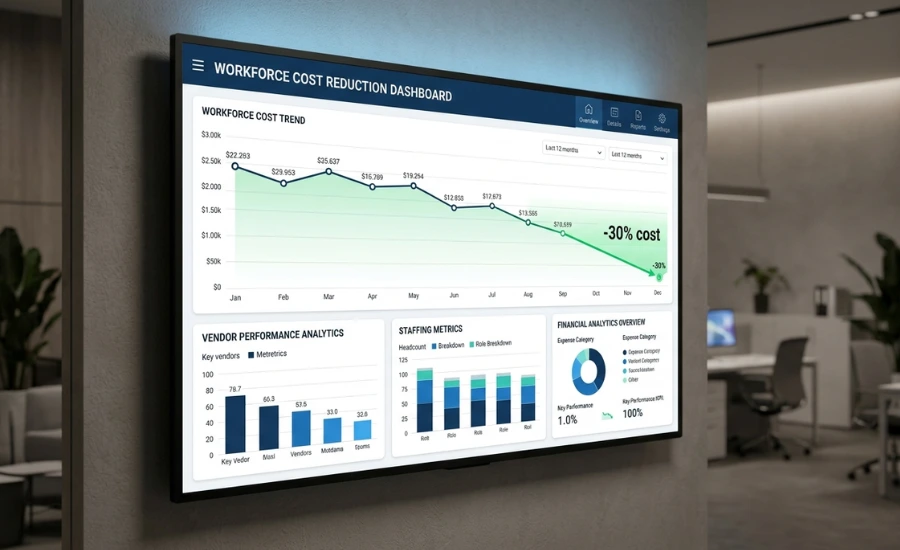
The answer lies in Managed Service Provider (MSP) staffing programs a proven model that has helped leading organizations slash workforce costs by an average of 30% while dramatically improving quality, speed, and visibility across their entire contingent workforce.
In this deep-dive guide, we’ll unpack exactly how MSP staffing programs work, the tangible ROI they deliver, and why Fortune 500 companies are doubling down on this approach. Whether you’re exploring managed services for the first time or evaluating your current provider, this is your definitive resource.
The Numbers Don't Lie: MSP Staffing by the Numbers
30%
Average Cost Savings
40%
Faster Time-to-Fill
2x
Better Talent Quality
These figures aren’t aspirational benchmarks they reflect real outcomes reported by enterprises that have implemented MSP staffing programs with experienced managed service providers. The cost savings alone make a compelling case, but the full value extends far beyond the bottom line.
MSP Staffing Program Explained: The Core Concept
An MSP (Managed Service Provider) staffing program is an outsourced solution in which a specialized provider assumes end-to-end responsibility for managing your contingent workforce. This includes:
Vendor Neutrality: The MSP manages ALL staffing vendors on your behalf, eliminating favoritism and driving healthy competition.
VMS Technology: A Vendor Management System (VMS) serves as the technology backbone, providing real-time visibility into spend, headcount, and performance data.
Compliance Management: From worker classification to contract standardization, the MSP ensures your contingent program meets regulatory requirements.
Performance Optimization: Data-driven scorecards keep your supply chain of vendors accountable and continuously improving.
💡 Key Insight: MSP vs. Traditional Staffing
Traditional staffing: You manage multiple vendors individually, with no unified data or process.
MSP staffing: One provider manages all vendors, all processes, and all data — on your behalf.
The result? Lower costs, better talent, and full workforce visibility.
How an MSP Staffing Program Works: 5 Core Stages
Understanding the mechanics of an MSP program helps demystify why it delivers such consistent results. Here’s how the process typically unfolds:
1
Assessment & Program Design
The MSP analyzes your current workforce spend, vendor landscape, job categories, and compliance risks to design a custom program architecture.
2
Technology Implementation (VMS)
A Vendor Management System is implemented to digitize requisitions, approvals, time tracking, invoicing, and analytics — creating a single source of truth.
3
Vendor On-Boarding & Rationalization
Existing vendors are evaluated, rationalized, and onboarded to the new program. New, high-performing vendors may be introduced to fill gaps.
4
Ongoing Operations & Optimization
The MSP manages day-to-day operations: fulfilling requisitions, managing SLAs, resolving issues, and running vendor scorecards.
5
Strategic Reporting & Continuous Improvement
Regular business reviews surface insights on spend, quality, and risk — driving continuous program improvements and sustained savings.
How Fortune 500s Cut Workforce Costs by 30%: The Savings Levers
The 30% cost reduction headline gets attention but where exactly do the savings come from? The answer is a combination of structural efficiencies and negotiation leverage that only scale delivers:
1. Consolidated Vendor Negotiations
When a single MSP represents the full buying power of your contingent spend, they can negotiate superior bill rates, volume discounts, and favorable payment terms that individual hiring managers simply cannot achieve. This alone typically yields 8–12% in direct cost savings.
2. Elimination of Maverick Spend
Unmanaged, off-program hiring often costs 15–25% more than negotiated rates. MSP programs enforce compliance with program pricing, eliminating rogue spend that silently erodes your workforce budget.
3. Reduced Administrative Overhead
Managing 20 vendors manually requires significant internal resources. MSP programs reduce the administrative burden by centralizing all activity through the VMS, freeing your HR and procurement teams for higher-value work.
4. Improved Quality = Lower Turnover Costs
Better-vetted talent through standardized supplier scorecards means lower attrition and fewer costly mis-hires. Given that replacing a contingent worker can cost 50–150% of their assignment value, quality improvements have massive financial impact.
5. Worker Misclassification Risk Reduction
Non-compliance fines, back taxes, and legal liability from misclassified workers can be devastating. MSP programs implement rigorous classification protocols that protect your organization from this growing risk.
💡 Key Insight: Real-World Impact: Contingent Workforce Cost Savings
A Fortune 100 technology company reduced contingent spend by $42M annually after implementing an MSP program.
A global financial services firm reduced time-to-fill from 47 days to 19 days — a 60% improvement.
A healthcare giant achieved 98% on-program compliance within 12 months of MSP launch.
MSP vs. No MSP: A Side-by-Side Comparison
| Challenge | Without MSP | With MSP |
|---|---|---|
| Vendor Management | Fragmented, 10–20 vendors | Single point of contact |
| Cost Visibility | Limited, hard to track | Full spend analytics |
| Compliance Risk | High — inconsistent vetting | Standardized & audited |
| Time-to-Fill | 4–6 weeks average | 2–3 weeks optimized |
| Quality Control | Variable across vendors | Consistent benchmarks |
Is an MSP Staffing Program Right for Your Organization?
MSP programs deliver the greatest ROI for organizations that meet one or more of the following criteria:
- Annual contingent workforce spend exceeding $10M
- 10 or more active staffing vendors across business units
- Limited visibility into total workforce costs and headcount
- Compliance risk exposure due to worker classification ambiguity
- Decentralized hiring creating inconsistent quality and pricing
- Rapid workforce scaling needs (ramp-up/ramp-down agility)
If your organization checks two or more of these boxes, an MSP program is not just an option — it’s likely a strategic imperative.
What to Look for in an MSP Partner: 6 Critical Criteria
Not all MSP providers are created equal. Here are the criteria that separate best-in-class programs from mediocre ones:
Program Neutrality: Your MSP should be vendor-neutral, ensuring the best talent wins — not the vendor with the best relationship.
VMS Expertise: Deep experience with leading VMS platforms (Fieldglass, IQN, Beeline, Coupa) ensures technology drives efficiency rather than complexity.
Industry Specialization: Domain expertise in your industry means better talent networks, faster fill times, and relevant compliance knowledge.
Analytics Capability: Robust reporting and workforce analytics turn data into decisions. Demand benchmark dashboards, rate intelligence, and predictive analytics.
Change Management Support: Program adoption requires stakeholder buy-in. Look for an MSP with proven change management methodologies.
Scalability: Your MSP program should grow with you — across geographies, job categories, and workforce models (SOW, IC, temp, etc.).
AITACS Staffing
Ready to close your talent gap?
Get pre-vetted specialists deployed in 3–10 days. No overhead, no risk — just the right talent, exactly when you need it.
Contact Us
Free consultation · No commitment
AITACS MSP/VMS Staffing: Your Partner for Workforce Transformation
At AITACS, we specialize in designing, implementing, and managing world-class MSP and VMS staffing programs for enterprises ready to take control of their contingent workforce. Our approach combines deep industry expertise, cutting-edge technology, and a relentless focus on measurable outcomes.
Our MSP/VMS clients experience:
Average 25–35% reduction in contingent workforce spend
30–50% faster time-to-fill across all job categories
Full workforce visibility through real-time VMS dashboards
Dramatically reduced compliance risk and liability exposure
A strategic workforce partner not just a vendor manager
Conclusion: The Time to Act Is Now
MSP staffing programs are no longer a luxury reserved for the Fortune 500 they are a strategic necessity for any enterprise serious about workforce cost management, talent quality, and operational agility.
The question is not whether your organization can afford an MSP program. Based on the data, the real question is: can you afford NOT to have one?
With average savings of 30%, improved fill times, better talent quality, and ironclad compliance, the ROI case is overwhelming. The organizations winning the talent war in 2025 and beyond will be those who take control of their contingent workforce today.
Frequently Asked Questions
What is an MSP staffing program and how does it work?
An MSP (Managed Service Provider) staffing program is an outsourced solution where a specialized provider like AITACS takes end-to-end responsibility for managing your contingent workforce. It works by consolidating all staffing vendors under one program, implementing a Vendor Management System (VMS) for real-time visibility, enforcing compliance standards, and using performance data to continuously optimize costs and talent quality.
How much can companies save with an MSP staffing program?
Enterprises that implement MSP staffing programs like those managed by AITACS — typically save an average of 25–35% on contingent workforce spend. These savings come from consolidated vendor negotiations, elimination of maverick spend, reduced administrative overhead, lower turnover costs through better-quality hires, and minimized worker misclassification penalties.
What is the difference between MSP staffing and traditional staffing?
With traditional staffing, companies individually manage multiple vendors with no unified data or standardized process. AITACS MSP staffing replaces that fragmentation with a single provider managing all vendors, processes, and spend data — delivering better cost control, up to 40% faster time-to-fill, and consistent talent quality across your entire contingent workforce.
Which companies benefit most from an MSP staffing program?
AITACS MSP staffing programs deliver the highest ROI for organizations with annual contingent workforce spend exceeding $10M, 10 or more active staffing vendors, limited spend visibility, worker misclassification risks, or rapid workforce scaling needs. If your organization meets two or more of these criteria, partnering with AITACS for a managed staffing solution is a strategic necessity.
Why choose AITACS as your MSP staffing provider?
AITACS combines deep industry expertise, cutting-edge VMS technology, and a results-driven approach to contingent workforce management. AITACS MSP/VMS clients consistently experience 25–35% reduction in workforce spend, 30–50% faster time-to-fill, full real-time workforce visibility, and dramatically reduced compliance risk — making AITACS a true strategic workforce partner, not just a vendor manager.
Categories
MSP/VMS Staffing
Let’s Build Your Workforce
Streamline hiring with AITACS MSP/VMS staffing solutions. Access pre-screened, interview-ready talent, reduce time-to-hire, improve vendor management, and scale your workforce with confidence.
Get Started